


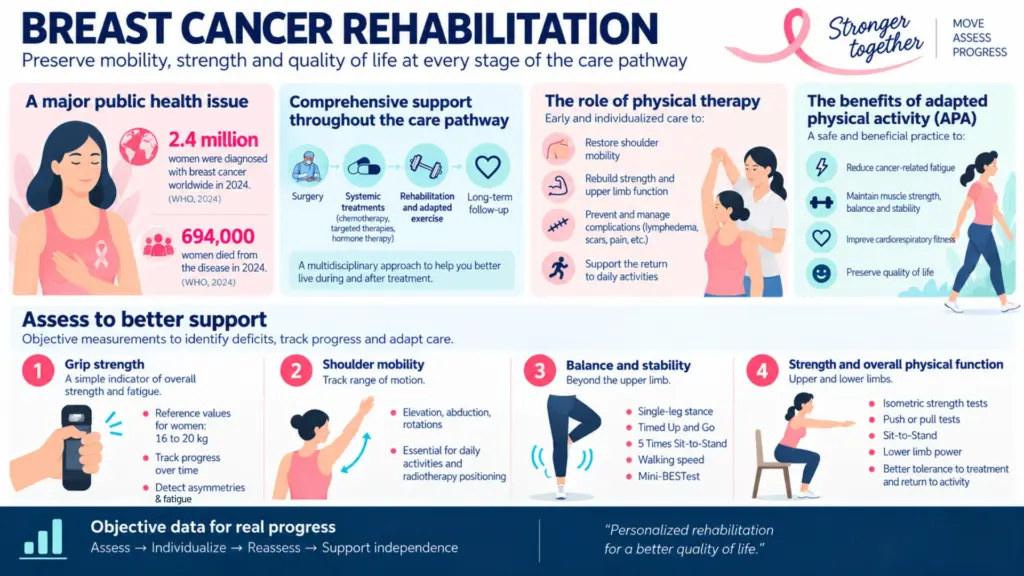
Breast cancer is the most common cancer in women worldwide. In 2024, according to the WHO, an estimated 2.4 million women were diagnosed with breast cancer globally, and approximately 694,000 women died from the disease.
But breast cancer care extends beyond treating the disease itself. Surgery, radiation therapy, and systemic treatments can affect mobility, muscle strength, physical function, and overall quality of life.
Breast cancer rehabilitation, including physical therapy and individualized exercise, can help preserve or restore these capacities throughout the care pathway. Objective assessments can further support this process by identifying physical deficits and tracking recovery over time.
In this article, we explore how physical therapy and exercise can support patients with breast cancer, which functional parameters can be assessed, and how objective data can help individualize rehabilitation and follow-up.
CONTENTS
1- Breast Cancer Care: A Multidisciplinary Approach
2- What Is the Role of Physical Therapy in Breast Cancer Rehabilitation?
3- Why Is Exercise Important During and After Breast Cancer?
4- Breast Cancer Rehabilitation: How Can Physical Capacity Be Objectively Assessed?
5- FAQ: Breast Cancer Rehabilitation and Exercise
6- References
1- Breast Cancer Care: A Multidisciplinary Approach
Breast cancer care requires a personalized and multidisciplinary approach, with treatment decisions based on factors such as the stage of the disease and its biological characteristics.
From Diagnosis to Treatment
Depending on the clinical situation, treatment may combine several approaches:
- breast-conserving surgery or mastectomy, with or without reconstruction;
- radiation therapy;
- chemotherapy;
- targeted therapies;
- hormone therapy.
While these treatments primarily aim to treat the cancer, they can also affect physical and functional capacities. This is where breast cancer rehabilitation becomes an important part of the overall care pathway.

Supportive Care as Part of the Cancer Care Pathway
Supportive care can be integrated throughout treatment and recovery to address the broader physical and psychological impact of breast cancer.
Physical therapy and exercise can help preserve or restore mobility, muscle strength, and physical function, while other forms of supportive care, including psychological support, contribute to a comprehensive approach.
Within breast cancer rehabilitation, physical therapists can intervene at different stages of the care pathway, including before surgery, to establish baseline measures, prepare patients for recovery, and support the progressive return of physical function.
2- What Is the Role of Physical Therapy in Breast Cancer Rehabilitation?
Physical therapy can play a role at different stages of breast cancer rehabilitation. Care should be early, progressive, and individualized according to the type of surgery, ongoing treatments, symptoms, and each patient’s physical capacity.
Before Surgery: Establish a Baseline
When possible, meeting with a physical therapist before surgery provides an opportunity to establish baseline measures and prepare for recovery.
The assessment can include:
- shoulder range of motion;
- muscle strength;
- grip strength;
- posture.
This stage can also introduce shoulder mobility and postural exercises, help prevent protective movement patterns and compensations, and provide guidance on movements and activities during recovery.
Early After Surgery: Restore Mobility Progressively
During the early postoperative phase, approximately Day 1 to Day 15, rehabilitation focuses on gradually restoring movement. With the surgeon’s approval, shoulder mobility exercises can begin as early as the day after surgery.
Key priorities include:
- breathing and thoracic mobility;
- restoring posture and limiting protective patterns;
- gradually recovering shoulder elevation, abduction and rotation;
- scar massage and mobilization when appropriate.
Pain, numbness, sensations of compression, and scar healing should also be monitored to help adapt rehabilitation to the patient’s recovery.
During Recovery and Cancer Treatment: Rebuild Strength and Function
As healing progresses, breast cancer rehabilitation can gradually shift toward restoring strength, endurance, and overall physical function.
Depending on the patient’s needs, physical therapy may include:
- progressive strength training;
- continued shoulder mobility work;
- prevention and management of lymphedema, including manual lymphatic drainage when indicated;
- management of scar adhesions or potential frozen shoulder;
- strategies to limit muscle loss and deconditioning during chemotherapy;
- maintaining sufficient shoulder elevation for positioning during radiation therapy;
- continued support during hormone therapy.
The goal extends beyond restoring shoulder mobility after surgery: physical therapy aims to help patients progressively regain the physical capacities needed for daily activities and a safe return to regular exercise.
Following breast reconstruction surgery, physical therapy can also help restore optimal body awareness and support the recovery of complete, functional movement across the upper limbs. This rehabilitation process can then be complemented by individualized exercise to progressively restore physical and functional capacity.
3- Why Is Exercise Important During and After Breast Cancer?
Exercise is an important component of breast cancer rehabilitation, both during and after treatment. When adapted to the patient’s health status and physical capacity, it can help limit deconditioning and support long-term recovery.
What Are the Benefits of Exercise?
Regular physical activity can help:
- reduce cancer-related fatigue;
- preserve muscle mass and strength;
- maintain or improve cardiorespiratory fitness;
- improve quality of life, mood and sleep;
- support overall physical function.
Evidence also shows associations between post-diagnosis physical activity and improved breast cancer outcomes, including lower recurrence and mortality risk.

How Much Physical Activity Is Recommended?
International guidelines recommend progressively working toward:
- 150–300 minutes of moderate-intensity aerobic activity per week, or 75–150 minutes of vigorous activity;
- strength training at least 2 days per week;
- reducing sedentary time and avoiding prolonged inactivity.
These recommendations should always be individualized according to treatment status, symptoms, fatigue, physical capacity, and potential limitations.
Individualizing Exercise to Each Patient

Physical capacity can vary considerably throughout breast cancer rehabilitation. Depending on the patient’s needs, an exercise program may combine:
- aerobic exercise;
- upper- and lower-body strength training;
- mobility exercises;
- balance and postural control exercises;
- progressive return to functional and daily activities.
Assessment is therefore essential to identify priorities, adapt exercise intensity, and monitor progress over time.
4- Breast Cancer Rehabilitation: How Can Physical Capacity Be Objectively Assessed?
Objective assessment can help identify physical deficits, establish a baseline, and track changes throughout breast cancer rehabilitation. Combined with clinical assessment, these measurements can help physical therapists individualize rehabilitation and adjust exercise progression.
Grip Strength
Handgrip strength (HGS) is a simple and reliable indicator of overall muscle strength and can contribute to the assessment of fatigue and sarcopenia.
Several thresholds have been proposed for women, generally ranging from 16 to 20 kg depending on the reference used. In oncology populations, lower grip strength has also been associated with poorer outcomes.
Connected dynamometers such as K-Grip can be used to quantify grip strength, endurance and fatigue and to compare results over time.

Shoulder Mobility
Breast surgery and subsequent treatments can affect shoulder range of motion and movement quality.
Assessing elevation, abduction and rotation can help physical therapists identify mobility restrictions, monitor recovery and detect compensatory movement patterns.
Digital goniometers and motion sensors such as K-Move can complement clinical assessment by providing objective range-of-motion measurements.
Balance and Stability
Balance and postural control may also be affected after breast cancer due to factors such as fatigue, treatment-induced neuropathy, lower-limb weakness, and postural changes.
Useful assessments can include:
- single-leg stance & double-leg stance;
- Timed Up and Go (TUG);
- Sit-to-Stand;
- gait speed;
- Mini-BESTest.

Force plates can provide additional information about postural stability and load distribution, helping clinicians monitor changes throughout rehabilitation.
Strength and Overall Physical Function
Assessing both upper- and lower-body capacities provides a broader picture of physical recovery.
Depending on the rehabilitation goals, clinicians may assess:
- isometric shoulder strength;
- pushing and pulling strength;
- chair-rise performance;
- lower-limb force and power;
- walking capacity.
Tools such as handheld dynamometer K-Push, traction dynamometer K-Pull, and force plates can help quantify these capacities and monitor progression over time.
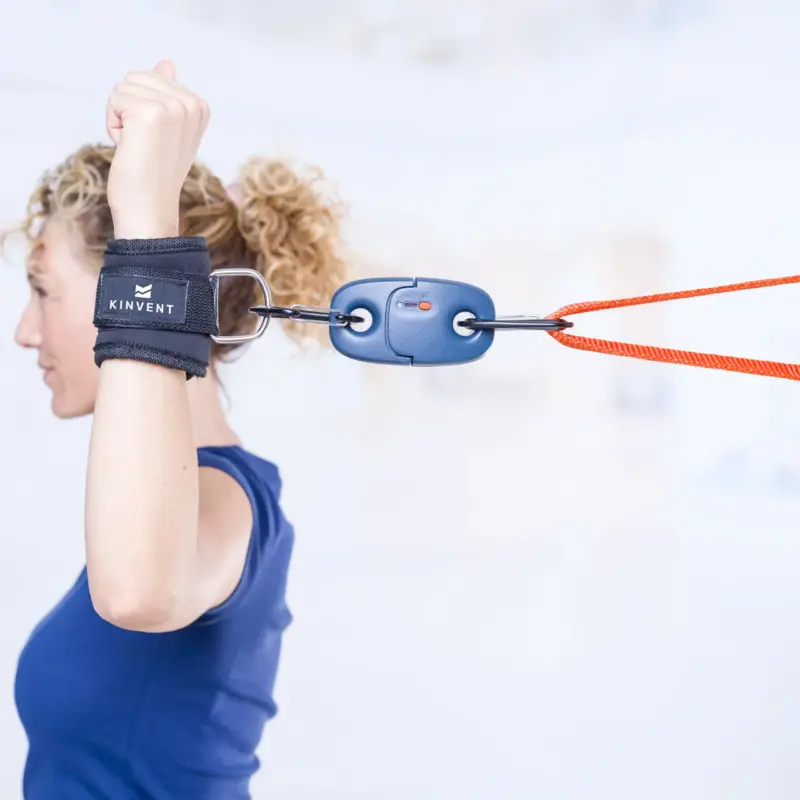
Rather than relying on a single measurement, combining several objective assessments can provide a more complete view of physical function and help guide breast cancer rehabilitation according to each patient’s needs.
5- FAQ: Breast Cancer Rehabilitation and Exercise
What is breast cancer rehabilitation?
Breast cancer rehabilitation is a multidisciplinary approach designed to help patients maintain or recover physical function during and after cancer treatment. It can include physical therapy, individualized exercise, and objective assessment to address limitations in mobility, strength, balance, and overall physical capacity.
When should physical therapy start after breast cancer surgery?
When appropriate and with the surgeon’s approval, gentle shoulder mobility can begin as early as the day after surgery. During the first two weeks, physical therapy typically focuses on breathing, thoracic mobility, posture, and the progressive recovery of shoulder range of motion.
Can physical therapy start before breast cancer surgery?
Yes. A preoperative physical therapy assessment can establish baseline measurements for shoulder mobility, muscle strength, grip strength, and posture. It can also help prepare patients for postoperative exercises, recovery, and fatigue.
What exercises are recommended after breast cancer?
Exercise should be individualized according to treatment status, symptoms, and physical capacity. A program may combine aerobic exercise, strength training, mobility, balance exercises, and functional activities. Progression should be adapted throughout breast cancer rehabilitation.
Why measure grip strength during breast cancer rehabilitation?
Grip strength is a simple and reliable measure that can provide information about overall muscle strength and contribute to the assessment of sarcopenia. Tracking it over time can help clinicians identify changes in physical capacity and monitor recovery.
Which physical capacities can be assessed during breast cancer rehabilitation?
Depending on the patient and stage of recovery, physical therapists may assess grip strength, shoulder range of motion, upper- and lower-body strength, balance, postural stability, gait, and functional performance. Combining several measurements provides a broader picture of physical recovery.
Can connected assessment tools be used in breast cancer rehabilitation?
Yes. Tools such as connected dynamometers, motion sensors and force plates can help quantify strength, range of motion, balance and physical function. They can support progress monitoring and exercise individualization, but should always complement clinical assessment and professional judgment.
6- References
- World Health Organization. Breast cancer. WHO Fact Sheet. Updated 2026.
- World Health Organization. WHO Guidelines on Physical Activity and Sedentary Behaviour. Geneva: World Health Organization; 2020.
- Umbrella review of 740 meta-analytic associations on physical activity in cancer survivors. Critical Reviews in Oncology/Hematology. 2025.
- Lahart IM, et al. Physical activity post-diagnosis and survival outcomes in breast cancer: a dose–response meta-analysis. Breast Cancer Research and Treatment. 2023.
- The effects of post-diagnosis recreational aerobic exercise among breast cancer survivors: a systematic review and meta-analysis. Cancer Epidemiology, Biomarkers & Prevention. 2025.
- Grip strength as a surrogate measure in breast cancer survivors. Scientific Reports. 2025;15:15782.
- Handgrip strength assessment in breast cancer patients: validity and reliability of the Activ5 dynamometer. Supportive Care in Cancer. 2025.
- Cruz-Jentoft AJ, et al. Sarcopenia: revised European consensus on definition and diagnosis (EWGSOP2). Age and Ageing. 2019;48(1):16–31.
- Evaluation of the validity and proposal of a cut-off point for the Y Balance Test in identifying sarcopenia in elderly women. 2024.


