


Evaluating a vertical jump assessment is about much more than just measuring height; it is a window into the neuromuscular status and explosive capacity of your athletes. Whether you are a Strength and Conditioning coach or a Physical Therapist, the precision of these tests is crucial for guiding your rehabilitation or performance programs.
In this article, we will break down the three fundamental jumps of sports science, physical conditioning, strength training, and athletic evaluation: the Squat Jump (SJ), the Countermovement Jump (CMJ), and the Drop Jump (DJ). We will explore how each jump isolates specific qualities, from pure concentric strength to the efficiency of the Stretch-Shortening Cycle (SSC), and how utilizing objective data transforms your clinical practice.
CONTENTS
1- Why Is Vertical Jump Assessment Essential for Your Athletes?
2- The Squat Jump (SJ): Measuring Pure Concentric Strength
3- The Countermovement Jump (CMJ): The Gold Standard for Explosive Power
4- The Drop Jump (DJ): Assessing Reactive Strength and Plyometrics
5- FAQ: Answer your questions about Vertical Jump Assessment
6- References
1- Why Is Vertical Jump Assessment Essential for Your Athletes?
In the realm of sports science and rehabilitation, vertical jump assessment is not merely a leaping exercise. It serves as a precise diagnostic tool to evaluate lower-body power and movement quality.
Integrating these tests into your practice addresses three major objectives:
- Evaluating Explosive Power: Jumps serve as benchmarks for measuring maximum force and the acceleration capacity of the lower limbs.
- Analyzing the Stretch-Shortening Cycle (SSC): They help in understanding how an athlete stores and releases elastic energy, a key skill for performance and injury prevention.
- Monitoring Readiness and Fatigue: Regular tracking of jump performance helps detect drops in neural drive or neuromuscular fatigue, allowing for real-time adjustments to training loads.
For a basketball player looking to grab a rebound or a rugby player needing to explode past a defensive line, mastering the different phases of a vertical jump assessment is the foundation of athletic excellence. By understanding an athlete’s jump profile (are they powerful but slow? fast but lacking force?), you can design targeted programs to turn weaknesses into strengths.
2- The Squat Jump (SJ): Measuring Pure Concentric Strength
The Squat Jump is the gold standard for evaluating explosive lower-body power by strictly isolating the propulsive phase. Unlike other vertical jump assessments, it neutralizes the assistance provided by elastic energy, making it a “raw” indicator of concentric force.

Why and How to Perform the Squat Jump?
This test gauges an athlete’s ability to generate force from a static position, a critical skill for explosive starts, such as an offensive lineman launching from a stationary stance.
- Principle: The athlete assumes a semi-squat position (hands on hips or holding a lightweight dowel) and must maintain this still posture for several seconds.
- Execution: Following a signal, the athlete must explode upward through a purely concentric action.
- Key Instruction: It is of paramount importance that there is no preliminary downward movement or “countermovement,” as this would introduce residual elastic energy and falsely inflate the results.
💡 Pro Tip: To master this challenging movement, advise the athlete to focus on activating their glute and abdominal muscles to initiate the jump from a dead stop.
How to Assess Squat Jump Performance?
Analysis goes far beyond jump height. By utilizing impulse-momentum data from a force platform, you can build a comprehensive athlete profile:
- Jump Height: The vertical displacement of the centre of mass, most accurately calculated via take-off velocity.
- Relative Peak Force: Adjusts the peak force for the athlete’s body weight to allow for fair comparisons between athletes of different sizes.
- Peak Power (W): The highest rate of work performed, offering a snapshot of the ability to exert maximum effort in the shortest time.
- Rate of Force Development (RFD): Measures how quickly an athlete can increase force from onset to peak, a critical indicator of explosive strength.
- Impulse (N-s): The total change in momentum, providing insight into the overall effectiveness of the force application.
Factors to Keep in Mind Before Conducting the Test
To ensure valid and reliable vertical jump assessment data, account for these critical considerations:
- Individual Effort: Sub-maximal efforts will lead to inaccurate and unreliable scores.
- Stillness: The athlete must remain as motionless as possible in the squat position before starting the motion to ensure data accuracy.
- Consistent Hand Placement: Hands should remain on the hips or by the sides throughout the test; hand movement often leads to an unintentional countermovement.
- Landing Position: Athletes should “stick” their landing, allowing for the analysis of time to stabilization and landing stiffness.
The Kinvent Advantage
To transform these vertical jump assessment protocols into rapid clinical tools, Kinvent force plates are essential. The K-Deltas not only measure height with precision but also provide real-time biofeedback, instantly identifying if a countermovement occurred by analyzing the force-time curve. This allows you to generate a complete report of propulsion capabilities and asymmetries, ready for immediate discussion with your patient or athlete.
3- The Countermovement Jump (CMJ): The Gold Standard for Explosive Power
Unlike the Squat Jump, the Countermovement Jump (CMJ) begins from an upright standing position, followed by a rapid downward squatting motion before immediately transitioning into an explosive upward jump. It is widely regarded as the most reliable and common assessment of lower-body power among athletes.
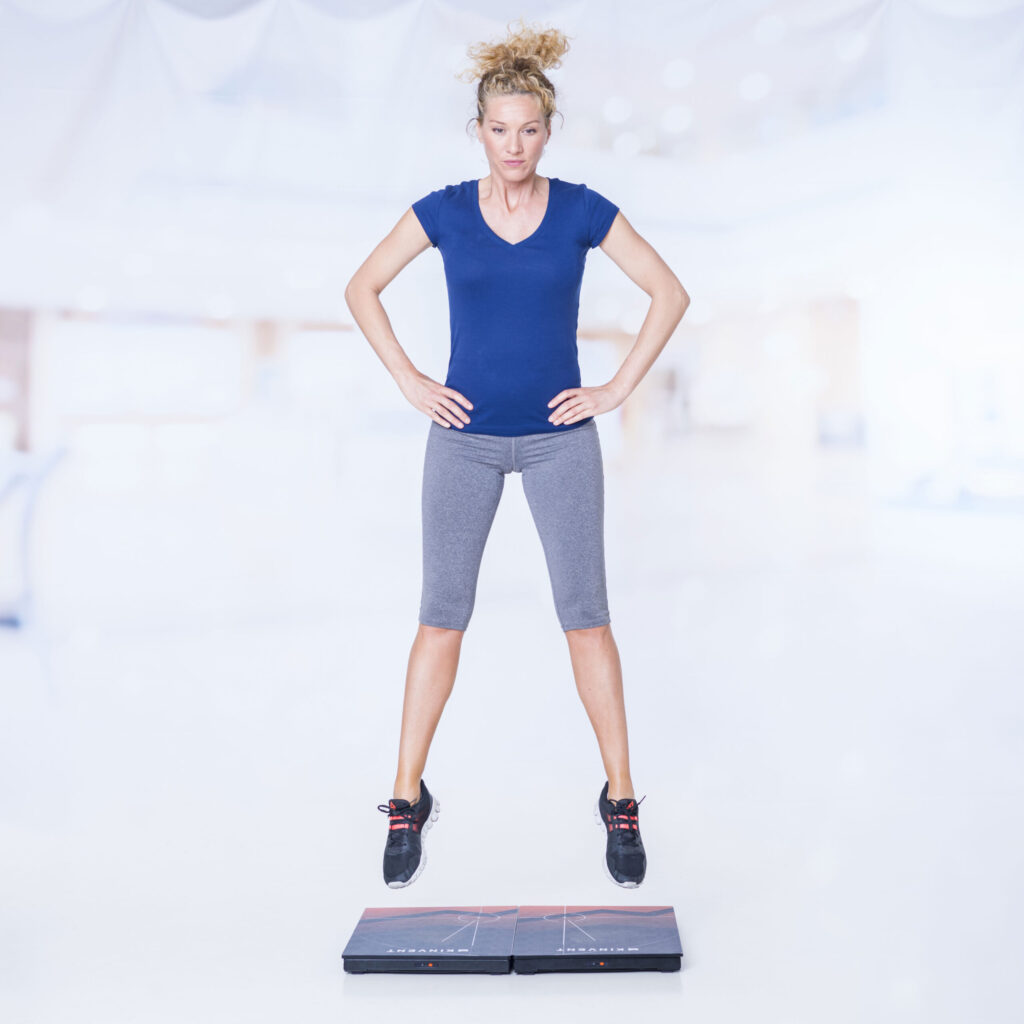
Why the CMJ is Vital for Athletic Profiling
The CMJ relies on the Stretch-Shortening Cycle (SSC), a physiological phenomenon where a rapid pre-stretch (eccentric phase) leads to a more powerful concentric action.
- Performance Correlation: CMJ scores are highly linked to sprinting speed (up to 30 meters) and dynamic strength movements like the 1RM squat and power clean.
- Versatility: It is an invaluable tool for strength and conditioning coaches, sports scientists, and physical therapists to monitor progress, customize training, or assess injury recovery.
- Efficiency Insight: Athletes with a smoother transition from braking to propulsion (less time in the “amortization” phase) are more efficient at transferring momentum, which is crucial for maximizing performance.
Key Phases of the CMJ Assessment
Using force platforms allows practitioners to break down the jump into distinct, actionable phases:
- Weighing Phase: The athlete stands as still as possible for at least 3 seconds. This establishes the system weight, which is critical for all subsequent force calculations.
- Unweighting Phase: Movement begins as force is reduced below the body weight threshold, essentially an “accelerating fall”.
- Braking Phase: This starts at peak negative velocity and continues until the center of mass (COM) velocity increases above zero. It reveals how well an athlete can decelerate their own body mass.
- Propulsive Phase: Forceful extension of the hips, knees, and ankles to propel the COM vertically.
- Flight and Landing: The flight phase ends upon contact with the platform, followed by the landing phase, where the athlete must decelerate and stabilize.
💡 Expert Insight: For a deeper dive into interpreting force curves and practical case studies on this specific test, visit our dedicated article: Mastering the Countermovement Jump: What It Is, How It Works, and What to Measure.
Essential Metrics (KPIs) to Track
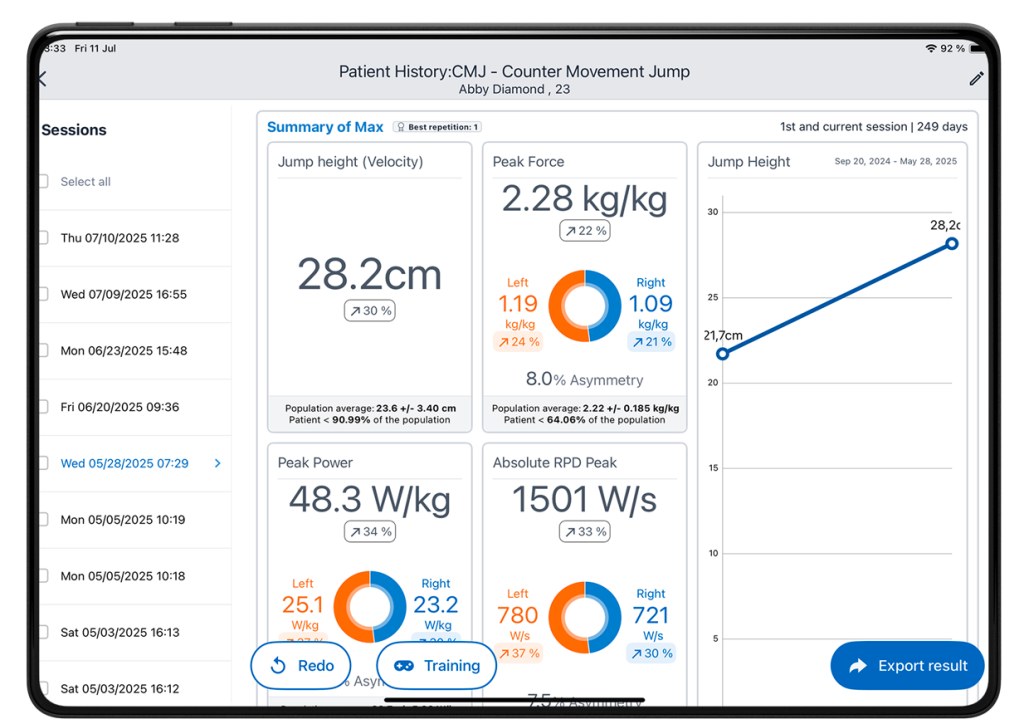
A professional vertical jump assessment provides a deep dive into an athlete’s strategy:
- Jump Height (cm): Ideally calculated via take-off velocity (impulse-momentum) for maximum accuracy.
- Relative Peak Power Output: A critical metric for profiling an athlete’s explosive strength.
- Peak RFD: Evaluated during the braking phase to show how quickly an athlete generates deceleration force.
- Asymmetry (%): Used during injury rehabilitation to detect differences in force output between the left and right limbs.
Protocol Standardization
To maintain high validity and reliability, the following factors must be controlled:
- Arm Swing: Decide in advance whether to include it, as swinging the arms can enhance jump performance by at least 10%.
- Hands Position: If arms are excluded, the athlete must keep their hands on their hips throughout the test (akimbo position).
- Consistency: Perform at least three trials with 60 seconds of rest between each to ensure reliable data.
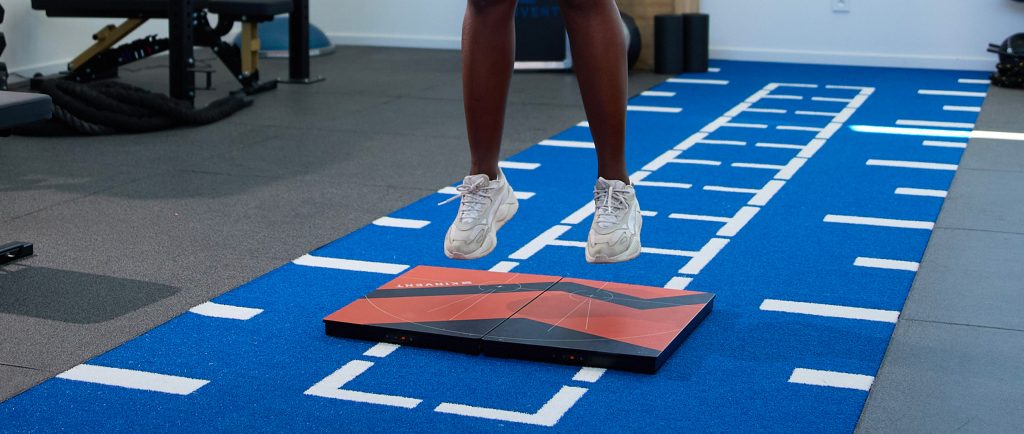
4- The Drop Jump (DJ): Assessing Reactive Strength and Plyometrics
The Drop Jump (DJ) is a specific plyometric exercise designed to test explosive power and, more specifically, the efficiency of the fast Stretch-Shortening Cycle (SSC). It is the ultimate test to measure an athlete’s ability to tolerate high eccentric loads and instantly transform them into vertical propulsion.
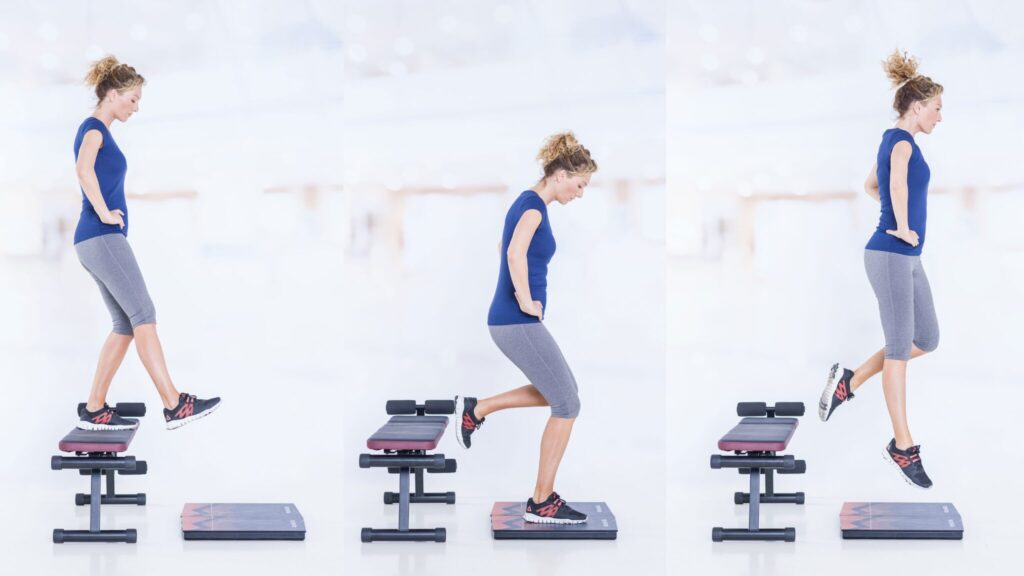
What is the Drop Jump Test?
In this assessment, the athlete starts by stepping off a platform or box of a predetermined height. Immediately upon landing, they execute a vertical jump as quickly and as high as possible.
- Key Objective: Minimize the Ground Contact Time (GCT) while maximizing jump height.
- Application: Essential for sports requiring rapid force production, such as basketball, volleyball, soccer, and track and field.
- Primary Metric: The Reactive Strength Index (RSI), calculated by dividing jump height by ground contact time.
How to Assess Drop Jump Performance?
Using Kinvent force platforms makes the analysis of the Drop Jump extremely precise by capturing data that contact mats might miss:
- Jump Height (cm): Reflects overall explosive power and the effective use of energy stored during the eccentric phase.
- Ground Contact Time (ms): Shorter times indicate better reactive strength and a more efficient SSC.
- Stiffness (N/m): Measures the musculoskeletal system’s ability to resist deformation during impact and rapidly generate force for the subsequent jump.
- Rate of Force Development: A critical indicator of explosive strength and the ability to rapidly generate power.
Factors to Keep in Mind Before Conducting the Test
The Drop Jump is a demanding test that requires strict standardization for valid results:
- Step Off, Don’t Jump Off: The athlete must step off the box to ensure the drop height is controlled and consistent.
- Maximal Effort: Sub-maximal efforts will result in inaccurate and unreliable scores.
- Flight Technique: Avoid flexing the ankles, knees, or hips during flight to ensure the integrity of the height measurement.
- Drop Height Accuracy: Calculating jump height from take-off velocity requires a very accurate calculation of the drop height, as errors here can contaminate results by 8% to 20%.
Why Choose Kinvent for Your Drop Jumps?
Manually calculating RSI or stiffness is complex and prone to human error. K-Deltas automate these measurements, providing an instantaneous Reactive Strength Index score. This allows coaches and physical therapists to identify if an athlete needs to strengthen their eccentric phase or work on their ground reaction speed to optimize plyometric performance.
5- FAQ: Answer your questions about Vertical Jump Assessment
How do I know if a Squat Jump test is valid?
An SJ is valid if the athlete maintains a stable semi-squat posture for several seconds before jumping. If there is any preliminary downward movement (countermovement) visible on the force-time curve, the jump is invalid as it falsely inflates the height using elastic energy.
What is the Reactive Strength Index (RSI) and why measure it?
The RSI is a composite measure calculated by dividing jump height by ground contact time during a Drop Jump (DJ). It evaluates how effectively an athlete converts energy absorbed during landing into explosive power, which is a key indicator of plyometric performance.
Why use a force platform instead of a jump mat?
While mats measure flight time, only a force platform (like the K-Deltas) provides insight into the strategy used to achieve that height. It directly measures applied forces, offering data on the rate of force development (RFD), braking impulses, and limb asymmetries.
What box height should be used for a Drop Jump?
Common box heights range from 30 to 60 cm. The height should be chosen based on the athlete’s experience and ability, as higher boxes increase impact forces and the difficulty of maintaining a minimal ground contact time.
6- References
- YOUNG, W. (1995). Laboratory strength assessment of athletes. New Study Athletics. 10, pp.88-96.
- MARKOVIC, G., D. DIZDAR, I. JUKIC, AND M. CARDINALE (2004). Reliability and factorial validity of squat and countermovement jump tests. J. Strength Cond. Res. 18(3):551-555.
- HAUN C. (2015). An Investigation of the Relationship Between a Static Jump Protocol and Squat Strength: A Potential Protocol for Collegiate Strength and Explosive Athlete Monitoring. Unpublished Master’s Thesis.
- DOCHERTY, D., ROBBINS, D., AND HODGSON, M. (2004). Complex training revisited: A review of its current status as a viable training approach. Strength Cond J. 27(4), pp.50-55.
- SALE, D.G. (1991). Testing strength and power. In: Physiological Testing of the High Performance Athlete. J.D. Mac Dougall, H.A. Wenger, and H.J. Green, eds. Champaign, IL: Human Kinetics, p. 21-106.
- HARRIS NK, CRONIN JB, HOPKINS WG, HANSEN KT. (2008). Relationship between sprint times and the strength/power outputs of a machine squat jump. J Strength Cond Res. May;22(3):691-8.
- MCLELLAN, CP, LOVELL, DI, AND GASS, GC. (2011). The role of rate of force development on vertical jump performance. J Strength Cond Res 25(2): 379-385.
- DORÉ E, BEDU M, VAN PRAAGH E. (2008). Squat jump performance during growth in both sexes: comparison with cycling power. Res Q Exerc Sport. Dec;79(4):517-24.
- MARKOVIC, G., DIZDAR, D., JUKIC, I., & CARDINALE, M. (2004). Reliability and factorial validity of squat and countermovement jump tests. Journal of strength and conditioning research, 18(3), 551-555.
- SHETTY, A. B., & ETNYRE, B. R. (1989). Contribution of arm movement to the force components of a maximum vertical jump. The Journal of orthopaedic and sports physical therapy, 11(5), 198-201.
- CHENG, K. B., WANG, C. H., CHEN, H. C., WU, C. D., & CHIU, Η. Τ. (2008). The mechanisms that enable arm motion to enhance vertical jump performance-a simulation study. Journal of biomechanics, 41(9), 1847-1854.
- SAHROM SB, WILKIE JC, NOSAKA K, BLAZEVICH AJ. (2020). The use of yank-time signal as an alternative to identify kinematic events and define phases in human countermovement jumping. R Soc Open Sci. Aug 26;7(8):192093.
- IMPELLIZZERI, F. M., RAMPININI, E., MAFFIULETTI, N., & MARCORA, S. M. (2007). A vertical jump force test for assessing bilateral strength asymmetry in athletes. Medicine and science in sports and exercise, 39(11), 2044-2050.
- HEISHMAN, A., DAUB, B., MILLER, R., BROWN, B., FREITAS, E., & BEMBEN, M. (2019). Countermovement Jump Inter-Limb Asymmetries in Collegiate Basketball Players. Sports (Basel, Switzerland), 7(5). 103.
- BISHOP, C., JORDAN, M., TORRES-RONDA, L., LOTURCO, I., HARRY, J., VIRGILE, A., MUNDY, P., TURNER, A., & COMFORT, P. (2023). Selecting metrics that matter: Comparing the use of the countermovement jump for performance profiling, neuromuscular fatigue monitoring, and injury rehabilitation testing. Strength and Conditioning Journal, 45(5), 545-553.
- MARTINEZ D.B. (2016). The use of Reactive Strength Index, Reactive Strength Index Modified, and flight time:contraction time as monitoring tools. J. Aust. Strength Cond. 24:37-41.


