


While the neuromuscular adaptations to isometric and variable resistance training are well documented, the acute recovery response of the upper body remains poorly understood. Most of the available literature focuses on the lower limbs or elbow flexors, leaving a gap in our understanding of how key muscles like the pectoralis major respond to different training modalities.
This study provides the first direct comparison between isometric exercise at different muscle lengths and variable resistance training using elastic bands, with a specific focus on recovery. The central question is simple but highly practical: Does variable resistance training delay muscle recovery compared to isometric exercise?
CONTENTS
1- Why Recovery Matters in Variable Resistance Training
2- Study Design: Comparing Variable Resistance and Isometric Exercise
3- Key Results: Does Variable Resistance Training Affect Recovery?
4- What These Results Mean for Coaches, Sport Scientists, and Clinicians
5- Key Takeaways
6- FAQ: Variable Resistance Training Recovery
7- References
1- Why Recovery Matters in Variable Resistance Training
Recovery is a critical variable when programming training frequency, especially for athletes relying on explosive upper-body performance.
Variable resistance training (VAR), particularly with elastic bands, introduces:
- a progressive increase in resistance,
- a significant eccentric component,
- and increased metabolic stress.
These characteristics can influence not only performance adaptations but also the timeline of recovery, which directly impacts:
- training frequency,
- injury risk,
- and long-term performance progression.

2- Study Design: Comparing Variable Resistance and Isometric Exercise
Participants and Protocol
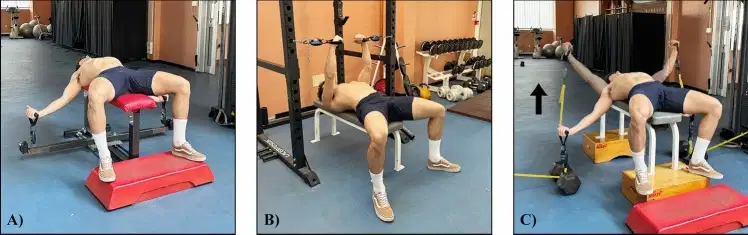
The study used a randomized, counterbalanced crossover design involving 12 resistance-trained men. Each participant completed three distinct protocols:
- Isometric contractions at long muscle length (LML)
- Isometric contractions at short muscle length (SML)
- Variable resistance training (VAR) using elastic bands
Measurement Tools and Methodology
To ensure high precision, the researchers implemented a comprehensive monitoring setup:
- Force Quantification: A wireless dynamometer (Kinvent K-Pull) was used to measure peak force during each isometric contraction and every VAR repetition.
- Joint Kinematics: To maintain strict form, a digital goniometer (Kinvent K-Move) monitored the elbow at a constant 10 degrees of flexion throughout all protocols.
- Power Output: A linear optical encoder (Tendo Unit model V104) measured average power during Bench Press Throw (BPT) tests.
- Imaging & Texture Analysis: A 12-MHz linear ultrasound probe (Echo Wave 2, Telemed) was used to capture high-resolution images of the pectoralis major. These images were then processed via ImageJ software to calculate muscle thickness (MT) and “Echo Intensity” (EI), alongside complex muscle texture parameters like entropy and correlation.
- Biochemical Markers: Blood samples were analyzed for Creatine Phosphokinase (CPK) levels to quantify systemic muscle damage.
3- Key Results: Does Variable Resistance Training Affect Recovery?
Delayed Structural Recovery After Variable Resistance Training
The most important finding was that muscle thickness remained significantly elevated 24 hours after VAR training.
This indicates a prolonged alteration in muscle architecture, suggesting that elastic band training induces a more persistent structural response compared to isometric exercise.
Rapid Recovery of Strength and Power
Despite these structural changes, performance metrics told a different story:
- Peak force returned to baseline within 24 hours
- Bench Press Throw power fully recovered within 24 hours
This creates a clear dissociation between functional recovery and structural recovery.
Similar Muscle Damage Across All Protocols
All three conditions (LML, SML, VAR) showed:
- increased CPK levels,
- and elevated muscle soreness lasting up to 48 hours.
This suggests that overall muscle damage was comparable, regardless of the training modality.
The Internal Force Paradox
An unexpected result emerged regarding internal force:
- SML produced ~33% higher internal force than LML
- despite LML traditionally being considered more damaging
This may explain why both isometric conditions resulted in similar recovery profiles, despite theoretical differences in muscle vulnerability.
4- What These Results Mean for Coaches, Sport Scientists and Clinicians
The “False Recovery” Trap
One of the most important practical insights is the concept of false recovery:
Athletes may:
- feel recovered,
- and perform at baseline levels,
- while their muscle structure is still undergoing recovery.
This is particularly relevant after elastic band training, where structural markers remain altered despite restored performance.
Programming Recovery After Elastic Band Training
Because variable resistance training induces:
- prolonged muscle swelling,
- and sustained structural stress,
coaches should consider:
- extending recovery windows,
- or avoiding consecutive high-intensity chest sessions.
When to Use Isometric Training
Isometric training offers a valuable alternative when the goal is to:
- maintain neuromuscular activation,
- while minimizing prolonged structural disruption.
This makes it particularly useful in:
- dense training schedules,
- return-to-play contexts,
- or fatigue management strategies.
5- Key Takeaways
- Variable resistance training prolongs structural recovery compared to isometric exercise
- Strength and power can recover within 24 hours, masking underlying fatigue
- Muscle damage markers are similar across all training modalities
- Elastic bands may require longer recovery periods in programming
- Isometric training provides a high stimulus with faster structural recovery
6- FAQ: Variable Resistance Training Recovery
Does variable resistance training delay recovery?
Yes, this study suggests that variable resistance training using elastic bands can delay structural muscle recovery, even if performance returns quickly.
Are elastic bands more damaging than isometric exercise?
Not necessarily. Muscle damage markers such as CPK were similar across all conditions, but elastic bands caused longer-lasting structural changes.
Can performance return before full recovery?
Yes. One of the key findings is that strength and power can return within 24 hours, even when the muscle is still structurally recovering.
How long should recovery last after elastic band chest training?
While performance may recover within 24 hours, structural recovery may take longer, suggesting that a more conservative recovery window is advisable.
Is isometric training easier to recover from?
In this study, isometric training showed faster normalization of muscle structure, making it potentially easier to recover from in certain contexts.


