


The drop jump test is a widely used assessment for evaluating explosiveness, reactive strength, and plyometric performance. Practitioners commonly rely on metrics such as jump height, ground contact time, and the Reactive Strength Index (RSI) to monitor athlete performance and guide training decisions.
But one common assumption may be distorting those results: assuming that a 40 cm box automatically means a 40 cm actual drop.
This study shows that this approximation can introduce significant measurement errors, directly affecting jump height calculations, touchdown velocity, and the interpretation of overall performance.
In this article, we explore why drop jump test accuracy matters and how to improve the reliability of your assessment protocols.
CONTENTS
1- What Is a Drop Jump Test?
2- Study Design: Comparing Different Drop Jump Measurement Methods
3- Key Findings: Why Box Height Does Not Equal Actual Drop Height
4- How Large Are the Measurement Errors?
5- Practical Applications for Coaches and Sport Scientists
6- FAQ: Answer Your Questions about the Drop Jump Test
7- Reference
1- What Is a Drop Jump Test?
The drop jump test is a plyometric assessment used to evaluate an athlete’s ability to rapidly absorb force upon landing and immediately reuse it to produce an explosive jump.
During the test, the athlete steps off a box, lands on the ground, and performs a maximal vertical jump while minimizing ground contact time.
As part of a broader vertical jump assessment, the drop jump complements other commonly used tests such as the squat jump (SJ) and countermovement jump (CMJ), providing specific insights into reactive strength and stretch-shortening cycle (SSC) efficiency.
Key performance metrics commonly analyzed include:
- jump height
- ground contact time
- Reactive Strength Index (RSI)
- touchdown velocity
- leg stiffness
👉 To explore the biomechanics of the movement in more detail, check out our guide on drop jump force-time curve analysis.
2- Study Design: Comparing Different Drop Jump Measurement Methods
To investigate how analysis methods influence drop jump test results, the researchers recruited 10 semi-professional volleyball players performing drop jumps from three standard heights: 20 cm, 40 cm, and 60 cm.
Performance data were collected using high-precision Kinvent K-Force Plates and K-Deltas force plates, allowing the researchers to compare four commonly used analysis methods:
- Double Force Plate (DFP): the reference method using one force plate on the box and another on the ground to precisely detect the exact “step-off” moment.
- Single Force Plate (SFP): the traditional approach assumes that box height equals actual drop height.
- Drop Time Method (DTM): estimating drop height based on the time spent between leaving the box and landing on the ground.
- Flight Time Method (FTM): calculating jump height from the flight time during the second jump.
The goal was simple: determine whether assuming that a 40 cm box automatically creates a 40 cm drop produces accurate data or introduces significant measurement bias.
3- Key Findings: Why Box Height Does Not Equal Actual Drop Height
The main takeaway from this study is clear: the nominal box height does not necessarily correspond to the athlete’s actual drop height.
In other words, stepping off a 40 cm box does not automatically mean the athlete experiences a true 40 cm drop. The way the athlete leaves the box, intentionally or unintentionally, changes the initial movement conditions and directly affects landing mechanics.
The researchers observed that:
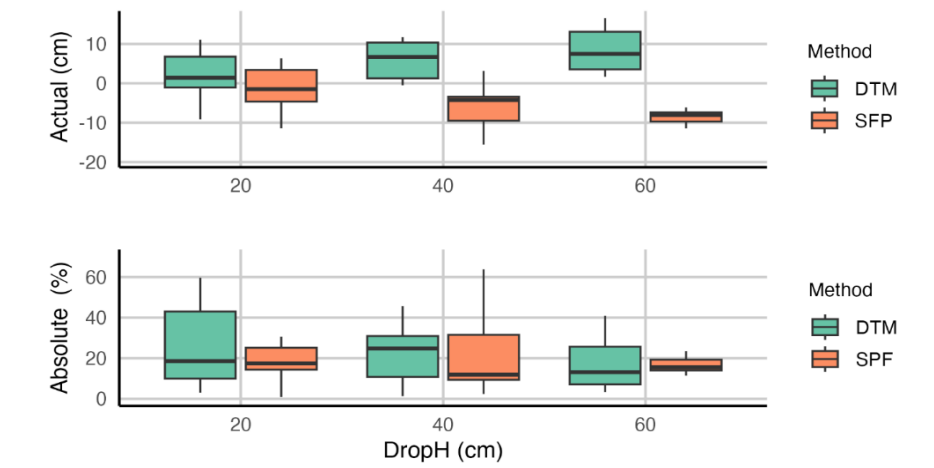
- actual drop height significantly differed from the theoretical box height;
- these discrepancies increased as the box height became higher;
- touchdown velocity varied depending on the analysis method used;
- several performance metrics were directly affected.
In practice, this means that incorrect assumptions at the start of the movement can distort the entire drop jump test analysis, especially when the test is used to compare performances, monitor fatigue, or individualize plyometric training.
4- How Large Are the Measurement Errors?
The differences observed in this study were far from negligible. Depending on the analysis method used, calculated jump height differences ranged from 16.1% to 26.6%.
In other words, two practitioners analyzing the same drop jump with different methods could obtain substantially different performance results.
The researchers also showed that these errors became larger as box height increased, particularly at 40 cm and 60 cm, where touchdown velocity differences were especially significant.
These discrepancies can have important practical consequences:
- inaccurate interpretation of athlete performance;
- unreliable fatigue and neuromuscular load monitoring;
- inconsistent comparisons between sessions or athletes;
- less effective plyometric training prescription.
When the drop jump test is used to guide training or return-to-sport decisions, measurement accuracy becomes essential.
5- Practical Applications for Coaches and Sport Scientists
For practitioners working in sports performance, the message is straightforward: data quality depends directly on the measurement method being used.
If the actual drop height is incorrectly estimated, key metrics such as Reactive Strength Index (RSI), jump height, and touchdown velocity may become unreliable, limiting the accuracy of athlete monitoring.
In practice, these findings highlight several important considerations:
- standardize testing protocols to ensure reliable comparisons between sessions;
- avoid assuming that box height automatically equals actual drop height;
- interpret drop jump results carefully, especially when different calculation methods are used;
- prioritize tools capable of more accurately measuring the initial conditions of the movement.
More reliable plyometric testing allows practitioners to better monitor performance adaptations, fine-tune training loads, and identify the true mechanical demands experienced by the athlete.
👉 To go further, explore our guide on vertical jump assessment (SJ, CMJ, DJ).
6- FAQ: Answer Your Questions about the Drop Jump Test
Is the drop jump test reliable for assessing performance?
Yes, the drop jump test is widely used to assess reactive strength, explosiveness, and stretch-shortening cycle efficiency. However, its reliability depends heavily on protocol standardization and the measurement method used.
What is the difference between a drop jump, squat jump, and countermovement jump?
The squat jump (SJ) evaluates explosive force without a preparatory movement, the countermovement jump (CMJ) includes a pre-stretch phase, while the drop jump assesses the athlete’s ability to rapidly absorb force and immediately produce an explosive rebound.
What is the Reactive Strength Index (RSI)?
The Reactive Strength Index (RSI) is a key metric commonly used in the drop jump test. It represents the ratio between jump height and ground contact time, helping practitioners evaluate reactive strength efficiency.
Why doesn’t box height always equal actual drop height?
Because the athlete’s stepping strategy influences the mechanics of the movement. A more active or passive step-off changes the real drop height and directly affects touchdown velocity.
Can a single force plate accurately measure a drop jump?
A single force plate can still provide useful information, but this study suggests that methods based on simplified assumptions may introduce substantial errors. More advanced setups allow for more accurate measurement of the movement’s initial conditions.
7- Reference
Chalitsios, Christos PhD; Panoutsakopoulos, Vassilios PhD; and Kollias, Iraklis A. (2025) “THE ANALYSIS METHOD RESULTS IN DIFFERENCES IN THE EVALUATION OF DROP JUMP KINETICS: PROOF OF CONCEPT AT THREE DROPPING HEIGHTS,” ISBS Proceedings Archive: Vol. 43: Iss. 1, Article 15. https://commons.nmu.edu/isbs/vol43/iss1/15


