


Double-leg balance, the ability to maintain stability while standing on two feet, is a key component of movement, injury prevention, and rehabilitation. Yet, many professionals still rely on subjective tests that lack sensitivity and fail to capture subtle deficits in postural control.
Today, objective balance assessment using force plates provides a more precise approach. By analyzing the center of pressure (CoP) and postural sway, clinicians and coaches can better understand neuromuscular control and make more informed decisions. This is essential, as balance depends on the complex interactions among the sensory, neuromuscular, and musculoskeletal systems.
In this article, you’ll discover:
- What double-leg balance is and why it matters
- Why traditional balance tests have limitations
- How force plates and CoP analysis improve assessment
- How to perform a reliable double-leg balance test
- The key balance metrics (ellipse area, path length, velocity)
- How to use balance data in rehab and performance
At the end of this article, you’ll also be able to download a free ebook to dive deeper into double-leg balance assessment protocols, data analysis, and clinical applications. This guide will help you integrate double-leg balance assessment into your practice using objective, actionable data.
CONTENTS
1- What Is Double-Leg Balance?
2- Why Objective Balance Assessment Is Essential
3- How to Perform a Double-Leg Balance Test
4- Key Metrics to Analyze in Double-Leg Balance
5- Clinical Interpretation of Balance Data
6- Zoom on The Romberg Test
7- FAQ: Double-Leg Balance Assessment
8- Conclusion
9- References
1- What Is Double-Leg Balance?
Definition and Physiological Mechanisms
Double-leg balance refers to the ability to maintain a stable posture while standing on both feet (Pollock et al, 2020). While it may seem simple, it relies on a highly complex interaction between multiple systems in the body.
Postural stability is continuously regulated through the integration of:
- Sensory inputs (visual, vestibular, and proprioceptive systems)
- Neuromuscular control (muscle activation and coordination)
- Musculoskeletal structures (joints, muscles, and alignment)
These systems work together to adjust the body’s position and maintain equilibrium constantly. Even during quiet standing, the body is never completely still; small continuous adjustments occur to control postural sway and keep the center of mass within the base of support.
Any disruption in this system, whether due to injury, fatigue, or neurological impairment, can negatively impact double-leg balance and increase the risk of instability or falls.
Why It Matters in Clinical and Performance Settings
Assessing double-leg balance is essential across multiple fields:
- Rehabilitation: Balance impairments are common in conditions such as stroke, Parkinson’s disease, musculoskeletal injuries, or concussion
- Injury prevention: Poor postural control is linked to a higher risk of lower-limb injuries
- Return-to-play: Objective balance metrics help determine readiness after injury
- Performance optimization: Efficient postural control supports better movement quality and force production
Because double-leg balance underpins so many functional and athletic tasks, accurately assessing it is a key step toward improving outcomes, whether in clinical rehab or high-performance environments.
2- Why Objective Balance Assessment Is Essential
Limits of Traditional Clinical Tests
For decades, balance has been assessed using tools like the Berg Balance Scale, the Timed Up and Go (TUG), or the Clinical Test of Sensory Integration of Balance. While these tests are widely used, they come with important limitations:
- Subjectivity: results often depend on the clinician’s observation
- Low sensitivity: difficult to detect subtle deficits or small improvements
- Inter-rater variability: results may differ between practitioners
These limitations make it challenging to accurately track progress or identify early impairments in postural control.
Benefits of Force Plate Assessment
This is where objective balance assessment using force plates becomes essential.
Force plates provide precise, real-time data on how a patient or athlete maintains stability. Instead of relying on observation, clinicians can quantify balance using metrics such as center of pressure (CoP) displacement and postural sway.

Key advantages include:
- Quantify postural sway to assess overall stability
- Analyze the center of pressure (CoP) to better understand postural control strategies
- Measure body weight distribution between the right and left lower limbs, which is essential for detecting asymmetries and compensatory patterns
- Visualize pressure mapping, helping identify dominant loading zones (forefoot vs. rearfoot, medial vs. lateral edge of the foot)
- Track progress over time using reliable and comparable data
Analyzing load distribution is particularly valuable in rehabilitation, where patients may unconsciously offload a painful or injured limb, but also in performance settings, where asymmetries can impact movement efficiency or increase injury risk.
Beyond assessment, these tools also create a seamless transition into rehabilitation or training through real-time biofeedback, allowing patients and athletes to visualize their loading patterns and actively correct their postural strategies.
Modern solutions also streamline daily clinical workflows with automatic data recording, secure patient data storage, and easy PDF or CSV export for reporting and analysis.
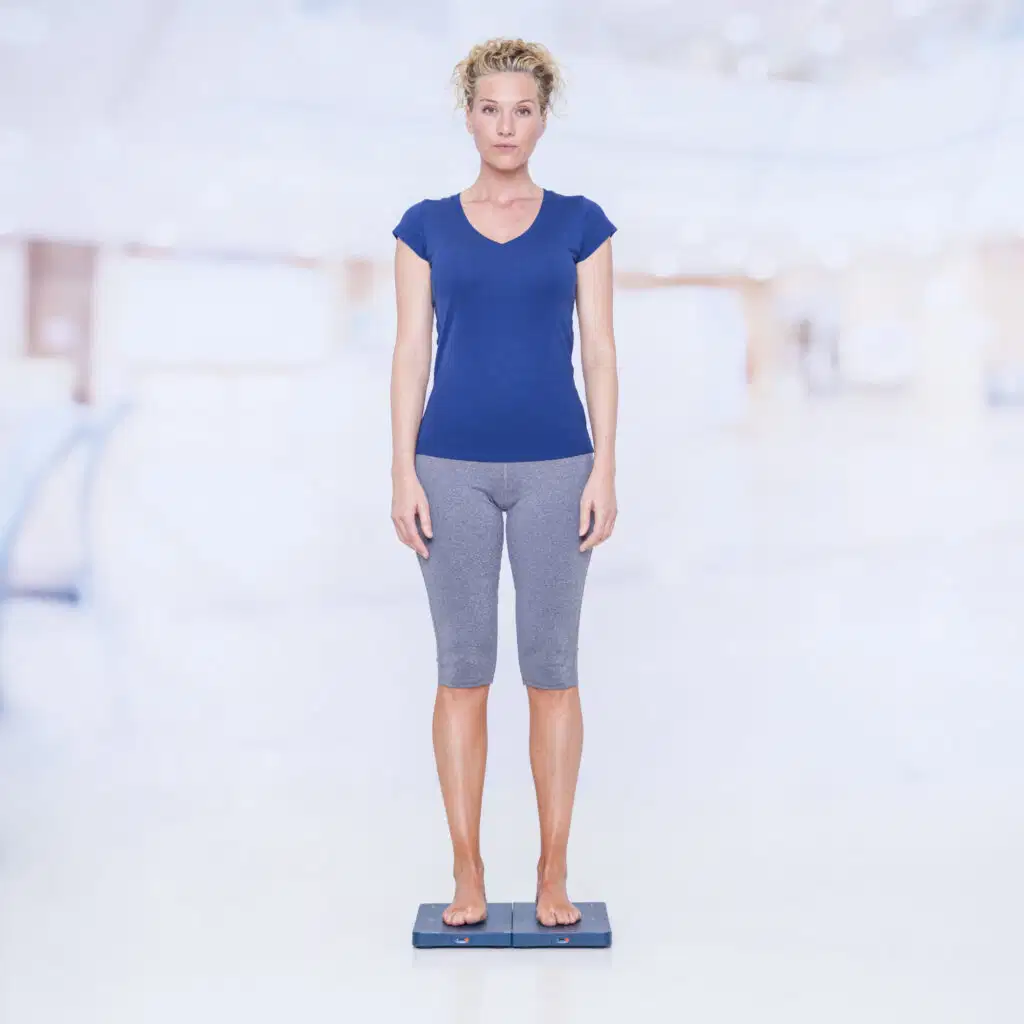
💡 Solutions like Kinvent K-force plates take this process a step further by combining high-precision sensors with an intuitive mobile application. Data is collected in real time via Bluetooth, automatically filtered, and translated into actionable metrics such as CoP displacement, path length, and velocity.
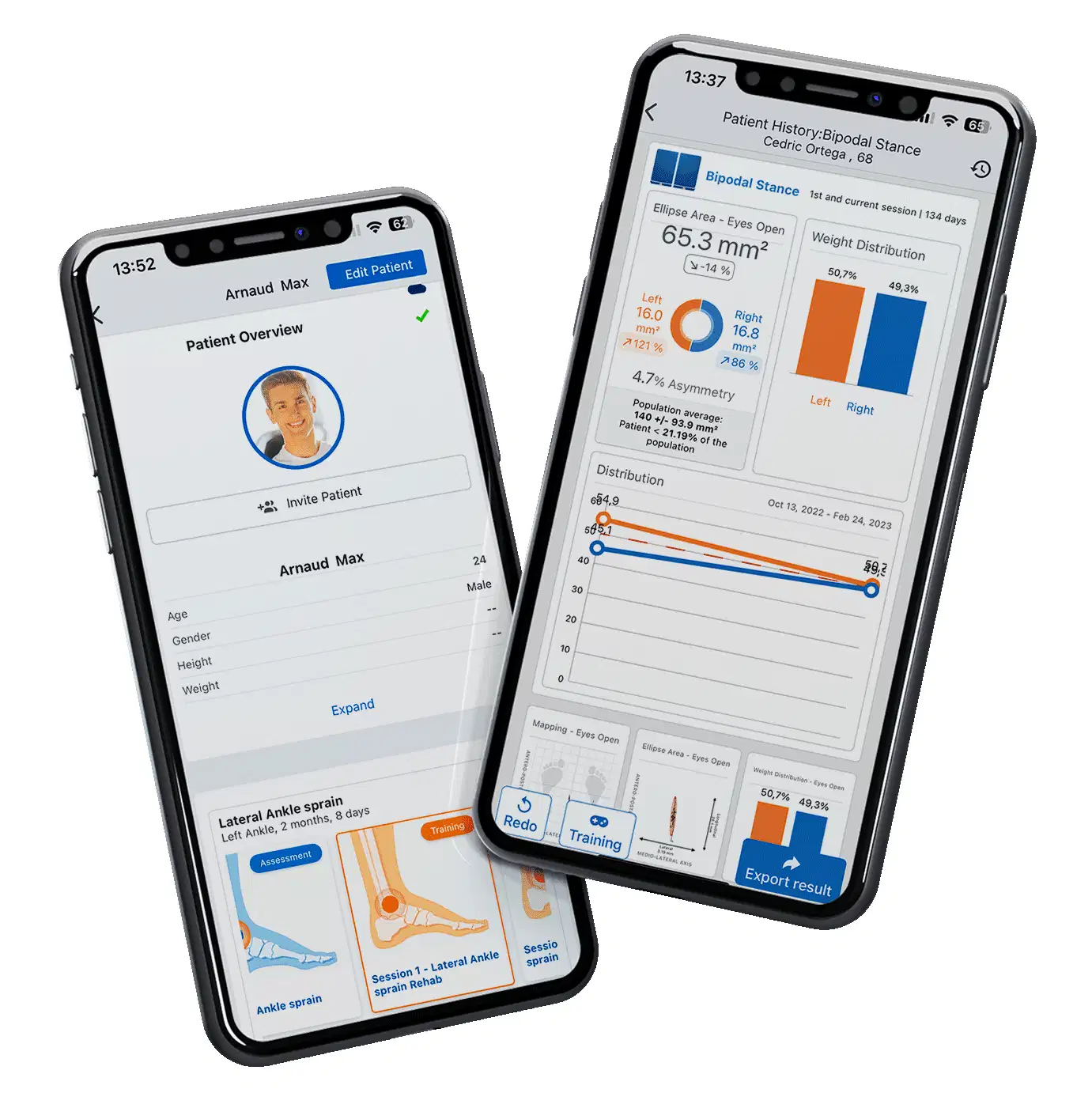
For clinicians and coaches, this means faster testing, immediate feedback, and easier integration into daily practice, without sacrificing scientific accuracy. By making objective balance assessment accessible and efficient, Kinvent helps professionals turn complex data into clear, actionable decisions.
3- How to Perform a Double-Leg Balance Test
Standardized Testing Protocol
To ensure reliable and reproducible results, a double-leg balance test must follow a standardized protocol. Small variations in setup can significantly impact center of pressure (CoP) measurements and overall interpretation.
A typical protocol includes:
- Step 1: Standing on the platform, the patients take 3-4 steps on the spot to find his/her optimal position
- Step 2: Arms are kept relaxed at the side
- Step 3: Focus is on a marker between 3 to 5 meters away (for the eyes-open condition)
- Step 4: Remain as stable as possible during the duration of the test
Before starting, individuals are usually asked to take a few steps in place to find a natural and stable stance. Test duration commonly ranges from 30 to 60 seconds, depending on the objective.
To assess sensory contributions to balance, tests are often performed under two conditions:
- Eyes open
- Eyes closed
This allows clinicians to evaluate how visual input influences postural control.
Should You Include a Warm-Up?
The inclusion of a warm-up depends on the context of the assessment.
- In sports performance, a short warm-up (5–10 minutes) can improve neuromuscular readiness and lead to more consistent results
- In clinical settings (e.g., fall risk assessment, neurological evaluation), skipping the warm-up may better reflect real-life conditions
Ultimately, the decision should align with the goal of the test and the population being assessed.
Common Mistakes to Avoid
To ensure valid and comparable results, avoid these common pitfalls:
- Inconsistent foot positioning between tests
- Lack of standardization (duration, instructions, environment)
- External distractions affecting focus
- Fatigue or prior activity influencing performance
Consistency is key. A well-standardized double-leg balance assessment allows for accurate comparisons over time and more meaningful clinical or performance insights.
📥 Go Further: Download the Free Ebook
Want to dive deeper into double-leg balance assessment?
Download our free ebook to explore:
- Detailed testing protocols
- In-depth explanation of CoP metrics
- Practical insights for clinical interpretation
- Advanced applications in rehab and performance
👉 Download the ebook and take your balance assessment to the next level.
4- Key Metrics to Analyze in Double-Leg Balance
Ellipse Area
The ellipse area represents the surface covered by CoP movement during the test. It reflects the overall magnitude of postural sway.
- A larger ellipse area indicates greater instability
- A smaller area suggests better postural control
This metric is widely used in both clinical and research settings, as it provides a global view of balance performance.
CoP Path Length
The CoP path length measures the total distance traveled by the CoP during the test.
- A longer path indicates more movement and reduced stability
- A shorter path reflects more efficient control of posture
This is a key indicator of how much the body needs to adjust to maintain balance, making it highly relevant for detecting subtle impairments.
CoP Mean Velocity
The mean velocity of the CoP is calculated by dividing the path length by the duration of the test.
- A higher velocity suggests rapid, frequent corrections → lower stability
- A lower velocity indicates smoother, more controlled postural regulation
This metric is particularly sensitive to balance deficits and is often used to assess neuromuscular control strategies.
How to Interpret These Metrics
Individually, each KPI provides valuable information. Combined, they offer a comprehensive view of balance performance:
- High area + high path length + high velocity → poor postural control
- Low values across metrics → efficient and stable balance
These objective measures allow clinicians and coaches to:
- Identify deficits
- Monitor progress over time
- Evaluate the effectiveness of interventions
5- Clinical Interpretation of Balance Data
What Indicates Poor Postural Control?
Interpreting a double-leg balance assessment goes beyond collecting data; it requires understanding what the metrics reveal about postural control.
In general, impaired balance is associated with:
- Increased CoP ellipse area → greater postural sway
- Longer CoP path length → more corrective movements
- Higher CoP mean velocity → less efficient neuromuscular control
These patterns indicate that the body is struggling to maintain stability and requires more frequent adjustments to stay balanced.
Linking Metrics to Pathologies
Objective balance metrics are strongly associated with various clinical conditions:
- Neurological disorders (e.g., Parkinson’s disease): increased sway, path length, and velocity
- Post-stroke patients: impaired postural control and asymmetry
- Musculoskeletal injuries (e.g., ankle instability): altered balance strategies
Research consistently shows that increased CoP displacement is linked to reduced stability and higher fall risk.
Tracking Progress Over Time
One of the biggest advantages of objective balance assessment is the ability to monitor changes over time.
Clinicians and coaches can:
- Track rehabilitation progress with precise data
- Evaluate intervention effectiveness (e.g., strength, proprioception, balance training)
- Support return-to-play decisions with objective criteria
For example, a reduction in ellipse area or CoP velocity after a training program typically reflects improved postural control.
6- Zoom on The Romberg Test
Eyes Open vs. Eyes Closed
Balance is not only a mechanical process; it relies heavily on sensory integration. The body continuously combines information from three main systems:
- Visual system
- Vestibular system
- Proprioceptive system
During a double-leg balance assessment, comparing eyes open and eyes closed conditions helps determine how much a person relies on vision to maintain stability.
When visual input is removed, the body must rely more on proprioceptive and vestibular feedback. This typically results in increased postural sway and changes in the center of pressure (CoP) behavior.
Understanding the Romberg Quotient
The Romberg Quotient is a key metric used to quantify the role of vision in balance control. It is calculated by comparing CoP sway in eyes-closed versus eyes-open conditions:
- Quotient > 1: vision improves balance (normal reliance)
- Quotient ≈ 1: little difference between conditions
- Quotient < 1: vision may negatively affect postural control
This metric provides valuable insight into how different sensory systems contribute to stability and can help identify neurological or vestibular impairments.
Clinical Applications
The Romberg test, especially when performed with force plates, offers a more objective and precise analysis than traditional observation alone.
It is particularly useful for:
- Assessing sensory integration deficits
- Identifying fall risk in older adults
- Evaluating neurological conditions
- Monitoring rehabilitation progress
The Romberg Quotient is a useful tool in the assessment of balance in a variety of populations, including older adults, individuals with Parkinson’s disease, and individuals with vestibular impairments.
However, it is important to note that the test, even performed on a force plate, is not a stand-alone diagnostic tool and should be used in conjunction with other measures of balance and functional ability.
7- FAQ: Double-Leg Balance Assessment
What is a double-leg balance test?
A double-leg balance test evaluates a person’s ability to maintain stability while standing on both feet. Using force plates, clinicians can measure center of pressure (CoP) movements and postural sway to objectively assess balance and neuromuscular control.
What is a normal result in a balance assessment?
Published reference values do exist for some double-leg balance metrics, but they vary significantly depending on age, population, recording duration, and especially testing conditions (foot position, eyes open vs. closed, protocol, equipment used).
In general, a smaller ellipse area, shorter CoP path length, and lower mean velocity are associated with better postural control.
In clinical practice, the most important factor is to standardize the assessment, allowing for reliable comparisons over time when monitoring a patient’s or an athlete’s progress.
How long should a double-leg balance test last?
Most double-leg balance tests last between 30 and 60 seconds. This duration is sufficient to capture meaningful CoP data while minimizing fatigue.
Why use force plates for balance assessment?
Force plates provide objective, precise, and reliable data. Unlike subjective tests, they allow clinicians to:
- Detect subtle balance deficits
- Quantify postural sway
- Track progress over time
This makes them a gold standard for balance assessment in both rehab and performance settings.
What is the center of pressure (CoP)?
The center of pressure (CoP) is the point where the body’s pressure is applied to the ground. Its movement reflects how the body maintains balance. Analyzing CoP displacement is essential to understanding postural control.
What is the Romberg test in balance assessment?
The Romberg test compares balance with eyes open vs. eyes closed. It helps determine how much a person relies on vision to maintain stability. When combined with force plates, it provides a more objective and precise analysis of sensory integration.
When should you use a double-leg balance assessment?
A double-leg balance assessment is useful for:
- Rehabilitation (injury, neurological conditions)
- Injury prevention
- Return-to-play decisions
- Performance optimization
- Fall risk screening
Can balance be improved with training?
Yes. Targeted interventions such as:
- Strength training
- Proprioceptive exercises
- Balance training
can significantly improve postural control. Objective measurements help track these improvements and optimize programs.
8- Conclusion
Double-leg balance is a fundamental pillar of both rehabilitation and performance. While it has long been assessed using subjective tests, these approaches are no longer sufficient to capture the full complexity of postural control.
With force plates, balance assessment becomes far more precise and actionable. Beyond simple center of pressure (CoP) analysis, clinicians and coaches can access key metrics such as:
- Body weight distribution between the right and left lower limbs is essential for detecting asymmetries and compensatory strategies
- Ellipse area (mm²), reflecting overall stability
- CoP displacement distance and velocity, providing insight into the efficiency of postural control
- Pressure mapping, which helps visualize how load is distributed across the foot (forefoot vs. rearfoot, medial vs. lateral loading), offers valuable insights into compensatory strategies and specific rehabilitation or training needs
But the real value of these tools lies in their ability to turn assessment into immediate action. With real-time biofeedback, patients and athletes can visualize their weight distribution, better understand their imbalances, and actively adjust their postural strategy during exercises. This seamless transition between assessment, rehabilitation, and training creates a more engaging, precise, and effective care pathway.
Modern solutions also make it easier to integrate these assessments into daily practice through:
- Automatic and secure patient data recording (GDPR-compliant)
- Longitudinal progress tracking
- Quick PDF report and CSV data export for analysis, sharing, or clinical documentation
Today, integrating objective double-leg balance assessment into practice is no longer just about measuring better; it’s about understanding better, guiding better, and helping patients and athletes progress more effectively.
9- References
- Markovic, G., Dizdar, D., Jukic, I., & Cardinale, M. (2004). Reliability and factorial validity of squat and countermovement jump tests. Journal of Strength and Conditioning Research, 18(3), 551–555.
- Maatar, D. (2013). Analyse des signaux stabilométriques et de la stabilité chez l’Homme: application à la biométrie (Doctoral dissertation, Université Paris-Est).
- Pizzigalli, L., Ahmaidi, S., & Rainoldi, A. (2014). Effects of sedentary condition and long-term physical activity on postural balance and strength responses in elderly subjects. Sport Sciences for Health, 10(2), 135–141.
- Pollock, A. S., Durward, B. R., Rowe, P. J., & Paul, J. P. (2000). What is balance? Clinical Rehabilitation, 14(4), 402–406.
- Quijoux, F., Nicolaï, A., Chairi, I., Bargiotas, I., Ricard, D., Yelnik, A., & Audiffren, J. (2021). A review of center of pressure (CoP) variables to quantify standing balance in elderly people: Algorithms and open-access code. Physiological Reports, 9(22), e15067.
- Verhagen, E., van der Beek, A., Twisk, J., Bouter, L., Bahr, R., & van Mechelen, W. (2004). The effect of a proprioceptive balance board training program for the prevention of ankle sprains: A prospective controlled trial. The American Journal of Sports Medicine, 32(6), 1385–1393.
- Winter, D. A. (1995). Human balance and posture control during standing and walking. Gait & Posture, 3(4), 193–214.
- Morenilla, L., Márquez, G., Sánchez, J. A., Bello, O., López-Alonso, V., Fernández-Lago, H., & Fernández-del-Olmo, M. (2020). Postural stability and cognitive performance in subjects with Parkinson’s disease during a dual-task in an upright stance. Frontiers in Psychology.
- Gama, G. L., Celestino, M. L., Barela, J. A., & Barela, A. M. (2019). Gait initiation and partial body weight unloading for functional improvement in post-stroke individuals. Gait & Posture, 68, 305–310.
- Paolucci, T., Iosa, M., Morone, G., Fratte, M. D., Paolucci, S., Saraceni, V. M., & Villani, C. (2018). Romberg ratio coefficient in quiet stance and postural control in Parkinson’s disease. Neurological Sciences, 39, 1355–1360.
- Miko, I., Szerb, I., Szerb, A., Bender, T., & Poor, G. (2018). Effect of a balance-training programme on postural balance, aerobic capacity and frequency of falls in women with osteoporosis: A randomized controlled trial. Journal of Rehabilitation Medicine, 50(6), 542–547. https://doi.org/10.2340/16501977-2349


