


In many team sports, sprint speed is a key performance factor. However, sprint evaluation often relies on a simple time recorded over a given distance.
But a 30-meter sprint time does not tell the whole story. It does not reveal:
- where the athlete performs best
- when the top speed is reached
- whether speed decreases during the sprint
- whether the athlete is ready to return to play
In this article, discover how the new Best 10 m and Best 10 yd metrics in the Kinvent app provide deeper sprint analysis using the K-Power sensor.
CONTENTS
1- Why Analyzing Sprint Phases Matters
2- Sprint Analysis with K-Power
3- How to Analyze Key Results
4- FAQ: Sprint Testing and Performance
1- Why Analyzing Sprint Phases Matters
In team sports such as football, rugby, or basketball, most decisive actions occur within the first 5 to 20 meters. This is where athletes create separation from opponents, intercept the ball, or initiate attacking actions.
Yet sprint performance is often evaluated using only total sprint time. While useful, this metric cannot identify:
- acceleration quality
- the ability to reach top speed
- deficits in specific sprint phases
Analyzing the different phases of sprinting also plays a key role in force–velocity profiling, a method used to determine whether an athlete lacks force during the acceleration phase or top-end speed later in the sprint.
💡 To learn more: read our dedicated article on force–velocity profiling in sprinting, which explains how to analyze the mechanical determinants of sprint performance and adapt training programs accordingly.
2- Sprint Analysis with K-Power
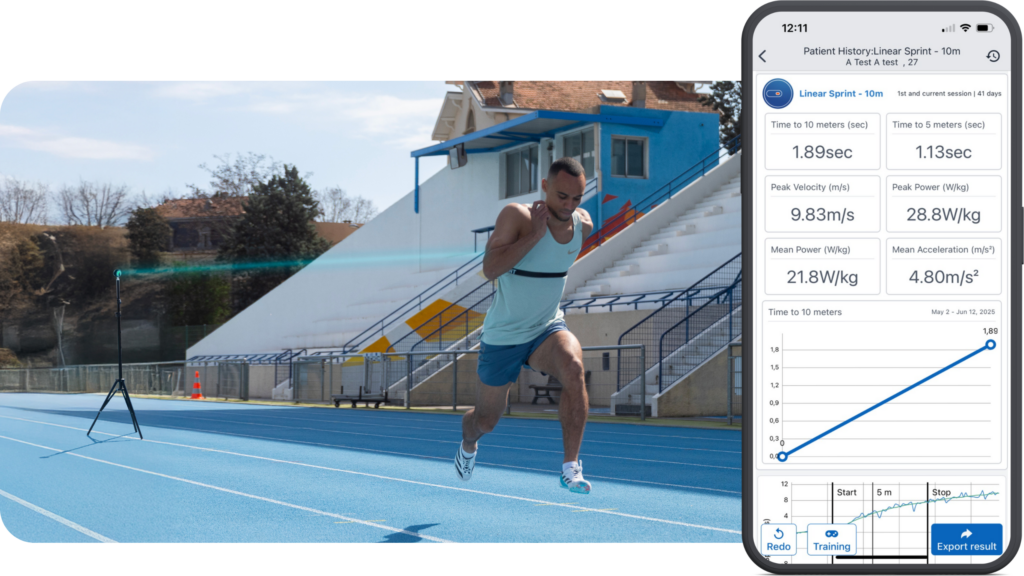
The K-Power sensor allows practitioners to analyze sprint performance with precision. Thanks to the protocols integrated into the Kinvent App, it is possible to measure different sprint phases and obtain key performance indicators.
New Metrics: Best 10 m and Best 10 yd
To properly analyze sprint performance, it is essential to break down the different phases. Thanks to new metrics available with K-Power, it is now possible to analyze the best 10 m within a 30 m sprint and the best 10 yd within a 40 yd sprint.
The Kinvent App automatically identifies the fastest segment of the sprint, providing insight into:
- Fastest 10 m and 10 yd time (s): the time recorded over the fastest segment.
- Average speed over this segment (m/s): typically corresponding to the maximum speed phase.
- Position of this segment (m): identify when the athlete reaches peak speed.
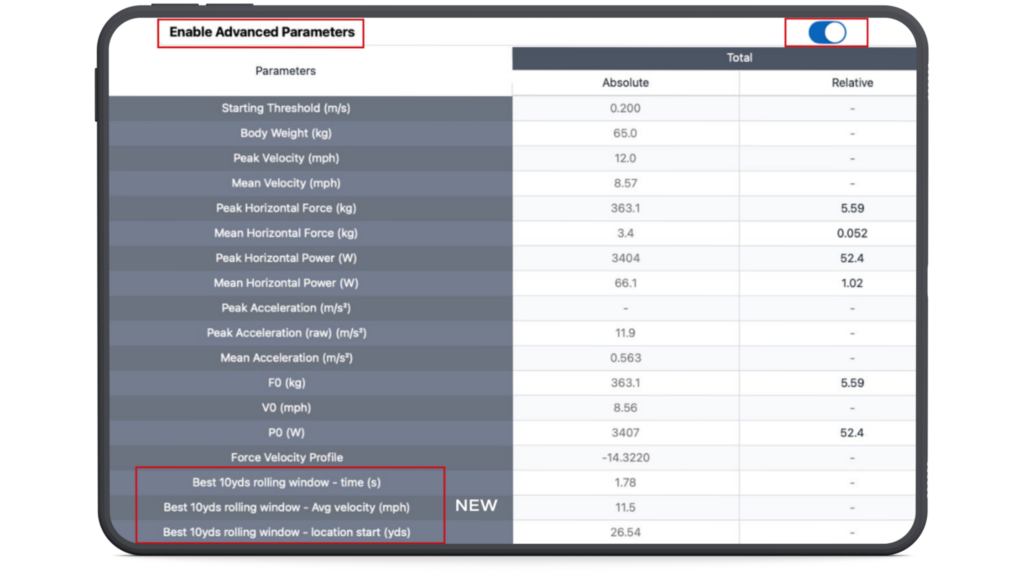
This approach allows practitioners to determine whether the athlete actually reaches maximum speed, reaches it too late, or shows a drop in speed toward the end of the effort.
Discover the K-Power Ebook
Go further in sprint analysis and understand how to apply these metrics in training and return-to-play decisions.

3- How to Analyze Key Results
Sprint protocols with K-Power provide several key indicators to assess acceleration, maximum speed, and horizontal force production.
Initial Acceleration
Acceleration is the ability to rapidly generate speed. Several metrics can be used to analyze this phase:
- Maximum acceleration (m/s²): ability to start quickly (essential in team sports).
- Average acceleration (m/s²): across the entire sprint.
- Maximum horizontal force (kg): a low value may indicate insufficient lower-limb force production.
Maximum Speed
- Maximum speed Vmax (m/s): the highest velocity reached.
- Distance to Vmax (m): if this distance is very long, it may indicate an inefficient acceleration phase.
Force–Velocity Profile
- F0: theoretical maximal horizontal force (acceleration focus).
- V0: theoretical maximal velocity (top-speed focus).
- P0: maximal horizontal power (global performance indicator).
4- FAQ: Sprint Testing and Performance
Why analyze sprint phases?
It helps identify how an athlete generates speed and where performance deficits may occur.
Why is the total sprint time not enough?
Total sprint time does not indicate when peak speed is reached or where speed decreases during the sprint.
In which sports is this analysis useful?
It is particularly valuable in football (soccer), rugby, basketball, and field sports where decisive actions occur within short distances.


