


In functional rehabilitation, muscle strength is commonly measured as part of the clinical evaluation. However, functional performance does not rely solely on muscular strength.
Standing up from a chair, for example, involves more than force production. It requires coordination, joint mobility, load transfer, and postural control.
This is why functional tests such as the Sit-to-Stand test have become essential tools for assessing autonomy, rehabilitation progress, and fall risk.
In this article, discover how the Sit-to-Stand test available in the Kinvent App allows clinicians to analyze functional strength, movement strategies, and asymmetries by combining force plates and the K-Move goniometer.
CONTENTS
1- Why Measuring Strength Alone Is Not Enough
2- Sit-to-Stand in the Kinvent App: Analyzing Strength and Movement
3- How to Interpret Key Metrics
4- FAQ: Sit-to-Stand and Functional Assessment
5- References
1- Why Measuring Strength Alone Is Not Enough
In rehabilitation, strength testing is often used to assess patient progress. Yet the ability to perform functional tasks depends on multiple biomechanical and neuromotor factors.
A patient may generate sufficient force while still presenting:
- joint mobility limitations
- limb asymmetries
- inefficient movement strategies
- unbalanced load transfer
- a persistent risk of falling
This is particularly relevant in several clinical situations:
- post-operative rehabilitation
- lower-limb rehabilitation
- functional autonomy assessments
- elderly populations
- fall prevention programs
For instance, in older adults, the ability to stand up from a chair is a major indicator of autonomy and fall risk. We discuss this in more detail in our article on elderly fall prevention.
To truly understand a patient’s functional ability, clinicians must analyze the entire movement, not just isolated strength.
2- Sit-to-Stand in the Kinvent App: Analyzing Strength and Movement
The Sit-to-Stand test is widely used to assess functional capacity and independence.
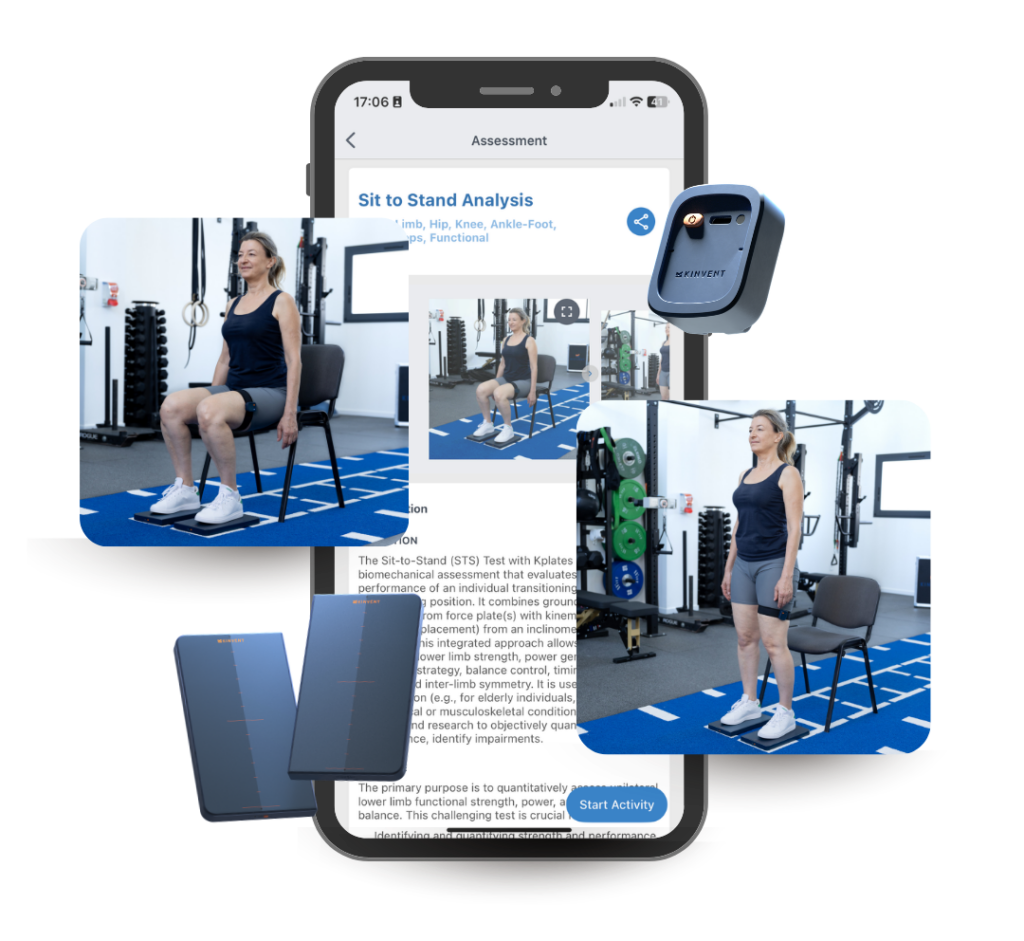
It helps evaluate:
- the ability to produce force to stand up
- movement coordination
- stability during load transfer
However, when assessed only visually, the analysis remains limited.
This is why the Kinvent ecosystem allows practitioners to instrument the test by combining the K-force plates and the K-Move goniometer.
This combination enables simultaneous analysis of:
- functional force production
- right/left symmetry
- compensatory movement strategies
- joint range of motion
This approach provides a comprehensive view of the movement.
Why Combine K-Force Plates and K-Move?
Force plates measure force production and load distribution, while the K-Move analyzes joint range of motion and movement strategy.
Together, they allow clinicians to:
- identify compensatory strategies
- detect functional asymmetries
- analyze joint mobility during movement
- monitor patient progress over time
All these metrics are automatically measured and analyzed within the Kinvent App.
Who Can Benefit From This Test?
The instrumented Sit-to-Stand test is particularly relevant for:
- elderly populations
- fall prevention programs
- functional rehabilitation
- autonomy monitoring
- post-operative rehabilitation
It is a simple yet powerful way to analyze overall functional capacity.
3- How to Interpret Key Metrics
The Sit-to-Stand analysis with Kinvent provides several indicators useful for clinical decision-making.
Vertical Force
Vertical force represents the patient’s ability to generate sufficient push to stand up.
It helps evaluate:
- overall functional strength
- efficiency of the movement
Low values may indicate:
- muscular weakness
- apprehension during movement
- global functional deficit.
Right/Left Symmetry
Symmetry analysis helps detect load transfer imbalances between limbs.
Persistent asymmetry may indicate:
- compensatory strategies
- post-operative deficits
- incomplete recovery of one limb
Symmetry is therefore a key indicator during rehabilitation monitoring.
Joint Range of Motion (Hip and Knee)
Using the K-Move sensor, clinicians can analyze joint range of motion during the movement.
A limitation may reveal:
- restricted mobility
- joint stiffness
- protective movement strategies
Excessive motion may indicate compensation.
Movement Strategy
Movement analysis helps identify key compensations such as:
- excessive trunk flexion
- center-of-mass displacement
- asymmetric load transfer
These insights help clinicians understand how the movement is performed, not just whether it is completed.
4- FAQ: Sit-to-Stand and Functional Assessment
What is the Sit-to-Stand test?
The Sit-to-Stand test is a functional assessment that consists of standing up from a seated position on a chair. It evaluates lower-limb functional strength, movement coordination, and the ability to transfer body weight.
When analyzed with instrumented tools such as K-force plates and the K-Move, it can also measure:
- force production during the movement
- right/left symmetry
- joint range of motion
- movement strategies
This test is widely used to assess functional independence, rehabilitation progress, and fall risk.
Why use the Sit-to-Stand test?
The Sit-to-Stand test is a simple way to assess functional strength, independence, and movement coordination.
When should this test be used?
The Sit-to-Stand test is particularly useful for:
- functional rehabilitation
- fall prevention
- elderly patients
- post-operative recovery
5- References
- Schlenstedt, C., B , M., Bauknecht, H. C., & Weisser, B. (2017). The five-repetition sit-to-stand test: evaluation of a new functional capacity test in different age groups. Journal of Human Kinetics, 58, 91–98.
- Janssen, W. G., Bussmann, J. B., & Stam, H. J. (2002). Determinants of the sit-to-stand movement: a review. Physical Therapy, 82(9), 866-879.
- Zijlstra, W., & Hof, A. L. (2003). Assessment of spatio-temporal parameters from trunk accelerations during human walking. Gait & Posture, 18(2), 1-10. (Principles of using inertial sensors for kinematics).
- Millington, P. J., Myklebust, B. R., & Shambes, G. M. (1992). Biomechanical analysis of the sit-to-stand motion in elderly persons. Archives of Physical Medicine and Rehabilitation, 73(7), 609-617.
- Ganea, R., Paraschiv-Ionescu, A., Büla, C., Rochat, S., & Aminian, K. (2011). Multi-parametric evaluation of sit-to-stand and stand-to-sit transitions in healthy elderly and patients with Parkinson’s disease. Gait & Posture, 34(1), 121-126.


