


Single-leg balance is a key indicator in rehabilitation and sports performance. After an ankle sprain, knee injury, or during return-to-sport rehabilitation, the ability to stabilize the body on one leg reflects the true functional capacity of the lower limb.
But is simply standing on one leg enough?
Today, assessing single-leg balance goes beyond a static test. It should also evaluate load capacity, force production, and neuromuscular reactivity.
In this article, discover the new single-leg tests available in the Kinvent App and how they help objectively assess stability, asymmetries, and readiness to return to sport.
CONTENTS
1- Why Single-Leg Analysis Has Become Essential
2- New Single-Leg Tests in the Kinvent App
3- How to Analyze Key Metrics
4- FAQ: Single-Leg Balance and Lower-Limb Testing
5- References
1- Why Single-Leg Balance Analysis Has Become Essential
In both sports and daily life, most movements rely on single-leg support phases: walking, running, cutting, jumping, and landing.
After a lower-limb injury, several deficits may persist:
- reduced load-bearing capacity
- decreased stability
- delayed neuromuscular response
- right/left asymmetries
- compensatory movement strategies
The classic single-leg balance test (eyes open or closed) is still useful, but it does not assess:
- impact tolerance
- explosive force production
- lower-limb reactivity
- stretch-shortening cycle efficiency
A patient may hold a single-leg stance for 30 seconds on each leg but still not be ready to return to sport.
This is why modern single-leg assessment must integrate dynamic and instrumented tests.
Instrumented analysis using force plates, such as those available in the Kinvent ecosystem, allows clinicians and coaches to objectively measure stability, load, and reactivity while identifying deficits that may not be visible to the naked eye.

2- New Single-Leg Tests in the Kinvent App
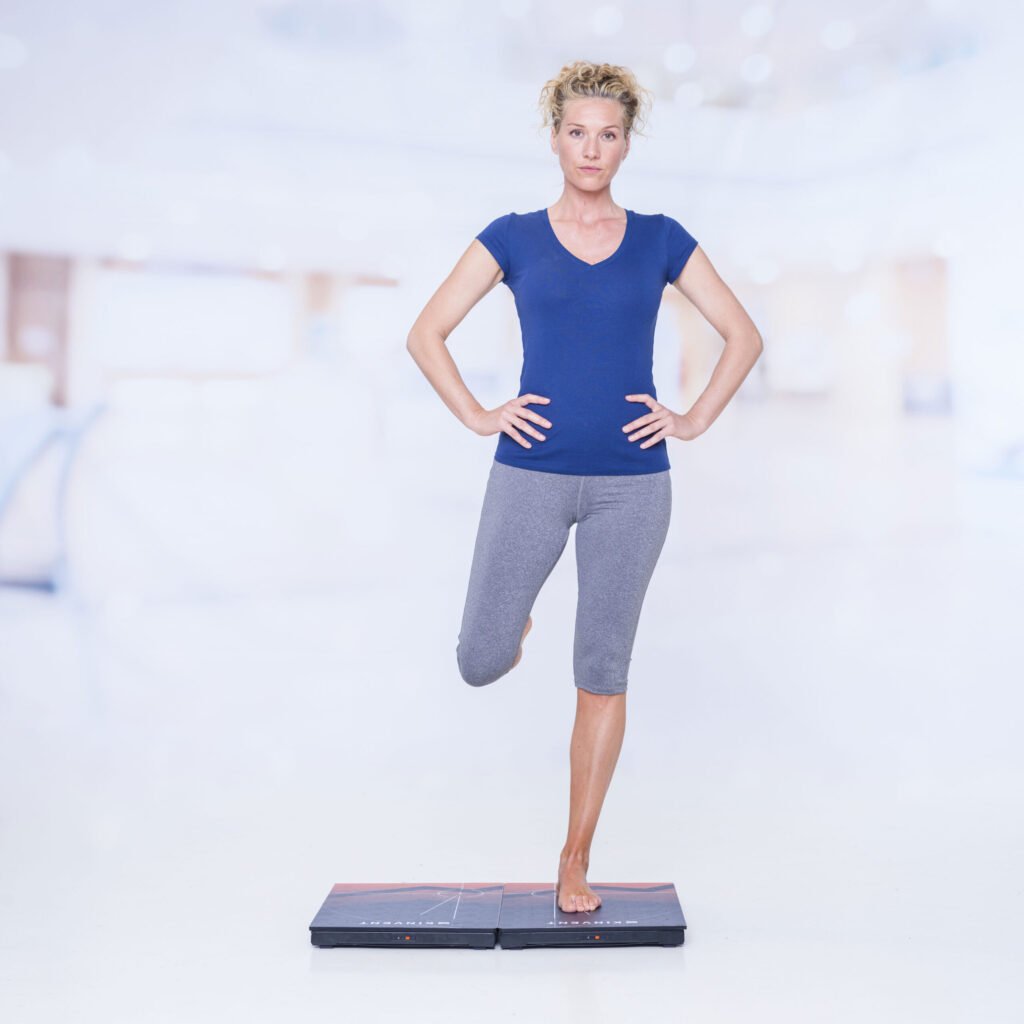
The Kinvent ecosystem already allows practitioners to evaluate single-leg balance and force through several protocols:
- Static single-leg balance
- Single Leg Squat Jump
- Single Leg Countermovement Jump (CMJ)
- Single Leg Drop Jump
These protocols provide a solid foundation to analyze stability and force production in each limb.
Now, new tests have been added to further enhance this analysis.
🆕 10/5 Single-Leg Repetitive Jump Test
This repeated single-leg jump test evaluates reactive strength and lower-limb stiffness. It analyzes:
- the ability to perform rapid consecutive rebounds
- neuromuscular reactivity
- impact management
- symmetry between limbs
This test is particularly relevant:
- after ankle sprains
- following Achilles tendon injuries
- during return-to-running phases
- before returning to explosive sports
It helps quantify something a static balance test cannot reveal: the lower limb’s real capacity to absorb and release elastic energy.
🆕 Multiple Single-Leg Jumps
Multiple single-leg jump protocols assess performance and stability across repeated efforts.
They provide valuable insights into:
- jump consistency
- landing stability
- neuromuscular coordination
- fatigue and loss of control
These tests are particularly useful for:
- late-stage rehabilitation
- monitoring functional progression
- return-to-sport preparation
- performance optimization
Why Integrate These New Tests Into Your Practice?
Combining static balance tests with dynamic single-leg jumps allows practitioners to:
- detect deficits invisible during visual observation
- accurately compare the right and left limbs
- objectively monitor progress over time
- adapt rehabilitation and training programs
- support safer return-to-sport decisions
With the Kinvent App and force plates, all these metrics are automatically measured, analyzed, and tracked longitudinally.
3- How to Analyze Key Metrics
Dynamic single-leg tests provide critical indicators for clinical decision-making and performance monitoring.
Here are the main metrics to analyze.
Reactive Strength Index (RSI)
The Reactive Strength Index (RSI) is calculated using:
- jump height
- ground contact time
It reflects the lower limb’s ability to produce force quickly.
Key points for interpretation:
- compare right vs left limb
- monitor asymmetries greater than 10–15%
- track progress across rehabilitation sessions
High RSI → good reactivity
Low RSI → deficit in stiffness or force production
Ground Contact Time (GCT)
Ground contact time measures the duration the foot stays on the ground between jumps.
- Short contact time → strong elastic capacity
- Long contact time → reduced reactivity or apprehension
A progressive reduction in GCT during rehabilitation is usually a positive sign of neuromuscular recovery.
Jump Height
Jump height reflects the limb’s ability to generate vertical force.
Combined interpretation with GCT:
- High jump + short GCT → optimal explosive profile
- High jump + long GCT → powerful but less reactive
- Low jump + short GCT → reactive but lacking force
- Low jump + long GCT → overall performance deficit
Limb Asymmetry
Limb asymmetry is a key indicator in single-leg assessment.
Practical thresholds:
- <10% → generally acceptable
- 10–15% → monitor closely
- 15% → significant deficit
Reducing asymmetries is often a primary objective before returning to sport.
Variability and Consistency
Beyond average values, analyzing the consistency of repeated jumps can reveal deeper insights.
Practitioners should observe:
- consistency of jump height
- stability of ground contact time
- performance drop-off during the test
Interpretation:
- consistent jumps → good motor control
- high variability → coordination deficit
- progressive decline → fatigue or reduced reactive endurance
Variability often provides more insight than average values alone.
4- FAQ: Single-Leg Balance and Lower-Limb Testing
How long should someone hold a single-leg balance?
A healthy adult should typically maintain a single-leg stance for:
- around 30 seconds with eyes open
- about 10–15 seconds with eyes closed
However, maintaining balance alone does not guarantee readiness to return to sport. Dynamic strength and reactivity must also be evaluated.
Why test single-leg balance in rehabilitation?
Single-leg assessment helps objectively detect:
- limb asymmetries
- stability deficits
- delayed neuromuscular response
- compensatory strategies
- reduced load capacity
These insights help clinicians tailor rehabilitation programs and reduce the risk of reinjury.
What are the best single-leg balance tests?
Commonly used tests include:
- single-leg stance test
- Star Excursion Balance Test
- Y-Balance Test
- single-leg jumps
- single-leg drop jumps
- repeated single-leg jump tests
Dynamic and instrumented tests provide the most detailed assessment of lower-limb function.
5- References
- Young, W. (1995). Laboratory strength assessment of athletes. New Study Athletics. 10, pp.88–96
- Lloyd, R.S., Oliver, J.L., Hughes, M.G., Williams, C.A. (2009). Reliability and validity of field-based measures of leg stiffness and reactive strength index in youths. Journal of Sports Sciences. 27(14), pp.1565-1573.
- Markwick WJ, Bird SP, Tufano JJ, Seitz LB, Haff GG. The intraday reliability of the Reactive Strength Index calculated from a drop jump in professional men’s basketball. Int J Sports Physiol Perform. 2015 May;10(4):482-8.
- McClymont, D. (2003). Use of the reactive strength index (RSI) as an indicator of plyometric training conditions. In: Proceedings of the 5th World Conference on Science and Football. pp. 408–416.
- Flanagan, E.P., & Comyns, T.M. (2008). The use of the reactive strength index as an indicator of plyometric performance. Strength & Conditioning Journal, 30(4), 32-38.
- Hamilton, D., 2009. Drop jumps as an indicator of neuromuscular fatigue and recovery in elite youth soccer athletes following tournament match play. Journal of Australian Strength and Conditioning, 17(4)
- Ebben WP, Petushek EJ. Using the reactive strength index modified to evaluate plyometric performance. J Strength Cond Res. 2010 Aug; 24(8):1983-7. doi: 10.1519/JSC.0b013e3181e72466. PMID: 20634740.
- Flanagan, E. P., & Comyns, T. M. (2008). The use of contact time and the reactive strength index to optimize fast stretch-shortening cycle training. Strength and Conditioning Journal, 30(5), 32-38.
- Markwick, W. J., Bird, S. P., Tufano, J. J., Seitz, L. B., & Haff, G. G. (2015). The intraday reliability of the reactive strength index calculated from a drop jump in professional men’s basketball. International Journal of Sports Physiology and Performance, 10(4), 482-488.
- Young, W. B., Pryor, J. F., & Wilson, G. J. (1995). Effect of instructions on characteristics of countermovement and drop jump performance. Journal of Strength and Conditioning Research, 9(4), 232-236.


