


The 5-0-5 agility test is a widely used change-of-direction test in sports performance, rehabilitation, and athlete monitoring. It evaluates an athlete’s ability to decelerate, perform a 180° turn, and accelerate again.
However, analyzing total time alone is often not enough to fully understand movement quality.
In this article, discover how the 5-0-5 agility test with K-Power allows you to objectively assess deceleration, entry speed, exit speed, and the quality of re-acceleration.
CONTENTS
1- Why the 5-0-5 Agility Test Is More Than Just a Stopwatch
2- 5-0-5 Agility Test with K-Power: Analyze Every Phase of Change of Direction
3- How to Interpret 5-0-5 Agility Test Metrics
4- FAQ: 5-0-5 Agility Test
1- Why the 5-0-5 Agility Test Is More Than Just a Stopwatch
In many sports, performance does not rely only on linear speed. Football, rugby, basketball, tennis, and field sports require repeated abilities to decelerate, change direction, and accelerate again.
The 5-0-5 agility test is particularly relevant because it focuses on this key transition between:
- approach speed
- deceleration
- change of direction
- re-acceleration
It is commonly used to evaluate:
- movement control
- footwork quality
- ability to absorb speed
- efficiency during directional changes
- potential asymmetries between sides
For physical therapists, this test is especially useful in the final stages of lower-limb rehabilitation, when reintroducing sport-specific demands.
For strength and conditioning professionals, it provides valuable insights into key performance qualities such as deceleration, control, reactivity, and mechanical efficiency.
However, when the test is only assessed using a stopwatch, it remains limited. Two athletes may achieve similar times with very different movement strategies: one may enter the turn at high speed, brake efficiently, and accelerate quickly, while another may adopt a more cautious approach.
This is why the 5-0-5 agility test becomes truly valuable when each phase of the movement is analyzed, not just the final time.
2- 5-0-5 Agility Test with K-Power: Analyze Every Phase of Change of Direction
🆕 New: The 5-0-5 agility test available with K-Power
With K-Power, the 5-0-5 agility test becomes a simple, fast, and objective assessment tool.
The protocol remains practical and field-based:
- acceleration phase
- crossing the 10 m timing gate (start)
- running to the 15 m line
- performing a 180° turn
- returning to the 10 m line
Once completed, the Kinvent App provides immediate access to key performance metrics.
The major advantage of K-Power is that it goes beyond total time. Instead of relying only on a stopwatch, practitioners can now understand how the movement is performed.
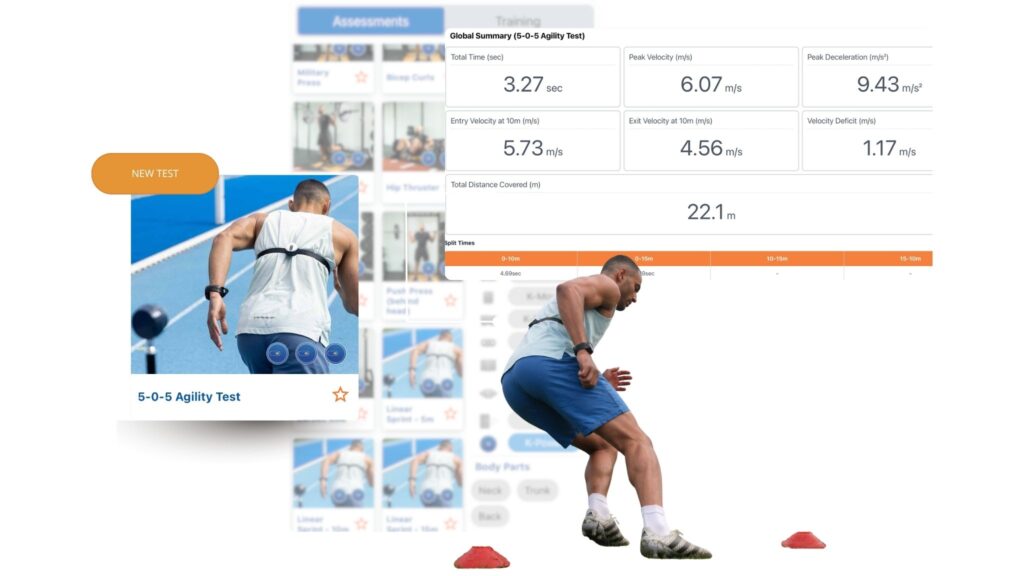
What changes with K-Power?
With these new insights, practitioners can answer key performance questions:
- Does the athlete approach the turn at high speed?
- Are they able to decelerate efficiently?
- How much speed is lost during the turn?
- Can they re-accelerate quickly after the change of direction?
This provides a much more objective and actionable analysis than visual observation alone.
Key metrics of the 5-0-5 agility test
The Kinvent App provides several key indicators:
- 5-0-5 Total Time (s)
→ overall performance - Entry Speed (m/s)
→ speed at the 10 m line - Exit Speed (m/s)
→ speed after the change of direction - Max Deceleration (m/s²)
→ ability to brake effectively before the turn
These metrics allow practitioners to analyze the entire movement sequence, not just the outcome.
A more precise and actionable analysis
With K-Power, the 5-0-5 agility test becomes a powerful decision-making tool.
It allows practitioners to:
- track performance over time
- identify braking or re-acceleration deficits
- compare athlete profiles
- detect asymmetries
- support return-to-sport decisions
The 5-0-5 agility test with K-Power helps you better understand how athletes decelerate, turn, and re-accelerate, leading to more precise and meaningful analysis.
3- How to Interpret 5-0-5 Agility Test Metrics
Performing a 5-0-5 agility test is not enough; its real value comes from how the data is interpreted. The goal is to understand how the athlete decelerates, changes direction, and re-accelerates.
Total Time (5-0-5)
Total time is the duration from entering to exiting the timed zone.
It provides an overall view of performance.
A lower time generally indicates a more efficient change of direction.
However, this metric should not be analyzed in isolation. Two athletes can achieve similar times using very different movement strategies.
👉 How to analyze:
- track progress over time
- compare between athletes or between sides
Entry Speed
Entry speed is the speed measured at the 10 m line, just before the turn.
It is essential to understand the context of the movement.
👉 Interpretation:
- high entry speed → requires greater braking capacity
- low entry speed → more cautious approach
This metric helps distinguish between a strong performance achieved at high speed versus one performed with a conservative strategy.
Exit Speed
Exit speed reflects how well the athlete accelerates after the change of direction.
It is a key indicator of re-acceleration ability.
👉 Interpretation:
- high exit speed → efficient re-acceleration
- low exit speed → difficulty producing force after the turn
Peak Exit Acceleration
Peak Exit Acceleration allows for an even deeper analysis of change-of-direction performance. This metric reflects the athlete’s ability to rapidly reapply force immediately after the change of direction.
👉 Interpretation:
- high peak exit acceleration → explosive and efficient re-acceleration
- low peak exit acceleration → difficulty accelerating quickly after the turn
This is particularly valuable in sports where rapid re-acceleration is a key performance factor.
Max Deceleration
Max deceleration is a key metric to evaluate braking capacity.
It measures how effectively the athlete can absorb speed before changing direction.
👉 Interpretation:
- high deceleration → strong braking ability
- low deceleration → difficulty controlling speed
Peak brake proximity provides an additional layer of insight into change-of-direction performance. This metric shows when and how close to the pivot point the athlete reaches maximal braking.
👉 Interpretation:
- peak braking reached far from the pivot → a more anticipatory, often more cautious approach
- peak braking reached close to the pivot → the ability to maintain speed longer before applying strong braking
This metric is often difficult to assess visually, yet it is highly valuable in both performance analysis and return-to-sport decision-making.
Combined Analysis
The real value comes from combining these metrics.
👉 Examples:
- High entry speed + low exit speed
→ The athlete approaches the change of direction at high speed but struggles to brake and re-accelerate efficiently. This may indicate reduced control entering the turn or difficulty reapplying force after the pivot. - Good deceleration + low exit speed
→ The athlete can brake effectively but lacks the power or explosiveness needed to accelerate quickly after the change of direction. - Good exit speed + low Peak Exit Acceleration
→ The athlete exits the change of direction at a reasonable speed but lacks explosiveness in the first steps of re-acceleration. The restart is effective, but not particularly aggressive. - Good deceleration + late Peak Brake Proximity + high Peak Exit Acceleration
→ The athlete is able to maintain speed longer, apply strong braking close to the pivot point, and then re-accelerate explosively. This is a highly valuable profile in sports where late braking and aggressive re-acceleration create a competitive advantage. - Low entry speed + good total time
→ The athlete is likely using a more cautious strategy, approaching the turn conservatively. The overall result may appear good, but it does not necessarily reflect the ability to perform an aggressive high-intensity change of direction.
Asymmetry Analysis
The 5-0-5 agility test can be performed turning on both sides, allowing for asymmetry analysis.
👉 Key insights:
- speed differences → performance imbalance
- deceleration differences → control deficit
- progression over time → recovery monitoring
4- FAQ: 5-0-5 Agility Test
What is the 5-0-5 agility test?
The 5-0-5 agility test is a change of direction test where an athlete sprints, decelerates, performs a 180° turn, and accelerates back. It is used to assess braking ability, directional control, and re-acceleration.
What does the 5-0-5 agility test measure?
The 5-0-5 agility test evaluates several key performance components:
- entry speed
- deceleration capacity
- change of direction efficiency
- exit speed
With K-Power, these metrics are measured objectively and in real time.
Why is the 5-0-5 agility test important?
This test is essential in sports that require rapid changes of direction, such as football, basketball, rugby, and tennis.
It helps practitioners:
- assess movement control
- evaluate braking ability
- monitor return-to-sport readiness
- identify performance asymmetries
How do you interpret 5-0-5 agility test results?
Interpreting the 5-0-5 agility test requires combining multiple metrics:
- total time → overall performance
- entry speed → context of the test
- max deceleration → braking capacity
- exit speed → re-acceleration ability
Analyzing these together provides a more complete understanding of performance.


