


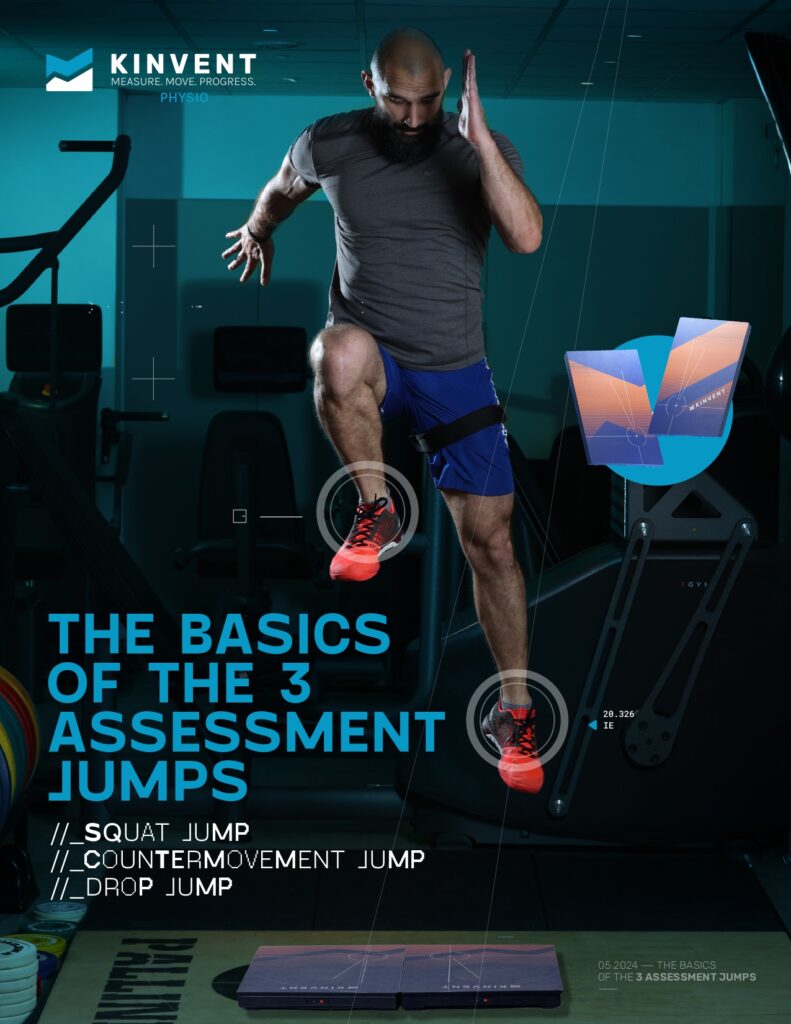
Master the 3 Assessment Jumps for Explosive Power
The Squat Jump (SJ), Countermovement Jump (CMJ), and Drop Jump (DJ) are the pillars of performance assessment in sports science. These 3 assessment jumps are non-negotiable benchmarks for measuring an athlete’s lower body strength, explosive power, and plyometric ability. While the SJ measures pure concentric power, the CMJ assesses the efficiency of the stretch-shortening cycle (SSC), and the DJ evaluates reactive strength. Mastering these three tests is essential for designing targeted training programs that enhance performance and mitigate injury risk.
This free ebook, “The Basics of the 3 Assessment Jumps” provides the concise yet authoritative guide needed to implement these tests using the gold-standard force plate jump test methodology. Download it now to gain practical, step-by-step procedures, understand the underlying biomechanics, and apply key metrics to accurately profile any athlete.
What You’ll Learn in This Ebook
🚀 Squat Jump (SJ): Pure concentric power
The SJ isolates the concentric phase, making it a pure measure of lower-body explosive power without the benefit of the stretch-shortening cycle (SSC). Learn the rigorous procedure to avoid the common mistake of an unintentional countermovement, which can invalidate the test results.
💪 Countermovement Jump (CMJ): SSC efficiency
The CMJ exploits the SSC, utilizing a rapid pre-stretch to generate a stronger concentric action. Discover why it is the most consistent indicator of lower-body power and the critical metrics for assessment, including concentric peak power.
⚡ Drop Jump (DJ): Reactive strength
The DJ is a plyometric test designed to improve reactive strength and SSC efficiency by minimizing ground contact time. Understand the crucial role of the Reactive Strength Index (RSI), calculated as Jump Height divided by Ground Contact Time (GCT), and the challenges of accurate jump height calculation in this test.
📊 Standardized protocols and key metrics
For all 3 assessment jumps, the eBook details the force plate jump test requirements and best practices, from warm-up to equipment. You will learn to assess performance using key metrics like jump height, peak force, peak power, and Rate of Force Development (RFD), which are crucial for diagnostics and tracking long-term training adaptations.
Why Download This Ebook?
This guide is an essential resource for strength coaches, physical therapists, and sports scientists:
✅ Implement the gold standard: Master the protocols for the three most critical force plate jump test assessments.
✅ Target training gaps: Differentiate between pure strength (SJ), elastic energy use (CMJ), and plyometric ability (DJ) to customize interventions.
✅ Quantify explosiveness: Use objective metrics like RSI, RFD, and Peak Power to accurately measure and track explosive potential.
Download your free copy of “The Basics of the 3 Assessment Jumps” and gain the foundational knowledge to measure and progress with precision.
Want to Learn More?
About K-Deltas
The K-Deltas are Kinvent’s force plates. Recognized for their superior accuracy, they are the ideal tool for all 3 assessment jumps. K-Deltas allow for gold-standard measurement of peak force, RFD, and impulse, providing the in-depth data necessary to precisely evaluate lower body strength, SSC efficiency, and plyometric ability.
About Kinvent
Present in over 70 countries, Kinvent supports sports and health professionals in assessment and tracking progress. Kinvent empowers clinicians to move from intuition to objective data, ensuring evidence-based decisions through precision.


