


Velocity-based training (VBT) is a training method that uses movement velocity to guide training intensity and load selection in strength training and physical preparation. Unlike traditional approaches based on fixed percentages of one-repetition maximum (1RM), velocity-based training adapts to the athlete’s actual daily readiness, taking into account fatigue, recovery, and neuromuscular status.
Made possible by recent advances in velocity measurement technology, VBT provides a more objective, individualized, and effective approach to developing strength, power, and explosiveness, while improving fatigue management and overall training quality. By focusing on how fast a load is moved rather than how heavy it is, velocity-based training offers a more accurate representation of the athlete’s true effort.
In this article, we explain what velocity-based training is, how it works, how it differs from traditional strength training methods, and how to apply VBT in practice to optimize performance.
CONTENTS
1- What Is Velocity-Based Training (VBT)?
2- Traditional Training vs Velocity-Based Training: What’s the Difference?
3- The Fundamental Principles of Velocity-Based Training
4- How Does VBT Work in Strength Training?
5- Practical Examples of VBT Application
6- FAQ: Everything You Need to Know About Velocity-Based Training
7- Conclusion
8- References
1- What Is Velocity-Based Training (VBT)?
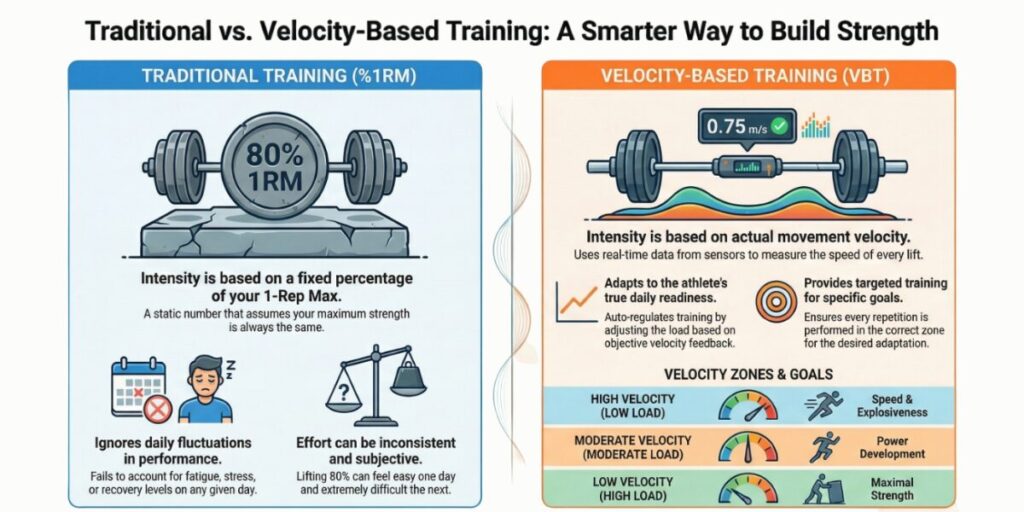
Velocity-based training (VBT) is a training method that uses the speed at which a load is moved to determine and adjust training intensity. Instead of prescribing loads based solely on a fixed percentage of one-repetition maximum (1RM), coaches rely on the actual movement velocity of each repetition to guide training decisions.
This approach is built on a fundamental principle: movement velocity is directly linked to the athlete’s neuromuscular state. For the same external load, a decrease in velocity typically reflects increased fatigue or suboptimal readiness, whereas higher velocities indicate greater neuromuscular availability. As a result, VBT provides an objective and immediate measure of true training effort, which is often more representative than load alone.
In practice, velocity-based training involves:
- measuring barbell or load velocity on every repetition,
- associating specific velocity zones with distinct training goals (maximal strength, power, strength-speed, explosiveness),
- adjusting load, volume, or set termination based on the measured velocity.
By doing so, VBT transforms training intensity from a static percentage-based prescription into a dynamic, effort-based metric, allowing for greater individualization and more consistent training quality across sessions.

📕 To go deeper into velocity-based training, understand the force-velocity relationship, and explore practical applications in strength training and sprinting, the free ebook K-Power Hybrid Sprint & VBT Sensor provides a comprehensive, science-based, and field-oriented approach. You will find concrete case studies, actionable velocity zones, and practical guidelines to help you integrate VBT effectively into daily training practice.
2- Traditional Training vs Velocity-Based Training: What’s the Difference?
For decades, strength training has primarily relied on load prescriptions expressed as a percentage of one-repetition maximum (1RM) to define training intensity. While this approach has shaped modern strength and conditioning, it also presents several limitations that velocity-based training (VBT) is designed to overcome.
The limitations of percentage-based training
Traditional programming assumes that a given percentage of 1RM always represents the same level of effort. In reality, however, an athlete’s strength can fluctuate daily due to fatigue, stress, training volume, and recovery status. As a result, lifting 80% of 1RM can feel, and actually be, very different from one session to the next.
Moreover, two athletes lifting the same absolute load may produce very different movement velocities, reflecting unequal levels of neuromuscular engagement. In this context, load alone does not accurately represent true training intensity or stimulus quality.
What velocity-based training changes in practice
Velocity-based training introduces a more precise and responsive approach to load management. By measuring movement velocity on every repetition, VBT allows coaches to:
- assess actual effort rather than theoretical intensity,
- adjust loads in real time based on daily readiness,
- monitor fatigue through velocity loss,
- ensure training occurs within the appropriate intensity zone for the targeted adaptation.
While traditional training imposes a predefined load, VBT relies on objective, real-time data to autoregulate intensity and volume. This results in higher-quality repetitions, improved fatigue management, and greater overall training efficiency.
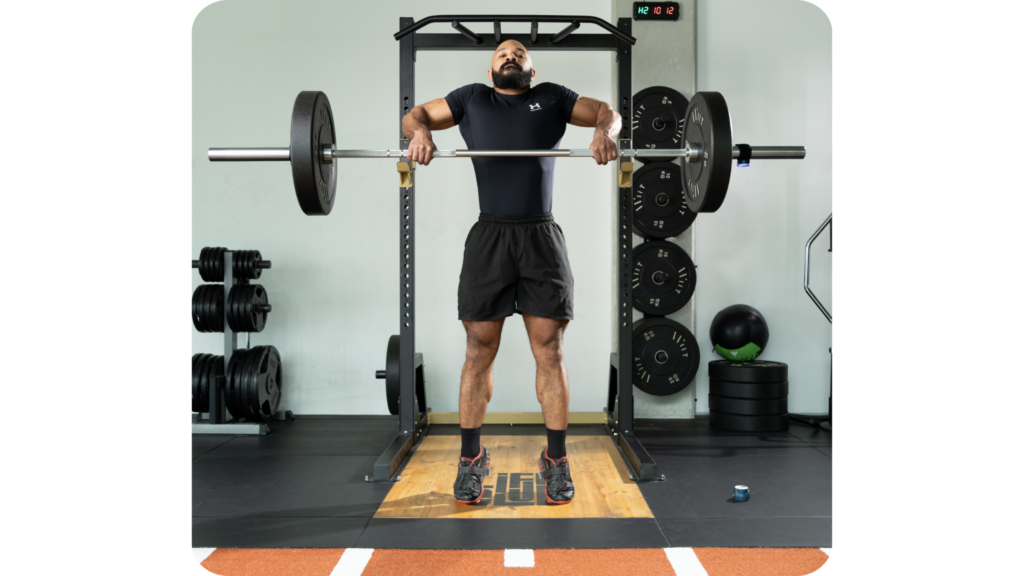
To make this approach truly applicable in the field, velocity-based training relies on technologies capable of accurately measuring movement velocity. Dedicated sensors allow practitioners to objectively quantify effort on every repetition and move beyond prescriptions based solely on load.
💡 In this context, solutions such as the K-Power sensor from Kinvent, built on advanced measurement technology, make VBT accessible and practical for daily use in both strength training and broader physical preparation.
3- The Fundamental Principles of Velocity-Based Training
Velocity-based training is built on simple yet powerful principles derived from the mechanical relationship between force, velocity, and neuromuscular performance. By measuring movement velocity, VBT allows training to be structured in a more precise and goal-oriented manner.
The load-velocity relationship at the core of VBT
In any strength training exercise, there is an inverse relationship between the load being lifted and movement velocity: as load increases, execution velocity decreases. This fundamental relationship forms the basis of velocity-based training.
VBT leverages this connection to estimate the true intensity of effort. For a given load, a reduction in velocity indicates increasing fatigue or reduced neuromuscular capacity, while higher velocities reflect greater readiness. Movement velocity, therefore, becomes a direct and sensitive indicator of the athlete’s neuromuscular state, far more informative than load alone.
The force-velocity continuum and velocity zones
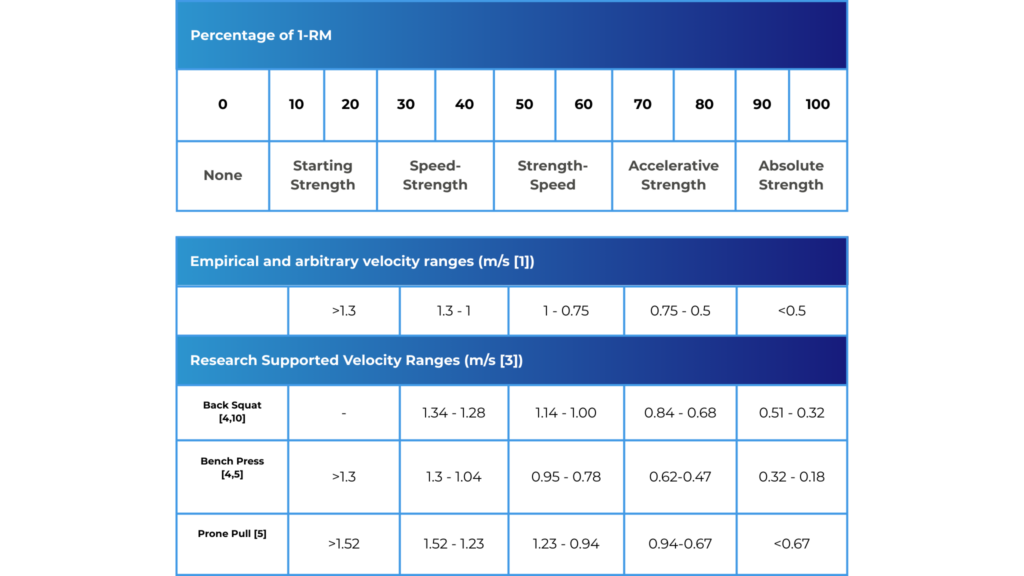
Velocity-based training fits within the force-velocity continuum, which describes how different physical qualities are developed depending on execution speed. Each velocity zone corresponds to a specific training objective:
- Low velocity – high load: maximal strength development
- Moderate velocity – moderate load: power development
- High velocity – low load: strength–speed and explosiveness
By associating specific velocity zones with each exercise, VBT ensures that the athlete is truly working within the zone that matches the intended adaptation, rather than relying on approximate estimates based on 1RM percentages.
Intensity based on actual effort
One of the key principles of velocity-based training is the transformation of training intensity into a dynamic, real-time metric. Training is no longer dictated solely by a predefined load, but by the athlete’s ability to move that load at a target velocity, ensuring a consistent and controlled neuromuscular stimulus throughout the session.
4- How Does VBT Work in Strength Training?
Velocity-based training relies on a simple yet powerful metric: the speed of movement on every repetition. This data allows coaches to adjust training variables in real time to ensure the right stimulus is delivered, session after session, regardless of daily fluctuations in performance.
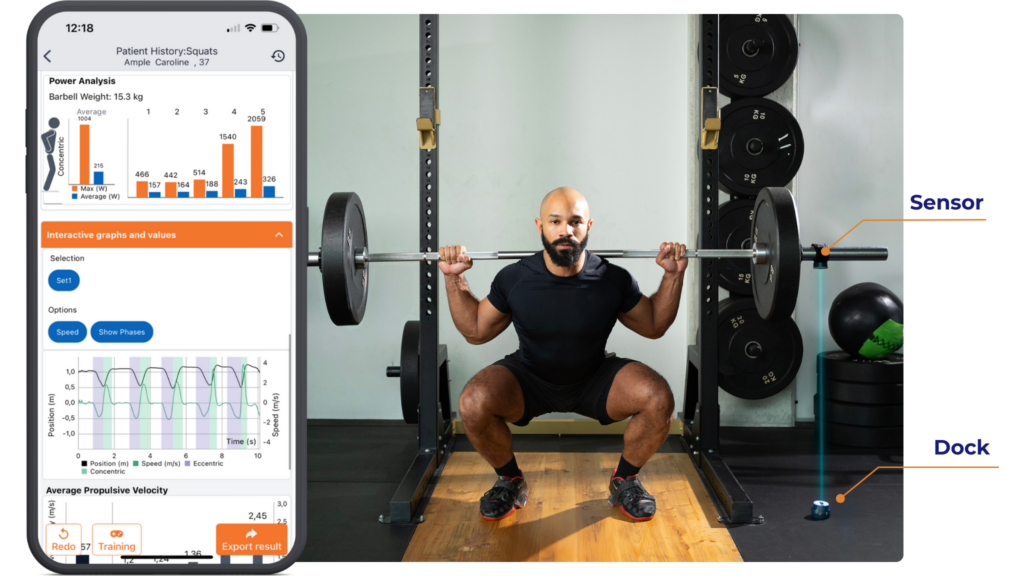
In practice, movement velocity is measured on each repetition using a sensor attached to the barbell or the load. This provides instant feedback, far more informative than load alone, and makes it possible to adapt the session to the athlete’s actual readiness. Tools such as the K-Power sensor from Kinvent make this approach directly applicable in the weight room by delivering reliable, real-time data.
Measuring movement velocity on every repetition
In VBT, barbell or load velocity is measured on every repetition using a dedicated sensor. This makes it possible to observe how force is produced during each effort. From the warm-up onward, velocity offers an objective indication of daily readiness, helping coaches prescribe appropriate loads before the main working sets begin.
Depending on the exercise and training objective, different velocity metrics can be used (mean velocity, peak velocity, or propulsive velocity). Regardless of the metric selected, the principle remains the same: control intensity through velocity rather than load, ensuring a consistent neuromuscular stimulus.
Adjusting load and volume in real time
One of the major advantages of velocity-based training is auto-regulation. When measured velocity drops below the target zone, it signals increasing fatigue or reduced readiness. Coaches can then:
- reduce the load,
- limit the number of repetitions,
- or stop the set altogether.
Conversely, when velocity remains stable or higher than expected, the load can be maintained or even increased to preserve the intended intensity. This approach allows training to adapt to daily readiness while maintaining high-quality repetitions and respecting the session’s objective.
Monitoring fatigue through velocity loss
VBT also enables practitioners to track velocity loss within and between sets. A progressive decrease in velocity is a reliable indicator of acute fatigue. By defining a velocity loss threshold, coaches can control training volume, prevent excessive fatigue, and preserve movement quality rather than relying on arbitrary repetition counts.
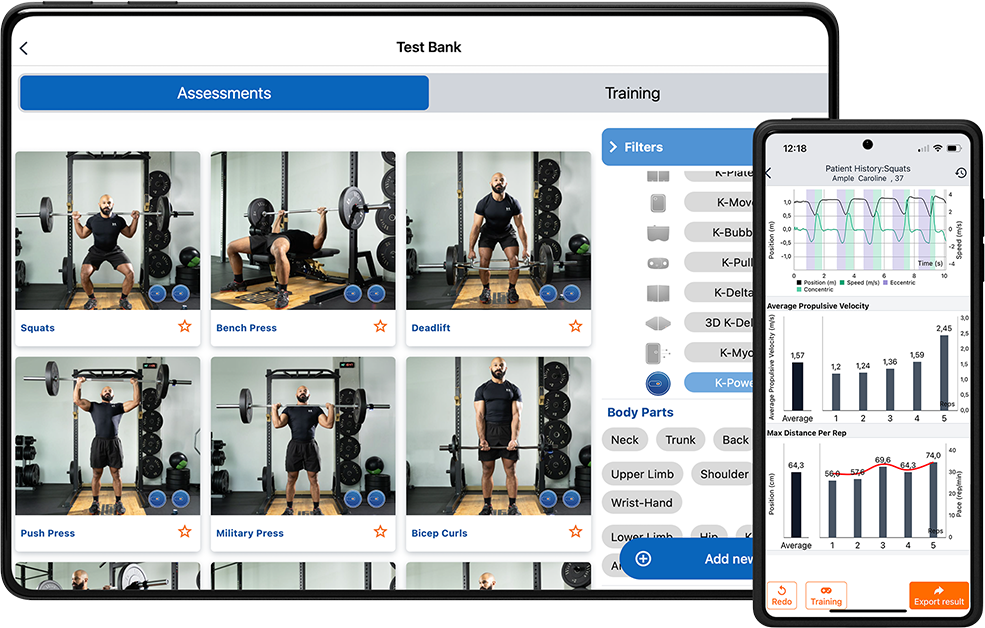
By using the K-Power sensor from Kinvent, strength training sessions become more precise, responsive, and effective.
- Load prescription is based on actual movement velocity, not just theoretical percentages of 1RM.
- Real-time velocity feedback highlights fatigue as soon as it appears, supports informed volume adjustments, and increases athlete engagement.
- In addition, automatic data storage facilitates post-session analysis, long-term monitoring, and more informed training planning.
5- Practical Examples of VBT Application
One of the main strengths of velocity-based training is how easily it can be applied in real training environments. By using movement velocity as a guiding variable, coaches can manage strength training sessions in a precise, responsive, and individualized way.
Example of VBT application in the squat
During a session focused on strength-speed or power development, the objective may be to maintain movement velocity within a predefined target zone. After the warm-up, the velocities recorded during the first working sets provide immediate insight into the athlete’s readiness for the day.
As long as movement velocity remains within the target range, the load is maintained. However, a progressive decrease in velocity across repetitions indicates the onset of fatigue. Rather than completing a predetermined number of repetitions, the set can be stopped as soon as velocity drops below the defined threshold, ensuring that execution quality and neuromuscular stimulus are preserved.
Auto-regulation and repetition quality
This example highlights one of the key principles of velocity-based training: volume auto-regulation based on objective data. Training decisions are driven by measured velocity rather than subjective sensations or fixed loading schemes.
This approach makes it possible to:
- limit excessive fatigue,
- preserve technical execution,
- maintain consistent work within the intended intensity zone,
- and maximize transfer to athletic performance.
6- FAQ: Everything You Need to Know About Velocity-Based Training
What is velocity-based training (VBT)?
Velocity-based training is a training method that uses movement velocity to determine training intensity. By measuring velocity on every repetition, VBT allows load and volume to be adjusted in real time based on the athlete’s neuromuscular state.
What is the difference between VBT and 1RM-based training?
Traditional strength training relies on fixed percentages of 1RM, whereas VBT is based on actual movement velocity. This approach accounts for daily fluctuations in strength and enables more precise auto-regulation of both intensity and fatigue.
Is velocity-based training only for elite athletes?
No. Although widely used in high-performance settings, velocity-based training is relevant for athletes and practitioners at all levels who want a more objective, individualized, and efficient approach to training.
Can VBT be used without frequent 1RM testing?
Yes. One of the major advantages of VBT is that it reduces reliance on frequent 1RM testing. Velocity provides a reliable indicator of actual intensity, allowing loads to be adjusted without regularly reassessing maximal strength.
How does VBT help manage fatigue?
A decrease in movement velocity for a given load is a reliable indicator of neuromuscular fatigue. VBT allows practitioners to monitor velocity loss within and between sets and adjust volume or stop sets at the appropriate time, helping to prevent excessive fatigue.
Does velocity-based training replace traditional methods?
Velocity-based training does not necessarily replace traditional methods, but rather complements and enhances them. By providing objective data on effort, VBT improves load prescription accuracy and overall training quality.
7- Conclusion
Velocity-based training (VBT) represents a major evolution in modern strength training and physical preparation. By using movement velocity as the primary indicator of training intensity, this approach overcomes the limitations of traditional methods based solely on fixed percentages of one-repetition maximum (1RM).
Through objective, real-time measurement of effort, velocity-based training enables more precise load prescription, improved fatigue management, and a consistent neuromuscular stimulus from session to session. By adapting training to the athlete’s actual readiness, VBT promotes more targeted, sustainable, and transferable performance gains.
Within this data-driven approach, tools such as the K-Power sensor from Kinvent allow practitioners to go even further by combining VBT in the weight room with force–velocity profiling, particularly in sprinting. This integrated perspective supports a deeper understanding of an athlete’s mechanical profile and enables a higher level of training individualization, from strength development to on-field performance transfer.
As strength and conditioning continues to move toward more individualized and data-driven methodologies, training based on velocity is becoming an essential tool to train smarter not just heavier.
8- References
- Morin JB, Samozino P, Murata M, Cross MR, Nagahara R. A simple method for computing sprint acceleration kinetics from running velocity data: replication study with improved design. J Biomech. 2019; 94: 82-87.
- Samozino P, Rabita G, Dorel S, et al. A simple method for measuring power, force, velocity properties, and mechanical effectiveness in sprint running. Scand J Med Sci Sports. 2016; 26(6): 648-658.
- DEVELOPING EXPLOSIVE ATHLETES: USE OF VELOCITY BASED TRAINING IN TRAINING ATHLETES: Bryan Mann: 9781540558824: Amazon.com: Books. 2017. DEVELOPING EXPLOSIVE ATHLETES: USE OF VELOCITY BASED TRAINING IN TRAINING ATHLETES: Bryan Mann: 9781540558824
- Ormsbee MJ, Carzoli JP, Klemp A, Allman BR, Zourdos MC, Kim JS, Panton LB. Efficacy of the Repetitions in Reserve-Based Rating of Perceived Exertion for the Bench Press in Experienced and Novice Benchers. J Strength Cond Res. 2019 Feb;33(2):337-345. doi: 10.1519/JSC.0000000000001901. PMID: 28301439.
- González-Badillo, J.J., Sánchez-Medina, L. Movement velocity as a measure of loading intensity in resistance training. International Journal of Sports Medicine. 31: 347 – 352. 2010.
- Sánchez-Medina L, González-Badillo, Pérez CE & Pallarés JG. Velocity- and Power-Load Relationships of the Bench Pull vs. Bench Press Exercises. Int J Sports Med 2014; 35: 209–216.
- Jovanovic M, and Flanagan EP. (2014). Researched applications of velocity-based strength training. J. Aust. Strength Cond. 22(2)58-69.
- org – The Official Site of the NCAA. 2017. Velocity Based Training | NCAA.org – The Official Site of the NCAA. [ONLINE] Available at: http://www.ncaa.org/health-and-safety/sport science-institute/velocity-based-training.
- Zourdos MC, Dolan C, Quiles JM, Klemp A, Jo E, Loenneke JP, Blanco R, Whitehurst M. Efficacy of daily 1RM training in well-trained powerlifters and weightlifters: a case series. Nutr Hosp 2016;33:437-443.
- Sánchez-Medina L, Pallarés JG, Pérez CE, Morán-Navarro R, González-Badillo JJ. Estimation of Relative Load From Bar Velocity in the Full Back Squat Exercise. Sports Med Int Open. 2017 Mar 28;1(2):E80-E88. German. doi: 10.1055/s-0043-102933. PMID: 30539090; PMCID: PMC6226068.


