


Anterior Cruciate Ligament (ACL) reconstruction rehabilitation relies heavily on accurate quadriceps strength testing to guide clinical decisions, such as return to running and return to sport. While isokinetic and electromechanical dynamometry are considered the gold standard, their cost and limited accessibility make them difficult to use in many real-world clinical settings. This has created a need for more practical tools that still provide high-quality, objective data.
A recent study published in The Knee (2024) by Norris et al. directly addresses this challenge by examining the reliability of inline dynamometry in ACL rehab. The research evaluates whether a portable inline dynamometer can deliver consistent, valid, and time-efficient measurements of quadriceps strength when compared to traditional electromechanical systems.
This article breaks down the study’s methodology, key findings on reliability and validity, efficiency advantages, and the clinical implications for rehabilitation professionals working with ACL-reconstructed patients.
CONTENTS
1- Why Quadriceps Strength Testing Is Critical in ACL Rehab
2- The Challenge of Reliable Strength Testing in Clinical Practice
3- The Study: Testing the Reliability of Inline Dynamometry in ACL Rehab
4- Key Results: Reliability, Validity, and Efficiency
5- Clinical Implications: Bringing Reliable ACL Strength Testing to the Point of Care
6- Conclusion: Inline Dynamometry as a Reliable Tool in ACL Rehabilitation
7- FAQ: Reliability of Inline Dynamometry in ACL Rehab
8- Reference
1- Why Quadriceps Strength Testing Is Critical in ACL Rehab
Restoring quadriceps strength is one of the central goals of rehabilitation after Anterior Cruciate Ligament (ACL) reconstruction. Persistent quadriceps weakness is common following surgery and is strongly associated with poor functional outcomes and a higher risk of reinjury. Because of this, objective strength assessment is essential throughout the rehab process.
Clinicians rely on quadriceps strength testing to guide major rehabilitation milestones:
- Return to running decisions, where insufficient strength can overload healing tissues
- Return to sport clearance, which depends on restoring adequate force production
- Progression of strengthening programs, ensuring exercises are advanced safely and effectively
Without accurate measurement, rehab progression can become guesswork:
- Advancing too slowly may delay performance recovery
- Advancing too quickly may increase the risk of graft failure or secondary injury
Quadriceps strength is also a key factor in long-term knee health:
- Persistent weakness is linked to altered knee mechanics
- Strength deficits are associated with ongoing functional limitations
- Poor recovery may contribute to future degenerative joint changes
For these reasons, clinicians need tools that provide consistent, objective, and repeatable data. This is where the reliability of inline dynamometry in ACL rehab becomes especially important. If portable systems can measure quadriceps strength with high reliability, they can bring gold-standard–level assessment into everyday clinical settings, not just specialized laboratories.
2- The Challenge of Reliable Strength Testing in Clinical Practice
Accurate quadriceps strength measurement is essential in ACL rehabilitation, but achieving both high reliability and clinical practicality remains a challenge. While several testing options exist, each comes with important limitations that affect how consistently strength can be measured in real-world settings.
Gold Standard: Electromechanical Dynamometry
Large electromechanical or isokinetic dynamometers are widely regarded as the reference standard for quadriceps strength testing. Their strengths include:
- High measurement precision, allowing detailed strength profiling
- Strong scientific backing, making them the benchmark in research
- Controlled testing conditions, which support reliable data collection
However, their use in everyday ACL rehab is often limited by practical barriers:
- High cost, often reaching tens of thousands of dollars
- Large size and lack of portability, restricting use to dedicated lab spaces
- Time-consuming setup and testing procedures, which can reduce clinical efficiency
As a result, many clinics cannot routinely use this gold-standard equipment despite its excellent reliability.
Common Alternative: Hand-Held Dynamometry Limitations
Hand-held dynamometry (HHD) is frequently used because it is affordable and portable. It appears to offer a practical solution, but important limitations affect its reliability, particularly in stronger individuals:
- Tester strength becomes a limiting factor, leading to an underestimation of the true quadriceps force
- Difficulty maintaining stabilization, especially when trying to test at 60° of knee flexion
- Inconsistent positioning, which can reduce repeatability between sessions or clinicians
Although belt-stabilized HHD setups can improve stability, they are often difficult to configure correctly at the optimal knee angle for peak torque production.
These challenges highlight a clear gap in ACL rehabilitation: clinicians need a method that combines the reliability of laboratory dynamometry with the portability and practicality required in clinical environments. This is the gap addressed by research investigating the reliability of inline dynamometry in ACL rehab.
3- The Study: Testing the Reliability of Inline Dynamometry in ACL Rehab
To address the clinical need for accurate yet practical strength assessment, Norris et al. (2024) investigated the reliability of inline dynamometry in ACL rehab and its validity compared to traditional electromechanical dynamometry. This cross-sectional study directly compared a portable inline setup with a gold-standard isokinetic system during isometric quadriceps testing.
Participants
The study included two groups:
- 50 healthy individuals, providing baseline data on strength measurement reliability
- 52 individuals following ACL reconstruction, all at least 12 weeks post-operative
Including both healthy and ACL-reconstructed participants enabled the researchers to evaluate how reliably inline dynamometry performs across typical and clinical rehabilitation populations.
Testing Setup
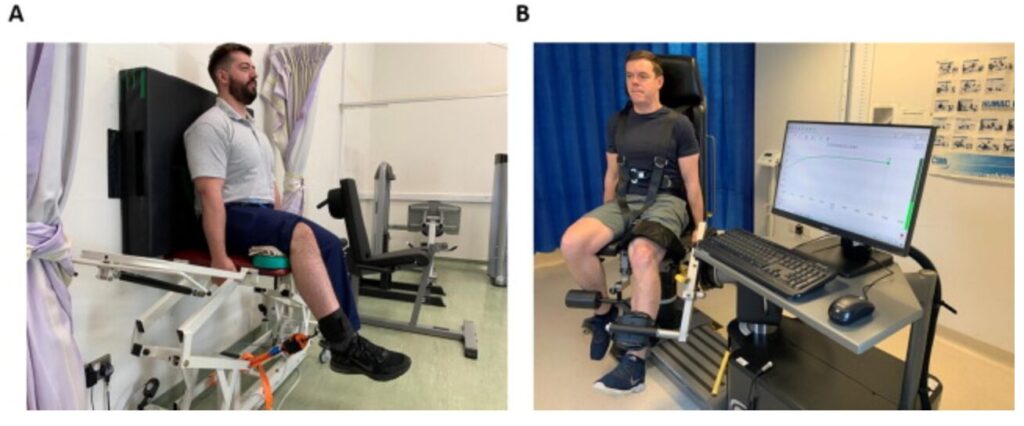
Both testing methods assessed isometric quadriceps strength at 60° of knee flexion, the angle commonly associated with peak torque production.
Inline Dynamometry (ID):
- Participants were seated on a plinth
- A strap was secured around the ankle
- The strap was connected to a portable load cell
- The load cell was anchored to the plinth, creating an inline resistance system
Electromechanical Dynamometry (ED):
- Participants were tested using a HUMAC NORM Cybex dynamometer
- The setup allowed controlled isometric testing at the same 60° knee angle
This design ensured that both systems measured strength under comparable joint positions and contraction types.
Testing Protocol
The testing protocol was standardized for both devices:
- Participants performed three maximal-effort isometric contractions
- Each contraction lasted 5 seconds
- The strongest values were recorded for analysis
By using identical contraction durations and joint angles, the study ensured that differences in results would reflect the measurement tools themselves rather than variations in testing procedure.
4- Key Results: Reliability, Validity, and Efficiency
The study confirmed that Inline Dynamometry is not just a “good enough” alternative; it is statistically excellent.
Excellent Reliability
Reliability refers to the consistency of the measurement. The study found:
- Healthy Participants: Excellent interrater reliability (consistency between different testers) and intrarater reliability (consistency for the same tester) with Intra-class Correlation Coefficients (ICC) greater than 0.90.
- ACL Patients: Excellent intrarater reliability (ICC > 0.90) for assessing the operated limb.
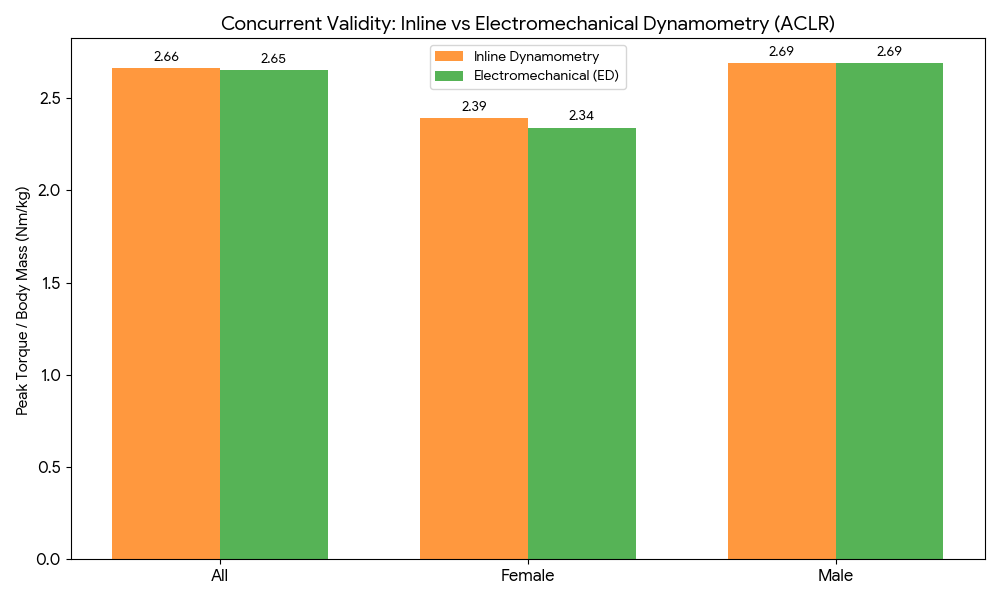
Figure 1: The plot illustrates the “concurrent validity” of the new method. It compares the strength scores obtained from the portable Inline Dynamometer against the gold-standard Electromechanical Dynamometer (ED) for the ACLR group. The nearly identical bar heights demonstrate the high accuracy of the inline method.
High Concurrent Validity
Validity determines if the tool measures what it claims to measure compared to the gold standard.
- Strong Correlation: The study demonstrated excellent concurrent validity between the portable ID setup and the expensive ED machine, with ICCs > 0.90.
- Minimal Bias: Bland-Altman analysis showed very little bias (0.01 Nm/kg), meaning the scores between the portable device and the large machine were nearly identical.
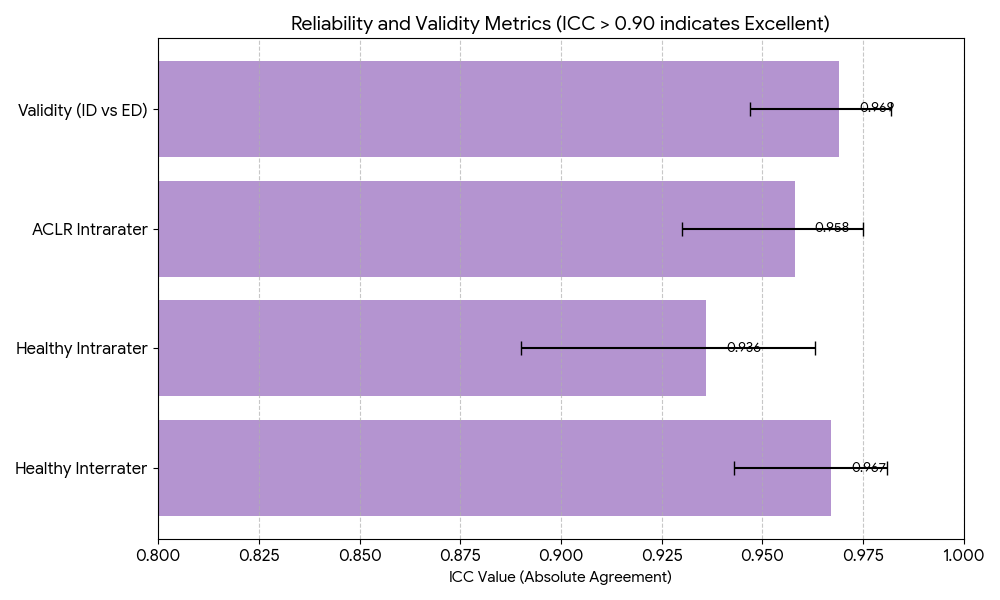
Figure 2: The plot summarizes the statistical reliability and validity using the Intra-class Correlation Coefficient (ICC). Values above 0.90 are considered “excellent.” The chart shows that Inline Dynamometry demonstrates excellent reliability (both between raters and for the same rater) and excellent validity when compared to the gold standard.
Superior Efficiency
Time is a major constraint in clinical settings. The study found a statistically significant difference in testing time:
- Inline Dynamometry: Averaged 3 minutes 43 seconds.
- Electromechanical Dynamometry: Averaged 6 minutes 20 seconds.
- Impact: For every two legs tested on the big machine, a clinician could test three legs using the portable inline setup.
Safety and Comfort
- No adverse events were reported during testing.
- Pain scores were low and did not differ significantly between the two methods, confirming that maximal isometric testing at 60° is safe for patients at least 12 weeks post-op.
5- Clinical Implications: Bringing Reliable ACL Strength Testing to the Point of Care
The study’s findings have important implications for clinicians working in ACL rehabilitation. By demonstrating strong reliability, high validity, improved efficiency, and safety, the research supports inline dynamometry as a practical solution for objective quadriceps strength assessment outside of specialized laboratory environments.
A Cost-Effective Alternative
Large electromechanical dynamometers are often financially out of reach for many clinics. Inline dynamometry offers:
- A more economical option compared to machines that can cost tens of thousands of dollars
- Access to objective strength data without major infrastructure investment
This makes high-quality strength assessment more attainable across a wider range of rehabilitation settings.
Portability and Point-of-Care Use
Unlike traditional laboratory-based systems, inline dynamometry can be used directly in clinical and field environments:
- Easily implemented in standard treatment rooms
- Suitable for sports medicine clinics and training facilities
- Potentially usable in sideline or on-field environments where rapid assessment is valuable
This portability supports more frequent and context-specific strength testing throughout the rehabilitation process.
Testing at a Clinically Relevant Joint Angle
Inline dynamometry allows testing at 60° of knee flexion, which is often associated with peak torque production. This provides an advantage over some belt-stabilized hand-held dynamometry setups that are forced into less optimal joint angles to prevent slippage.
Supporting Objective Decision-Making
With evidence supporting the reliability of inline dynamometry in ACL rehab, clinicians can use strength data more confidently to guide:
- Progression of strengthening programs
- Return-to-running timelines
- Return-to-sport decisions
The study also supports the use of absolute strength values (Nm/kg), which may provide more meaningful insight into functional recovery than relying solely on limb symmetry indices.
6- Conclusion: Inline Dynamometry as a Reliable Tool in ACL Rehabilitation
The findings from Norris et al. (2024) provide strong evidence supporting the reliability of inline dynamometry in ACL rehab. The portable inline setup demonstrated excellent reliability in both healthy individuals and ACL-reconstructed patients, with Intra-class Correlation Coefficients consistently above 0.90. These results indicate that clinicians can obtain consistent and repeatable quadriceps strength measurements using a clinically accessible system.
Beyond reliability, inline dynamometry also showed excellent concurrent validity when compared to gold-standard electromechanical dynamometry. Strength values were closely aligned between devices, with minimal measurement bias. This confirms that the portable method is not only consistent but also accurate.
The study further highlighted meaningful practical advantages. Inline dynamometry required significantly less testing time, making objective strength assessment easier to integrate into routine clinical workflows. No adverse events were reported, and pain levels remained low, supporting the safety of maximal isometric testing at least 12 weeks after ACL reconstruction.
Together, these findings position inline dynamometry as a valuable bridge between laboratory-grade measurement and real-world clinical practice. For rehabilitation professionals seeking accessible, efficient, and evidence-based methods to guide recovery, inline dynamometry offers a reliable solution for objective quadriceps strength testing throughout ACL rehabilitation.
7- FAQ: Reliability of Inline Dynamometry in ACL Rehab
How reliable is inline dynamometry for ACL rehabilitation?
Research shows excellent results regarding the reliability of inline dynamometry in ACL rehab, with Intra-class Correlation Coefficients (ICCs) greater than 0.90. This indicates that the method provides highly consistent strength measurements across repeated tests and between clinicians.
Is inline dynamometry as reliable as isokinetic testing?
Yes. The study found that inline dynamometry demonstrated reliability comparable to gold-standard electromechanical dynamometry. Both interrater and intrarater reliability were rated as excellent, supporting its use in clinical strength assessment.
Why is reliability important in ACL strength testing?
Reliable measurements ensure that changes in quadriceps strength reflect true recovery rather than testing variability. This is essential when clinicians use strength data to guide return-to-running and return-to-sport decisions during ACL rehabilitation.
What knee angle is best for reliable quadriceps testing after ACL surgery?
Testing at 60° of knee flexion is commonly recommended because this angle is associated with peak torque production. The study evaluating inline dynamometry used this position for all participants.
Can inline dynamometry be used for return-to-sport decisions?
Yes. Because the method provides reliable and valid objective strength data, it can support clinical decision-making when combined with other functional and clinical criteria. Absolute strength values (Nm/kg) may be particularly useful for monitoring recovery.


