


Recovery after isometric exercise is often viewed as a relatively standard process, guided by the return of muscle strength or subjective feelings of readiness.
But is recovery really the same for everyone?
In this article, we explore a recent study investigating how biological sex may influence recovery following an intense pectoralis major isometric protocol.
Using objective measures of force, power, and muscle status, this research highlights differences that could influence how coaches, strength professionals, and healthcare practitioners interpret readiness to return to performance.
CONTENTS
1- Why Recovery After Isometric Exercise Deserves a Closer Look
2- Study Design: How Researchers Analyzed Recovery After Isometric Exercise
3- Results: A Short-Term Power Gap Between Men and Women
4- Force, Power, and Recovery: Why One Metric Doesn’t Tell the Whole Story
5- Practical Implications for Coaches, Physical Therapists, and Sport Scientists
6- FAQ: Recovery After Isometric Exercise
7- Reference
1- Why Recovery After Isometric Exercise Deserves a Closer Look
Isometric training, producing force without visible joint movement, is widely used in strength and conditioning, rehabilitation, and performance settings. Its benefits for strength development, neuromuscular control, and even hypertrophy are well established.
However, when it comes to recovery after isometric exercise, the picture is often oversimplified.
In practice, return-to-training decisions are frequently guided by subjective indicators such as muscle soreness, fatigue perception, or an athlete’s general sense of readiness. But these markers do not always accurately reflect the true state of neuromuscular recovery.
An athlete may feel recovered, or even regain maximal strength, while still experiencing deficits in other key physical qualities, such as explosive power.
That is exactly what this study set out to explore: is recovery a single, universal process, or do certain performance markers recover differently depending on the athlete’s biological profile?
2- Study Design: How Researchers Analyzed Recovery After Isometric Exercise
To better understand recovery after isometric exercise, researchers monitored 22 healthy participants (12 men and 10 women) following a high-intensity isometric protocol targeting the pectoralis major.
The protocol consisted of 6 sets of 5-second maximal voluntary isometric contractions, performed at long muscle length, with standardized recovery periods between repetitions.
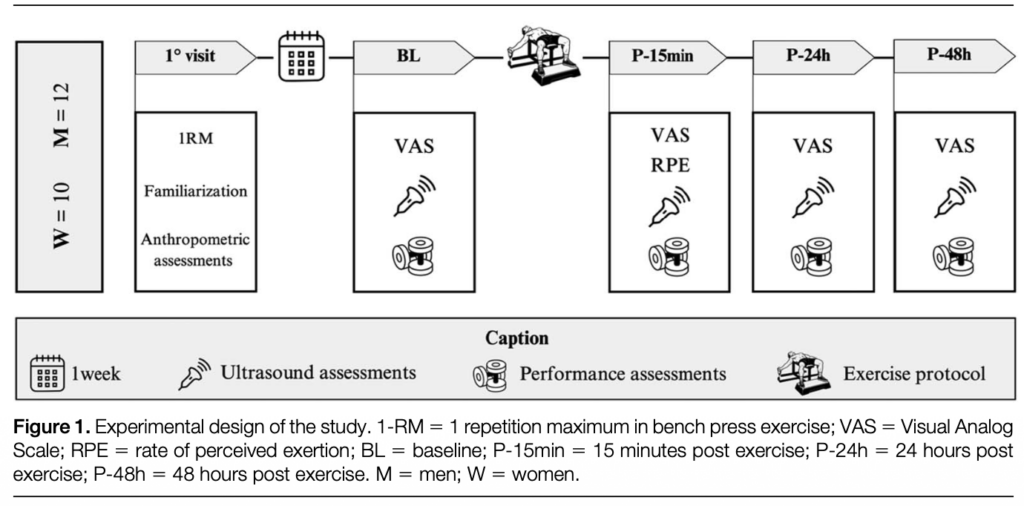
To capture recovery from multiple perspectives, the research team used the following measurement tools:
- Force Quantification: A high-precision wireless traction dynamometer (K-Pull) was utilized to measure peak force at both Long Muscle Length (LML) and Short Muscle Length (SML). The device sampled data at 1,000 Hz, ensuring every micro-fluctuation in force was captured.
- Precision Angle Tracking: To ensure the experimental results weren’t skewed by shifting form, the researchers used a digital goniometer (K-Move). This sensor allowed for real-time monitoring to keep the elbow at a strict 10° of flexion throughout every repetition.
- Explosive Power Tracking: A linear optical encoder (Tendo Unit model V104) was attached to a Smith Machine to measure average power output (Watts) during the Bench Throw Power (BTP) tests.
- Musculoskeletal Ultrasound: A 12-MHz linear probe (Echo Wave 2, Telemed) was used to assess the muscle internally, measuring muscle thickness and echo intensity (a marker of muscle quality). These images were processed using ImageJ software to calculate Corrected Echo Intensity (CEI), accounting for subcutaneous fat thickness.
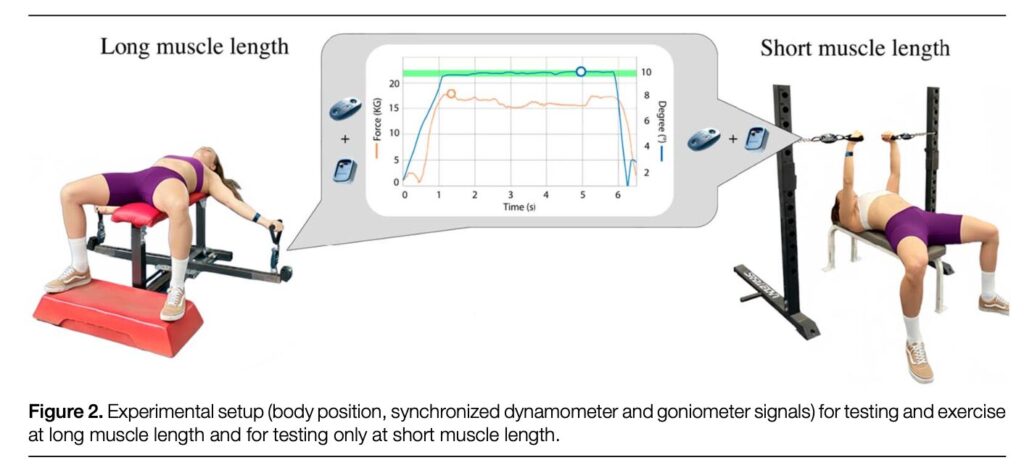
Assessments were conducted at multiple time points, from immediately post-exercise through 48 hours of recovery, allowing researchers to compare strength, power, muscle architecture, and subjective recovery responses.
3- Results: A Short-Term Power Gap Between Men and Women
The findings show that recovery after isometric exercise does not follow the same timeline across all performance markers.
The most notable difference was observed in explosive power.
💡 Fifteen minutes after the protocol, men showed a significant reduction in average power output during the Bench Throw Power test, while no comparable decrease was observed in women.
However, this difference was not seen across all measured variables.
Researchers found that maximal isometric strength recovered on a similar timeline in both groups, alongside comparable recovery patterns in key markers of muscle architecture.
Another important finding: perceived exertion and reported muscle soreness were similar between men and women, despite objective differences in explosive performance.
In other words, two athletes may report feeling similarly recovered after the same protocol, while their actual neuromuscular readiness tells a different story.
For practitioners, this reinforces an important takeaway: subjective feedback alone may not be enough to accurately assess recovery status.
4- Force, Power, and Recovery: Why One Metric Doesn’t Tell the Whole Story
One of the most important takeaways from this study is that recovery cannot be reduced to a single metric.
An athlete may regain maximal isometric strength while still experiencing a temporary reduction in their ability to produce explosive power. Likewise, lingering muscle soreness does not necessarily mean performance capacity remains impaired.
This happens because strength, power, perceived exertion, and muscle recovery do not reflect the same physiological mechanisms.
Maximal isometric strength provides insight into the ability to generate voluntary force under controlled conditions. Explosive power, on the other hand, depends more heavily on rapid neuromuscular recruitment, intermuscular coordination, and the ability to generate force quickly.
That is what makes recovery after isometric exercise more complex than simply returning to baseline on a single test.
For practitioners, this means return-to-training or return-to-explosive work decisions should not always rely solely on maximal strength testing or subjective athlete feedback.
A broader assessment approach helps reduce the risk of overestimating an athlete’s true readiness, especially when explosive performance is a key requirement.
5- Practical Implications for Coaches, Physical Therapists, and Sport Scientists
For performance and rehabilitation professionals, these findings reinforce an important message: returning to baseline on one metric does not necessarily mean full recovery has occurred.

In practice:
- Regaining maximal strength does not guarantee restored explosive power. An athlete may appear “recovered” on an isometric strength test while still showing temporary limitations in explosive performance.
- Subjective feedback should not be the sole recovery marker. Similar ratings of perceived exertion or muscle soreness do not always reflect the same level of neuromuscular readiness.
- The timing of explosive training matters. In some athlete profiles, particularly male athletes in this study, performing explosive tasks shortly after intense isometric work may temporarily compromise performance.
- Recovery strategies should be individualized. These findings suggest that recovery responses may differ based on biological sex, reinforcing the limitations of a one-size-fits-all approach.
- Objective metrics support better decision-making. For physical therapists, strength coaches, and sport scientists, integrating force, power, or other functional performance measures can provide a clearer picture when progressing training, rehabilitation, or return-to-play decisions.
6- FAQ: Recovery After Isometric Exercise
Do men and women recover differently after isometric exercise?
This study suggests that some aspects of recovery may differ based on biological sex. While maximal strength recovery and key muscle architecture markers followed similar timelines in both groups, a short-term drop in explosive power was only observed in men 15 minutes after the protocol.
Is maximal strength enough to assess recovery after isometric exercise?
No. Maximal strength is a useful recovery marker, but it does not reflect the full picture of neuromuscular readiness. An athlete may regain isometric strength while still experiencing temporary deficits in explosive performance.
Why do strength and power recover at different rates?
Strength and explosive power rely on different physiological mechanisms. Explosive power depends more heavily on rapid neuromuscular recruitment, coordination, and force production speed, which may take longer to fully recover in certain contexts.
Is athlete perception a reliable recovery indicator?
Subjective feedback remains valuable, but it should not be used in isolation. This study showed that similar perceived exertion and muscle soreness ratings can coexist with measurable differences in objective performance.
How can recovery after isometric exercise be measured objectively?
Recovery can be monitored using objective tools such as dynamometry for force assessment, power testing, movement analysis, or other functional performance metrics. Combining multiple indicators provides a more accurate picture of recovery status than subjective feedback alone.
Can isometric exercise temporarily reduce explosive performance?
Yes. According to this study, an intense isometric protocol may temporarily reduce explosive power output, which has practical implications when programming explosive training or making return-to-performance decisions.


