





Assessing an athlete’s strength goes beyond determining how much weight they can lift. For physical therapists, strength and conditioning coaches, and sports scientists, it is equally important to quantify force production capacity, monitor changes over time, and compare results under reproducible testing conditions.
The Isometric Mid-Thigh Pull (IMTP) is an isometric strength test used to assess lower-limb force production capabilities. Typically performed using force plates, it provides objective measurements such as Peak Force and various force-time metrics.
Quick to administer and well-suited for longitudinal monitoring, the Isometric Mid-Thigh Pull is widely used in both sports performance assessment and rehabilitation monitoring.
In this article, discover how to perform an IMTP test, which metrics to analyze, and how to interpret the results to better monitor an athlete’s or patient’s strength and neuromuscular capabilities.
1- What Is the Isometric Mid-Thigh Pull (IMTP)?
The Isometric Mid-Thigh Pull (IMTP) is a multi-joint isometric strength test used to assess lower-limb force production capabilities. Unlike dynamic movements, the athlete exerts maximal force against a fixed barbell without any movement of the bar.
When performed using force plates, the IMTP measures ground reaction forces and analyzes how force develops throughout the effort. This provides objective data on an athlete’s or patient’s force production profile.
How Does the IMTP Test Work?
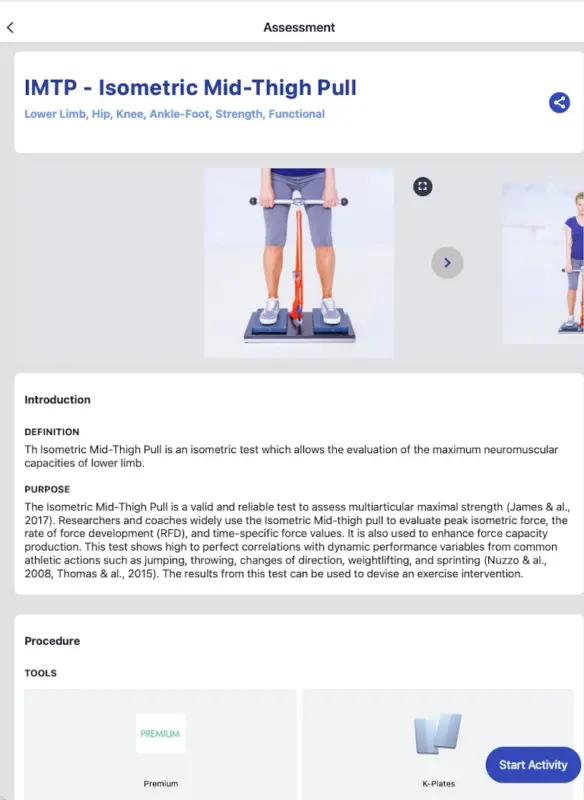
During an Isometric Mid-Thigh Pull, the athlete stands on force plates with a fixed bar positioned at mid-thigh height (hip angle: 145° ± 5°; knee angle: 130° ± 5°). The hip and knee joints are positioned at specific angles to ensure standardized and reproducible testing conditions.
From this position, the athlete performs a maximal isometric pull against the bar, typically instructed to pull as hard and as fast as possible.
Since the bar remains stationary, there is no external movement to measure. Instead, the force plates record ground reaction forces, which can be represented as a force-time curve showing how force develops from the onset of contraction to peak force.
What Does the IMTP Measure?
The IMTP provides more than just an athlete’s maximal strength. Depending on the metrics analyzed, it offers valuable insights into several aspects of neuromuscular performance.
The test can assess:
- Maximal force production, primarily through Peak Force;
- Rapid force production capacity, through force measurements at specific time intervals and Rate of Force Development (RFD);
- Neuromuscular profile, by analyzing different characteristics of the force-time curve;
- Changes in strength over time, when testing is repeated under standardized conditions.
Scientific research supports the use of the IMTP to assess Peak Force and various time-dependent force production metrics. These measurements can complement other physical assessments, providing a more comprehensive understanding of an athlete’s capabilities and helping practitioners objectively monitor progress throughout training or rehabilitation programs.
2- How to Perform an Isometric Mid-Thigh Pull?
To obtain reliable data from an Isometric Mid-Thigh Pull, the test must follow a standardized protocol. From the starting position to recovery, each step should be reproducible across testing sessions.
Step 1: Set Up the Force Plates and Bar
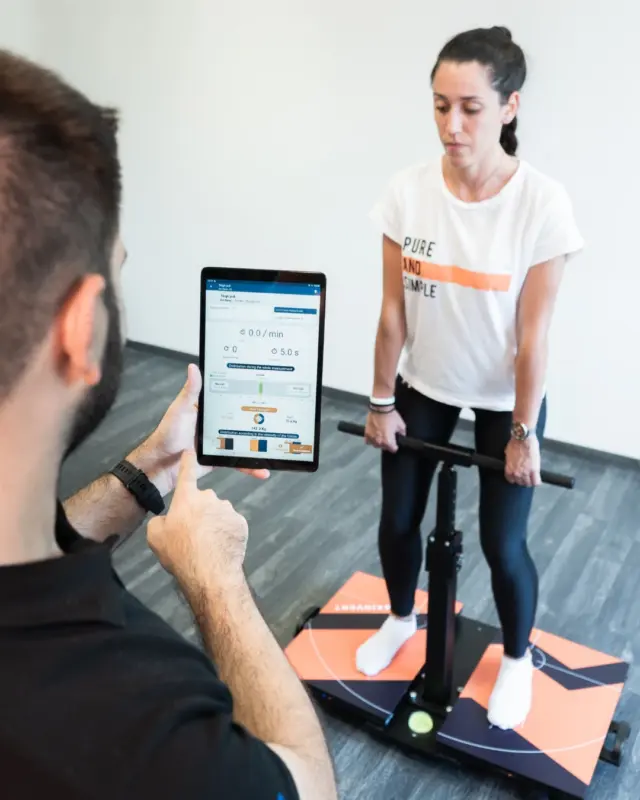
Position the force plates beneath the athlete’s feet and adjust the fixed bar to mid-thigh height. The athlete should be able to exert maximal pulling force without moving the bar.
Step 2: Position the Athlete
The athlete stands on the force plates with arms extended and hands gripping the bar. Foot placement, bar height, and hip and knee angles should be clearly defined and reproducible.
For example, a study using K-Deltas individualized bar height to achieve hip angles of 135–150° and knee angles of 125–150°. These values are specific to that protocol and should not be considered universal standards.
Step 3: Select the IMTP Protocol
In the Kinvent App, select the Isometric Mid-Thigh Pull (IMTP) protocol and connect the K-Deltas force plates. This dedicated protocol helps structure the assessment and collect test data under standardized conditions.
Step 4: Perform the Maximal Pull
After applying slight pre-tension to the bar, instruct the athlete to pull as hard and as fast as possible. The bar remains stationary while the force plates record the forces generated throughout the effort, producing a force-time curve.
Step 5: Repeat the Trials
Perform multiple trials, allowing sufficient recovery time between attempts. Check the consistency of the results before selecting valid trials for analysis.
For longitudinal monitoring, maintain the same bar height, body position, instructions, and testing conditions whenever possible. This standardization enables more accurate comparisons between sessions. For greater precision, a tare function can also be used to ensure the accuracy of the selected pre-tension force.
💡 With K-Deltas, objectively measure force production during the Isometric Mid-Thigh Pull and track your athletes’ or patients’ progress over time.
3- Which Metrics Should You Analyze During an IMTP?
The Isometric Mid-Thigh Pull measures more than just maximal strength. Analyzing the force-time curve provides several complementary metrics to better understand an athlete’s or patient’s force production capabilities.
Peak Force: Measuring Maximal Strength
Peak Force represents the highest force recorded during the IMTP. It is one of the primary metrics used to assess maximal isometric strength.
It can be expressed as an absolute value (N) or normalized to body mass (N/kg). This normalization helps compare athletes of different body sizes.
Rate of Force Development (RFD)
The Rate of Force Development (RFD) measures how quickly force increases during a contraction. In other words: how fast can an athlete generate force?
RFD provides additional information beyond Peak Force, particularly in sports where athletes have limited time to produce force. However, its interpretation requires a standardized testing protocol and consistent calculation methods.
Force at Specific Time Intervals
Force can also be analyzed at specific time points after the onset of contraction, such as 100 or 200 ms.
These measurements provide insights into an athlete’s ability to generate force rapidly, even before reaching maximal force.
Left-Right Asymmetries
Using two independent force plates, the IMTP can also assess the contribution of each lower limb during the test.
An asymmetry should not automatically be interpreted as an indicator of injury risk. Instead, it provides additional information for longitudinal monitoring, particularly during rehabilitation and return-to-sport assessments, helping practitioners track changes in potential strength deficits between limbs.
4- How to Interpret IMTP Results?
The data obtained from an Isometric Mid-Thigh Pull is most meaningful when analyzed over time and interpreted in the context of the athlete’s individual profile, sport, and performance goals.
Compare Athletes Against Their Own Baseline
One of the most relevant approaches is to establish an individual baseline and repeat the test under similar conditions.
This longitudinal comparison helps practitioners monitor changes in Peak Force, rapid force production capacity, and inter-limb differences throughout training or rehabilitation programs.
Can Normative Values Be Used?
Normative values should be interpreted with caution. IMTP results can vary depending on sport, sex, performance level, body mass, and the testing protocol used.
Scientific literature highlights that differences in IMTP protocols can make direct comparisons between studies or populations challenging.
Therefore, available normative data should be used alongside individual athlete monitoring, rather than treated as universal performance thresholds.
Combining IMTP and Countermovement Jump: The Dynamic Strength Index
The IMTP can also be combined with the Countermovement Jump (CMJ) to calculate the Dynamic Strength Index (DSI):
DSI = CMJ Peak Force / IMTP Peak Force
The DSI compares force production during a dynamic movement with maximal isometric force. It provides additional insights into an athlete’s strength profile and may help guide training decisions.
However, the DSI should always be interpreted alongside other available metrics, as the same DSI value can represent different strength and performance profiles.
5- IMTP: Applications in Sports Performance and Rehabilitation
Thanks to the objective data provided by the Isometric Mid-Thigh Pull, this test can be integrated into both sports performance monitoring and rehabilitation programs.
Monitoring Sports Performance
For strength and conditioning coaches and sports scientists, the IMTP helps establish an athlete’s strength profile and monitor changes throughout the season.
When repeated under standardized conditions, it can help practitioners:
- Track changes in maximal strength;
- Assess adaptations to training programs;
- Identify specific strength qualities that need improvement;
- Individualize training objectives.
Objectively Assessing Rehabilitation and Return to Sport
In rehabilitation, the IMTP provides quantitative data to complement clinical examinations and other functional assessments.
Physical therapists can use it to monitor the recovery of force production capabilities, track potential inter-limb differences, and identify persistent strength deficits before progressing to more demanding activities.
The IMTP has also been investigated as a functional strength assessment tool in musculoskeletal rehabilitation settings.
Tracking Progress Over Time
Another key advantage of the IMTP is its repeatability. By establishing an individual baseline and regularly performing the same standardized protocol, practitioners can objectively monitor an athlete’s or patient’s progress.
The goal is not simply to reach a reference value, but to understand how the individual’s strength profile evolves over time in response to training, rehabilitation, and personal objectives.
6- FAQ: Isometric Mid-Thigh Pull
What Is the Isometric Mid-Thigh Pull (IMTP)?
The Isometric Mid-Thigh Pull (IMTP) is an isometric strength test in which an athlete pulls maximally against a fixed bar positioned at mid-thigh height. When performed using force plates, it allows practitioners to assess maximal force production and the ability to generate force rapidly.
How Do You Perform an IMTP Test?
The athlete stands on force plates with a fixed bar positioned at mid-thigh height, then pulls as hard and as fast as possible. To compare results over time, body position, bar height, instructions, and testing conditions must be standardized.
What Metrics Can Be Measured During an IMTP?
The IMTP can measure Peak Force, Rate of Force Development (RFD), force production at specific time intervals, and, when using two independent force plates, the contribution of each lower limb.
What Is the Difference Between the IMTP and the Isometric Squat?
Both tests assess isometric strength but involve different body positions. During the IMTP, the athlete pulls against a fixed bar at mid-thigh height. During the Isometric Squat, the athlete primarily pushes against a fixed resistance from a squat position.
The choice between these tests depends on the specific strength qualities being assessed and the testing protocol.
What Is the Difference Between the IMTP and the Countermovement Jump?
The IMTP primarily assesses isometric force production, while the Countermovement Jump (CMJ) evaluates force production during a dynamic, explosive movement.
These tests provide complementary information and can be combined to calculate the Dynamic Strength Index (DSI).
Why Use Force Plates for an IMTP Test?
Force plates allow practitioners to objectively quantify force production during the Isometric Mid-Thigh Pull and analyze the force-time curve.
They also facilitate comparisons between testing sessions, helping practitioners monitor changes in an athlete’s or patient’s strength capabilities over time.
7- References
- Brady, C. J., Harrison, A. J., & Comyns, T. M. (2020). A review of the reliability of biomechanical variables produced during the isometric mid-thigh pull and isometric squat and the reporting of normative data. Sports Biomechanics, 19(1), 1–25. https://doi.org/10.1080/14763141.2018.1452968
- Martin, E. A., & Beckham, G. K. (2020). Isometric mid-thigh pull performance in rugby players: A systematic literature review. Journal of Functional Morphology and Kinesiology, 5(4), 91. https://doi.org/10.3390/jfmk5040091
- Merrigan, J. J., Stone, J. D., Hornsby, W. G., & Hagen, J. A. (2021). Identifying reliable and relatable force–time metrics in athletes—Considerations for the isometric mid-thigh pull and countermovement jump. Sports, 9(1), 4. https://doi.org/10.3390/sports9010004
- Suchomel, T. J., Sole, C. J., Bellon, C. R., & Stone, M. H. (2020). Dynamic strength index: Relationships with common performance variables and contextualization of training recommendations. Journal of Human Kinetics, 74, 59–70. https://doi.org/10.2478/hukin-2020-0014
- Walters, V., Coppack, R. J., Cassidy, R. P., Suffield, C., Papadopoulou, T., Bilzon, J., & Ladlow, P. (2022). Use of an isometric mid-thigh pull test during musculoskeletal rehabilitation: Can the criterion values from the updated British Army physical employment standards be used to inform UK Defence Rehabilitation practice? BMJ Military Health, 168(4), 279–285. https://doi.org/10.1136/bmjmilitary-2021-001950


