


Cardiac rehabilitation is now recognized as a cornerstone of care for people recovering from cardiovascular disease. Once primarily delivered in specialized hospital settings, it is now implemented across a variety of environments, including rehabilitation centers, physical therapy clinics, community exercise programs, and telehealth services.
Whether following a myocardial infarction, coronary angioplasty, coronary artery bypass graft (CABG), heart valve surgery, or in patients living with stable heart failure, the goal of cardiac rehabilitation is to support a safe and progressive return to physical activity. Beyond improving functional capacity, it helps reduce hospital readmissions, enhances quality of life, and enables patients to regain confidence in their daily activities.
In this article, you’ll learn who can benefit from cardiac rehabilitation, how to build an evidence-based rehabilitation program, and why objective assessment tools are becoming essential for personalizing patient care and monitoring long-term progress.
CONTENTS
1- What Is Cardiac Rehabilitation?
2- Why Is Cardiac Rehabilitation Essential?
3- How to Build an Effective Cardiac Rehabilitation Program
4- How to Objectively Measure Progress During Cardiac Rehabilitation
5- Current Evidence-Based Recommendations for Cardiac Rehabilitation
6- Frequently Asked Questions About Cardiac Rehabilitation
7- References
1- What Is Cardiac Rehabilitation?
Cardiac rehabilitation is a multidisciplinary, evidence-based program that combines exercise training, patient education, lifestyle modification, and individualized support to improve the long-term health of people living with cardiovascular disease. Recommended by leading international organizations, it is now considered an essential component of treatment following a cardiac event and for many patients with chronic heart disease.
The goal extends far beyond simply improving fitness. Cardiac rehabilitation helps reduce symptoms, prevent complications, restore confidence during physical activity, and support a safe return to everyday life. It also promotes long-term adherence to medical treatment and encourages healthier lifestyle habits that reduce the risk of future cardiovascular events.

The Goals of Cardiac Rehabilitation
Every cardiac rehabilitation program should be tailored to the patient’s clinical condition, physical capacity, and individual goals. Its primary objectives are to:
- improve exercise capacity and cardiovascular endurance;
- restore muscle strength and functional independence;
- reduce fatigue and shortness of breath;
- lower the risk of recurrent cardiovascular events and hospital readmission;
- support long-term adherence to regular physical activity.
Cardiac rehabilitation is much more than an exercise program. It combines aerobic training, resistance exercise, patient education, lifestyle counseling, and ongoing medical supervision to achieve sustainable improvements in cardiovascular health.
Who Can Benefit from Cardiac Rehabilitation?
Cardiac rehabilitation is recommended for a wide range of patients, including those recovering from:
- myocardial infarction (heart attack) or acute coronary syndrome;
- coronary angioplasty with stent placement;
- coronary artery bypass graft (CABG) surgery;
- heart valve surgery;
- pacemaker or implantable cardioverter-defibrillator (ICD) implantation;
- stable chronic heart failure.
In patients with chronic heart failure, the heart is unable to pump enough blood to meet the body’s needs, leading to symptoms such as fatigue, shortness of breath, and progressively reduced physical capacity. Disease severity is commonly classified using the New York Heart Association (NYHA) functional classification, which helps clinicians tailor the cardiac rehabilitation program to each patient’s functional limitations.
Following cardiac surgery, rehabilitation must also account for procedure-specific precautions. For example, after a median sternotomy performed during CABG or valve surgery, upper-limb loading is generally restricted for several weeks to allow proper bone healing. Exercise progression should always be individualized and coordinated with the multidisciplinary healthcare team.
2- Why Is Cardiac Rehabilitation Essential?
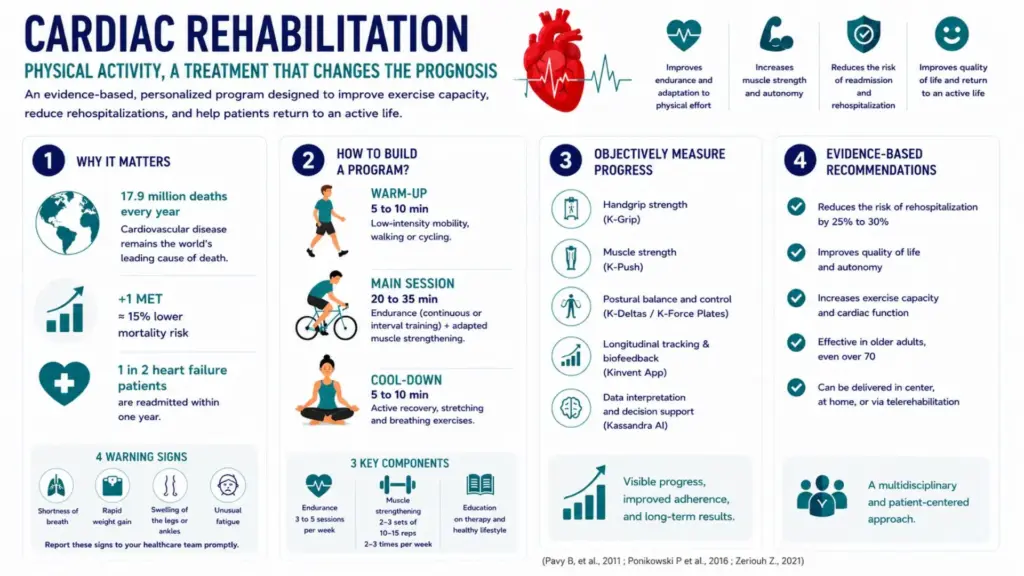
Cardiovascular disease remains the leading cause of death worldwide, accounting for an estimated 17.9 million deaths every year. Despite strong evidence supporting exercise-based rehabilitation, many eligible patients still do not participate in a cardiac rehabilitation program, limiting their recovery and increasing their risk of future cardiovascular events.
Improving Outcomes Through Exercise
Cardiac rehabilitation is far more than supervised exercise. It is an evidence-based intervention that improves physical function, enhances quality of life, and reduces the risk of hospital readmission and premature death.
Following hospitalization for heart failure, nearly one in two patients is readmitted within one year, and mortality remains high. Patients recovering from acute coronary syndrome also remain under-referred to cardiac rehabilitation programs, despite the well-established benefits of structured exercise training and secondary prevention strategies.
These findings highlight the importance of integrating cardiac rehabilitation into routine cardiovascular care rather than considering it an optional component of recovery.
Exercise Is Medicine
One of the strongest predictors of long-term survival is cardiorespiratory fitness.
Research has shown that every 1-MET increase in exercise capacity (approximately 3.5 mL/kg/min of VO₂) is associated with an approximately 15% reduction in all-cause mortality. This is one of the reasons why exercise is now recognized as a cornerstone of cardiovascular disease management.
By progressively improving aerobic capacity, muscle strength, and functional independence, cardiac rehabilitation enables patients to safely return to everyday activities while reducing their risk of future cardiovascular complications.
Four Warning Signs of Heart Failure
Physical therapists and other healthcare professionals involved in cardiac rehabilitation should be able to recognize the early signs of worsening heart failure and refer patients promptly when necessary.
Key warning signs include:
- Shortness of breath
- Rapid weight gain
- Swelling of the legs or ankles
- Unusual fatigue
Educating patients to recognize these symptoms is an essential part of cardiac rehabilitation. Early identification can help prevent clinical deterioration, reduce hospitalizations, and improve long-term outcomes.
3- How to Build an Effective Cardiac Rehabilitation Program
An effective cardiac rehabilitation program should always be individualized according to the patient’s medical condition, functional capacity, and rehabilitation goals. Before exercise begins, a comprehensive assessment helps determine a safe training intensity and provides a baseline for monitoring progress throughout the program.
A successful rehabilitation program combines aerobic exercise, resistance training, patient education, and long-term lifestyle modification.
Initial Assessment
The initial evaluation is the foundation of every cardiac rehabilitation program. It helps clinicians identify the patient’s physical limitations, establish realistic goals, and prescribe exercise safely.
Whenever possible, the assessment should include:
- a cardiopulmonary exercise test (CPET) with peak VO₂ and ventilatory threshold measurements;
- or, when CPET is not available, a 6-Minute Walk Test (6MWT);
- an assessment of muscle strength;
- an educational interview to understand the patient’s knowledge, concerns, and readiness for lifestyle change.
This comprehensive assessment provides the information needed to individualize exercise prescription and objectively monitor progress over time.
A Typical Cardiac Rehabilitation Session
A standard cardiac rehabilitation session usually lasts 45 to 60 minutes and consists of three phases.
Warm-up (5–10 minutes)
The session begins with low-intensity mobility exercises, walking, or light cycling to gradually increase heart rate and prepare the cardiovascular and musculoskeletal systems for exercise.
Exercise Training (20–35 minutes)
The main part of the session combines aerobic exercise with resistance training tailored to the patient’s abilities and clinical status.
Cool-down (5–10 minutes)
The session concludes with active recovery, gentle stretching, and breathing exercises to gradually lower heart rate and promote recovery.

Aerobic Exercise
Aerobic training is the cornerstone of cardiac rehabilitation. Two complementary approaches are commonly used.
Continuous aerobic training
- Intensity: at or just below the first ventilatory threshold (VT1).
Alternatively, training intensity can be prescribed using the Karvonen formula:
Training HR = Resting HR + [(Max HR − Resting HR) × 0.6]
For patients taking beta-blockers, a coefficient of 0.8 may be used, as the standard formula can underestimate the appropriate training heart rate.
- Perceived exertion: Borg Rating of Perceived Exertion (RPE) 12–14 (“somewhat hard” to “hard”). Patients should still be able to comfortably hold a conversation during exercise (the talk test).
Exercise duration: 20–30 minutes.
Interval training
A simple, evidence-based protocol includes:
- 30 seconds at 80–90% of peak aerobic power (or approximately 85–95% of the peak heart rate achieved during the exercise test);
- followed by 1–2 minutes of active recovery at 20–30% intensity;
- repeat 8–12 times.
Interval training provides a greater muscular stimulus without placing excessive strain on the cardiovascular system. It is often well tolerated and can be more engaging for patients than continuous exercise.
Recommended frequency: 3–5 sessions per week.
Minimum dose: 20 supervised sessions are generally recommended to achieve meaningful and lasting clinical benefits. Patients with severe deconditioning or chronic heart failure may require a longer rehabilitation program.
Resistance Training
Resistance exercise is now recognized as an essential component of cardiac rehabilitation. It helps improve muscle strength, functional capacity, and the ability to perform daily activities independently.
A typical program includes:
- 8–10 exercises targeting major muscle groups;
- 10–15 repetitions per exercise;
- 2–3 sets using light-to-moderate loads (approximately 30–50% of one-repetition maximum).
Simple equipment such as resistance bands, light dumbbells, resistance machines, or bodyweight exercises is generally sufficient. However, prolonged isometric exercises should be avoided, as they can cause excessive increases in blood pressure.
Following a median sternotomy or cardiac implantable electronic device implantation, upper-limb resistance exercises should be reintroduced gradually, with appropriate precautions during the first few weeks of recovery.
Stretching, Relaxation, and Stress Management
The final 5–10 minutes of each session should focus on recovery.
This phase may include:
- gentle stretching of major muscle groups;
- diaphragmatic breathing exercises;
- cardiac coherence breathing (5-second inhalation / 5-second exhalation for 5 minutes).
These strategies help reduce anxiety, promote recovery, and provide patients with practical techniques they can continue independently at home.
Patient Education: A Key Component of Long-Term Success
Exercise alone is not enough. Patient education is a fundamental pillar of cardiac rehabilitation, empowering individuals to become active participants in managing their cardiovascular health.
Education typically includes:
- recognizing the warning signs of heart failure;
- managing daily physical activities safely;
- understanding prescribed medications;
- nutritional counseling, including reducing sodium intake and adopting a heart-healthy diet;
- smoking cessation support;
- strategies to maintain an active lifestyle after the supervised program ends.
The ultimate goal is to help patients achieve and maintain at least 150 minutes of moderate-intensity physical activity per week, together with two resistance-training sessions, in line with current international recommendations.
4- How to Objectively Measure Progress During Cardiac Rehabilitation
Assessment does not end after the initial evaluation. Throughout a cardiac rehabilitation program, objectively measuring patient progress is essential for adapting exercise prescription, ensuring safe progression, and maintaining long-term motivation.
Beyond clinical observation and patient-reported outcomes, objective measurement tools provide reliable data that support evidence-based clinical decision-making and allow clinicians to track recovery over time.
Measuring Physical Performance
Cardiac rehabilitation aims to improve several key physical capacities that can be assessed regularly throughout the rehabilitation process, including:
- upper- and lower-limb muscle strength;
- grip strength, recognized as an indicator of overall physical function and frailty risk;
- functional power, assessed through tests such as the Sit-to-Stand Test;
- balance and postural stability, particularly important in older adults and deconditioned patients.
Monitoring these outcomes allows clinicians to verify patient progress, identify plateaus or regressions early, and adjust rehabilitation strategies accordingly.
Making Progress Visible with Connected Assessment Tools
Modern assessment technologies make it easier than ever to monitor patients throughout cardiac rehabilitation. Connected dynamometers, grip strength devices, force sensors, and balance assessment tools provide objective, reproducible measurements that can be compared across sessions.

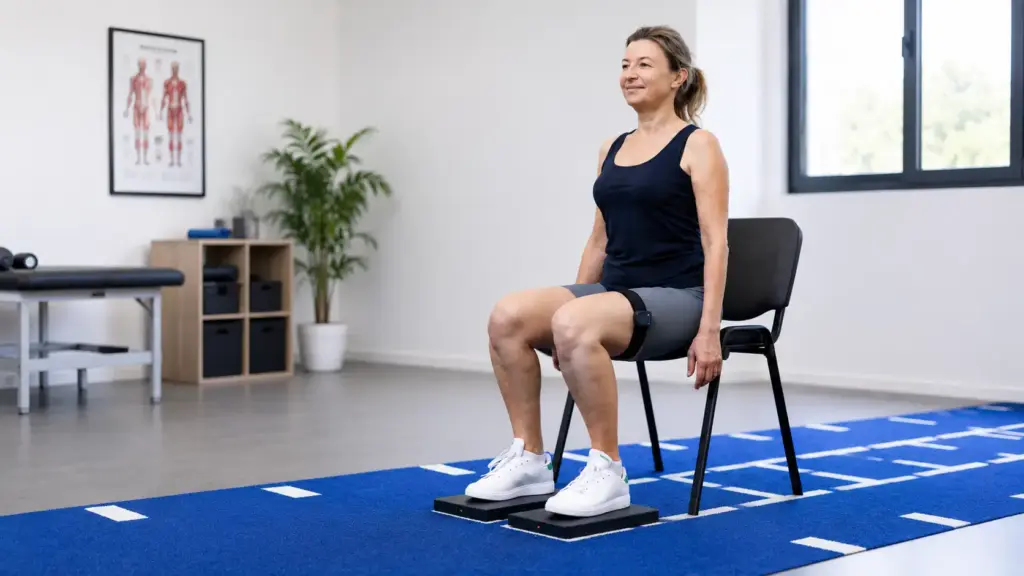
Within the Kinvent ecosystem, devices such as K-Grip for grip strength, K-Push for muscle strength assessment, and K-Deltas for balance and functional performance enable clinicians to quantify physical capacity throughout the rehabilitation process.
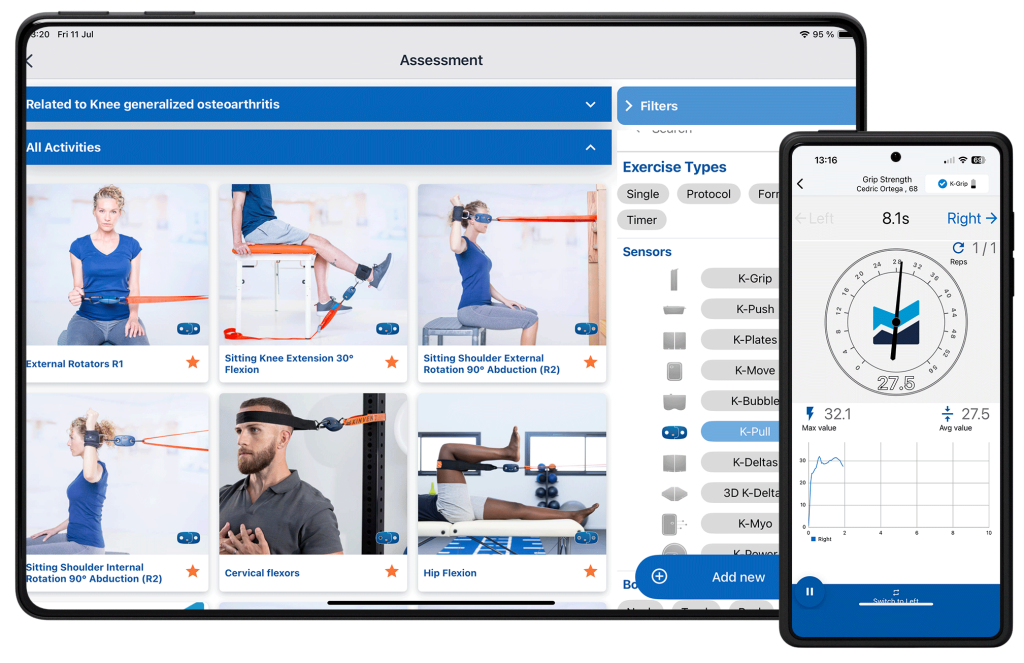
All assessment data are centralized within the Kinvent App, allowing clinicians to visualize patient progress over time, compare results across sessions, standardize testing protocols, and share objective reports with the multidisciplinary care team.
Improving Patient Engagement Through Biofeedback
One of the greatest advantages of objective assessment is that it makes progress visible.
When patients can clearly see improvements in their strength, balance, or functional performance, they gain confidence in their recovery and become more engaged in the rehabilitation process.
Real-time feedback further enhances motivation by providing immediate visual feedback during testing and exercise. Combined with longitudinal progress tracking, it helps improve treatment adherence, supports communication between clinicians and patients, and encourages long-term participation in physical activity, an essential factor in maintaining the benefits of cardiac rehabilitation.
5- Current Evidence-Based Recommendations for Cardiac Rehabilitation
The benefits of cardiac rehabilitation are now supported by decades of high-quality scientific evidence. International organizations, including the European Society of Cardiology (ESC), the American Heart Association (AHA), and the American Association of Cardiovascular and Pulmonary Rehabilitation (AACVPR), recommend exercise-based cardiac rehabilitation as a standard component of care for patients recovering from cardiovascular disease.
Research consistently shows that cardiac rehabilitation:
- reduces hospital readmissions by 25–30%;
- improves quality of life;
- increases exercise capacity and functional independence;
- remains effective even in older adults;
- can be successfully delivered in hospitals, outpatient clinics, community settings, or through well-structured home-based and telehealth programs.
Key Principles of Evidence-Based Cardiac Rehabilitation
Current international guidelines emphasize several fundamental principles:
- Individualize every program based on a comprehensive clinical assessment and, whenever possible, a cardiopulmonary exercise test.
- Combine aerobic exercise, resistance training, and patient education rather than relying on a single intervention.
- Provide at least 20 supervised rehabilitation sessions, followed by lifelong physical activity.
- Progress exercise gradually according to each patient’s functional capacity and clinical response.
- Monitor patients according to their level of cardiovascular risk, while avoiding unnecessary exclusion of clinically stable individuals.
- Use objective assessments to guide clinical decision-making and optimize exercise prescription over time.
A Multidisciplinary Approach to Long-Term Recovery
Successful cardiac rehabilitation relies on close collaboration between cardiologists, physical therapists, clinical exercise physiologists, nurses, dietitians, and other healthcare professionals.
Within this multidisciplinary team, physical therapists play a central role. Through evidence-based exercise prescription, patient education, and objective functional assessment, they help patients regain confidence, improve physical capacity, and adopt healthier long-term lifestyle habits.
As objective measurement technologies continue to evolve, clinicians can make more informed decisions, personalize rehabilitation programs, and accurately monitor recovery throughout every stage of the patient’s journey.
6- Frequently Asked Questions About Cardiac Rehabilitation
What is cardiac rehabilitation?
Cardiac rehabilitation is a personalized, multidisciplinary program designed for people recovering from cardiovascular disease or cardiac procedures such as a heart attack, coronary angioplasty, or coronary artery bypass graft surgery. It combines exercise training, patient education, lifestyle counseling, and medical supervision to improve physical function, reduce the risk of future cardiovascular events, and support long-term recovery.
How long does a cardiac rehabilitation program last?
The length of a cardiac rehabilitation program varies depending on the patient’s condition, rehabilitation goals, and clinical progress. Most guidelines recommend at least 20 supervised sessions over several weeks to achieve meaningful improvements. Long-term physical activity remains essential to maintain cardiovascular health after the supervised program ends.
What exercises are included in cardiac rehabilitation?
A cardiac rehabilitation program typically includes:
- aerobic exercise such as walking, cycling, or treadmill training;
- resistance training to improve muscle strength;
- balance and mobility exercises when appropriate;
- breathing and recovery exercises.
Exercise intensity is always individualized according to the patient’s functional capacity and medical condition.
Can you exercise after a heart attack?
Yes. Most people can safely return to physical activity after a heart attack under the guidance of healthcare professionals. Cardiac rehabilitation provides a structured, progressive approach that helps patients regain confidence, improve cardiovascular fitness, and safely return to daily activities or recreational sports.
How do clinicians measure progress during cardiac rehabilitation?
Progress is commonly assessed using objective outcome measures such as the 6-Minute Walk Test (6MWT), muscle strength testing, grip strength assessment, balance evaluation, and functional tests like the Sit-to-Stand Test. Connected assessment technologies, such as the Kinvent ecosystem, allow clinicians to monitor recovery over time, standardize assessments, and improve patient engagement through real-time biofeedback.
7- References
1. Inserm. Activité physique – Prévention et traitement des maladies chroniques. Expertise collective. 2019 (chapitres “Pathologies coronaires et Insuffisance cardiaque chronique”).
3. Dalal HM, Doherty P, Taylor RS. Cardiac rehabilitation. BMJ 2015;351:h5000.
12. Ordre des Masseurs-Kinésithérapeutes (CNO MK). Réadaptation cardiaque et kinésithérapie. 2020.
25. Kiné Médical. La kinésithérapie cardio-vasculaire. 2022.


