


Artificial intelligence (AI) is rapidly becoming a major driver of innovation in healthcare, and physical therapy is no exception. From motion analysis to personalized rehabilitation programs, AI offers physical therapists new ways to objectively assess patient progress, enhance clinical decisions, and optimize treatment plans.
By combining algorithms with connected sensors, AI enables practitioners to measure movement, track functional performance, and adjust interventions in real time. Evaluations become more precise, reports are generated faster, and communication with patients becomes clearer and more data-driven.
However, this digital revolution comes with a critical challenge: the management and protection of patient data. AI relies on collecting and processing sensitive information about physical performance, pain, or rehabilitation outcomes. How can physical therapists ensure data privacy? How can they choose AI tools that are both effective and secure?
In this article, we explore the opportunities offered by AI and data management in physical therapy, while also examining its limitations, ethical challenges, and best practices. We will show how AI can support physical therapists, provided it is used responsibly, with clinical judgment and respect for patient confidentiality.
CONTENTS
1- The role and applications of AI: tangible benefits for physical therapists
2- Limitations and challenges of AI in physical therapy
3- Patient data privacy and security: a core challenge of AI and data management in physical therapy
4- Best practices and Recommendations for physical therapists
5- FAQ: AI and Data Management in Physical Therapy
6- Conclusion: Building a Responsible Future for AI and Data in Physical Therapy
1- The role and applications of AI: tangible benefits for physical therapists
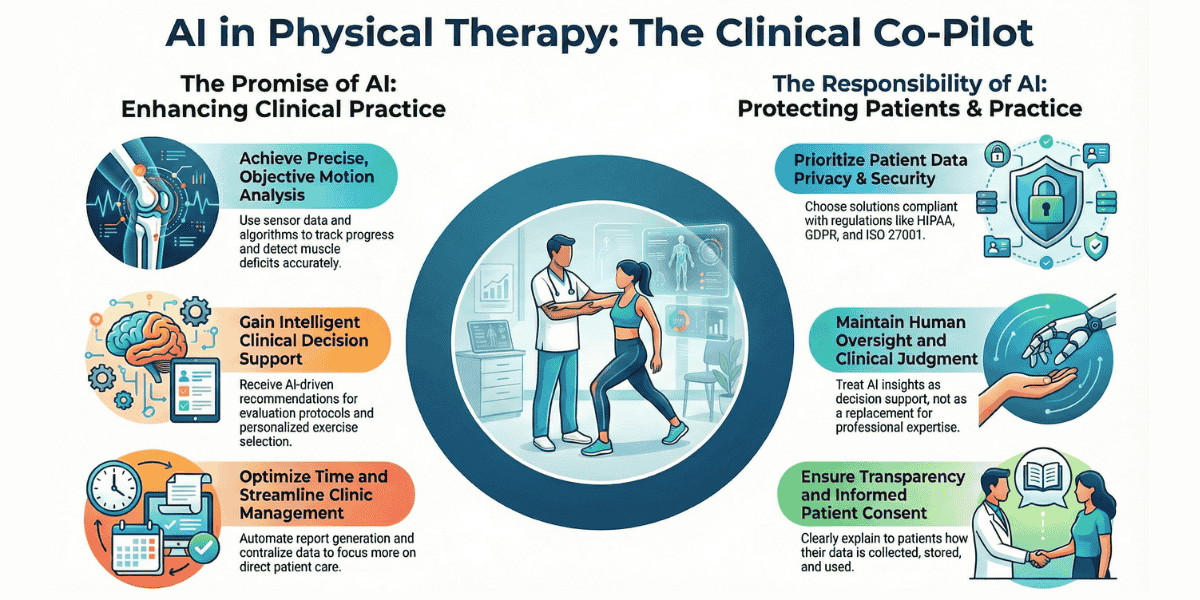
Artificial intelligence is no longer limited to research labs or large hospitals; it is increasingly present in physical therapy clinics, becoming a valuable clinical partner. By combining connected sensors with AI platforms, physical therapists can objectively assess movement, analyze data faster, and personalize rehabilitation plans. Here’s how AI is transforming daily practice.
Motion analysis and objective care
AI goes far beyond simple observation. By combining force, mobility, and balance sensor data with advanced algorithms, physical therapists can access precise, objective motion analysis.
This allows practitioners to track patient progress over time, detect asymmetries or muscle deficits, and make decisions based on solid, actionable data. Objective metrics also improve patient communication and collaboration with other healthcare professionals.
AI enhances assessments by making them faster, more accurate, and better documented. Rather than replacing the therapist’s judgment, it supports and enriches clinical decision-making.
Clinical decision support
One of AI’s key advantages in physical therapy is its ability to analyze large volumes of data in real time.
AI can provide personalized recommendations: evaluation protocols, exercise selection, or adjustment of intensity and frequency. This is particularly valuable for complex conditions where multiple parameters, such as pain, mobility, strength, and endurance, must be considered.
AI acts as an intelligent assistant, suggesting options without imposing them, while keeping the physical therapist at the center of the decision-making process.
Time optimization and clinic management
AI also helps streamline clinic operations. Reports can be generated automatically, test data is centralized, and patient communication becomes more efficient.
This reduces administrative burden and frees up time for patient care, allowing physical therapists to focus on what matters most: the therapeutic relationship.
AI thus becomes a productivity and organizational lever, improving efficiency while maintaining high-quality care.
💡 Want to dive deeper into the benefits of this technology? We explored its clinical applications and its growing impact on practice efficiency in our previous article: Revolutionizing Physical Therapy: The Growing Role of AI in Modern Healthcare.
Spotlight on Kassandra: Kinvent’s AI for motion and rehabilitation
At Kinvent, this vision comes to life through Kassandra, the artificial intelligence integrated into the Kinvent App. Designed to support professionals in their daily practice, Kassandra combines technological power with strict data confidentiality standards.
An intelligent and responsive assistant
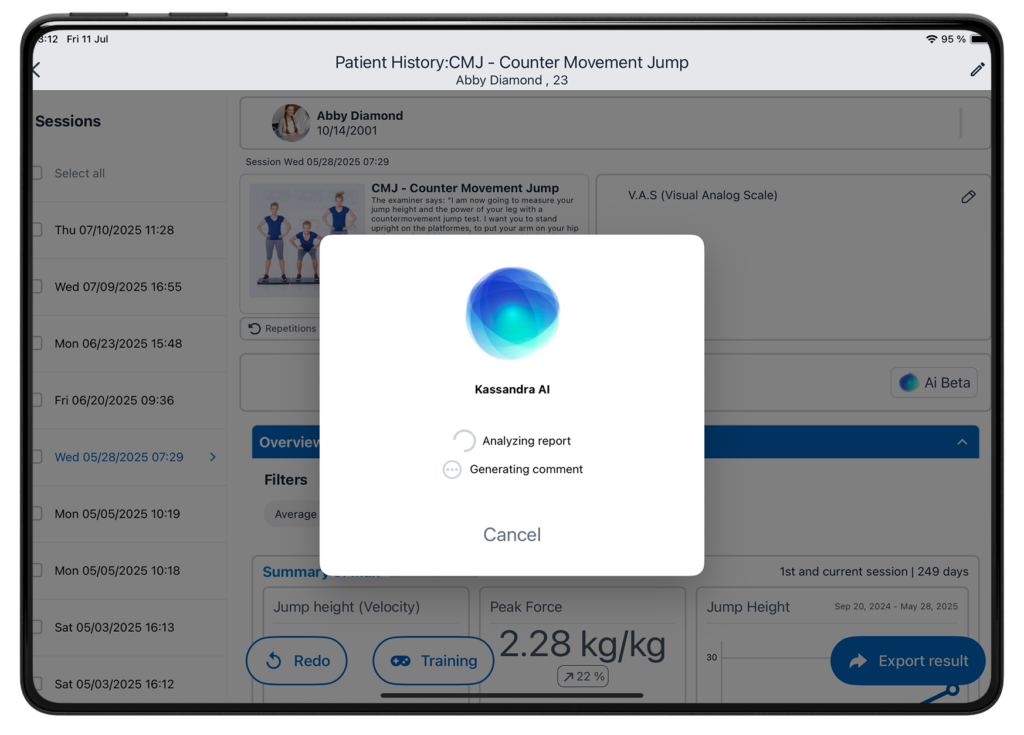
Fully connected to Kinvent’s sensors, Kassandra analyzes test results, identifies key insights, and generates clear, automated commentary for each report. It can also recommend the most appropriate evaluation protocols based on the patient’s profile or pathology.
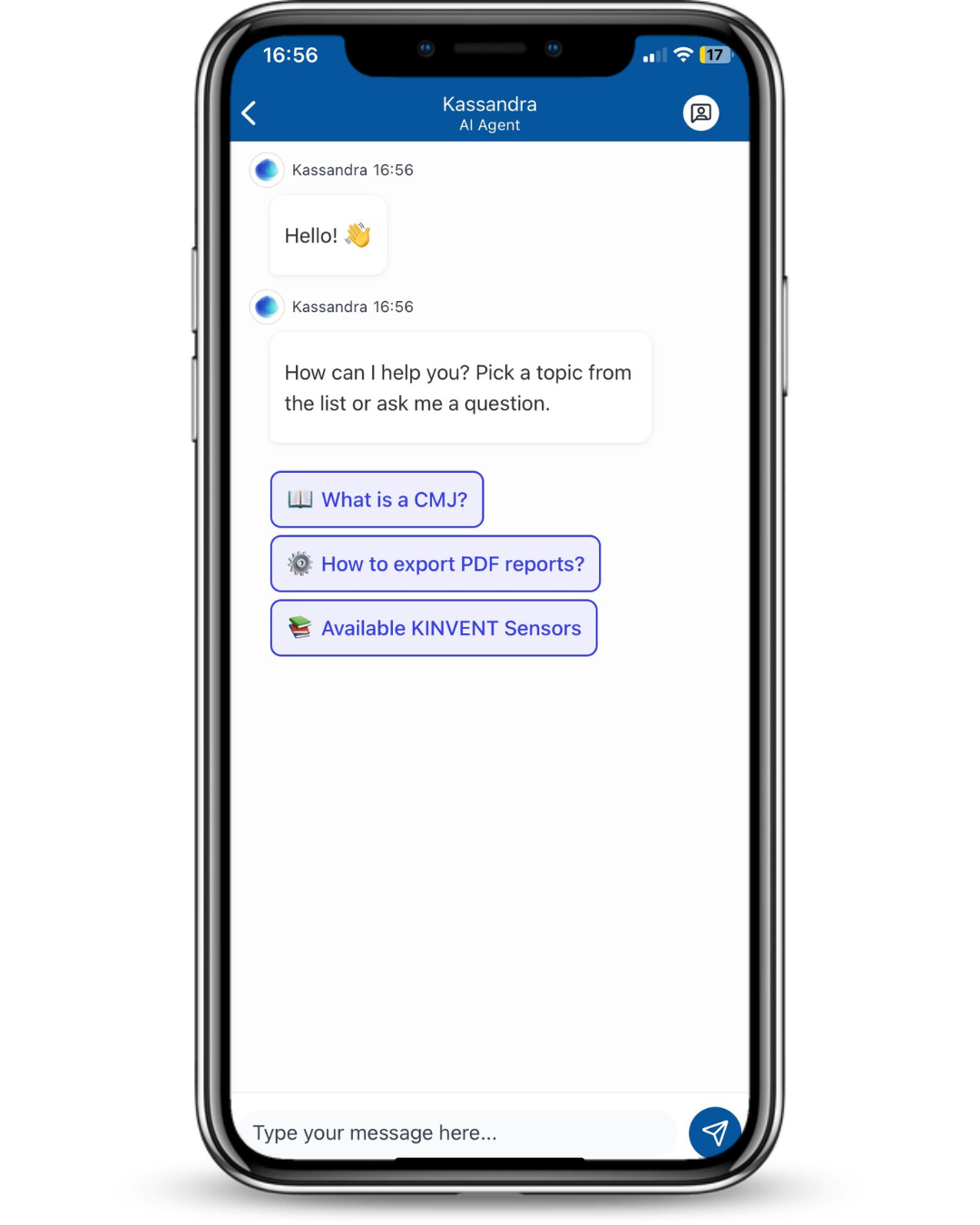
Its new smart chat feature even allows professionals to ask questions directly and receive instant, context-aware answers, similar to a conversational assistant but one specifically trained in rehabilitation and performance.
A reliable and secure AI
Kassandra is built with data protection at its core. All information processed by the system is fully anonymized before analysis, and the Kinvent App complies with international standards such as ISO 27001 (Information Security Management) and HIPAA (Health Data Protection).
This ensures optimal security and complete confidentiality for both practitioners and their patients. Kassandra exemplifies what AI in physical therapy should be: high-performing, transparent, and ethical.
2- Limitations and challenges of AI in physical therapy
While artificial intelligence is transforming physical therapy practice, it is not without limitations. Understanding these challenges is crucial for using AI safely and effectively while protecting patient data.
Data quality and reliability risks
AI’s effectiveness depends entirely on the quality of the data it receives. Incomplete, biased, or poorly calibrated data can lead to inaccurate recommendations.
For example, an algorithm trained on limited populations might misinterpret the progress of an atypical patient or suggest inappropriate protocols. This is why clinical judgment remains essential: AI is a support tool, not a replacement for the physical therapist.
Reliability also depends on sensor accuracy, proper recording, and consistent measurement protocols to ensure safe and valid analysis.
Lack of transparency and explainability
Another key challenge is the opacity of some AI algorithms. Certain tools act as “black boxes,” providing results without explaining how they were derived.
This lack of transparency can lead to uncertainty or errors if recommendations are followed blindly. Explainable AI solutions are therefore crucial, allowing physical therapists to understand the reasoning behind AI suggestions and integrate them safely into their practice.
Adoption challenges in clinical practice
Despite its benefits, AI adoption in physical therapy faces several obstacles:
- Limited training: not all therapists are familiar with AI tools and interpreting complex datasets.
- Technical and financial constraints: costs of sensors, software, or subscriptions can be barriers for some clinics.
- Resistance to change: introducing new technologies may be perceived as time-consuming or intrusive.
Overcoming these challenges requires continuous training, technical support, and gradual integration of AI tools into daily practice.
3- Patient data privacy and security: a core challenge of AI and data management in physical therapy
Artificial intelligence in physical therapy relies on one essential resource: data. Every movement captured, every strength measurement, and every recovery metric contributes to training and improving AI systems. But this dependence on data also raises one of the most sensitive issues in healthcare: the confidentiality and protection of patient information.
Why data protection matters
Patient data in physical therapy often contains highly personal health information from biomechanical performance to injury history. When integrated into AI platforms, this information becomes part of a digital ecosystem that must remain secure, confidential, and ethically managed.
If security measures are insufficient, the consequences can be serious: loss of trust, misuse of sensitive data, or even legal violations. Protecting patient data is therefore not just a regulatory obligation; it’s a professional and ethical responsibility for every physical therapist.
Regulatory frameworks and compliance standards
In many countries, healthcare professionals are subject to strict data protection laws.
- In Europe, the General Data Protection Regulation (GDPR) defines how personal data must be collected, processed, and stored, with an emphasis on transparency and consent.
- In the United States, HIPAA (Health Insurance Portability and Accountability Act) establishes standards for safeguarding medical information, ensuring it is used only for legitimate clinical purposes.
- On a global scale, ISO standards such as ISO 27001 provide a framework for Information Security Management Systems, helping organizations maintain consistent and auditable data protection practices.
For AI and data management in physical therapy, this means selecting solutions that adhere to these international standards, ensuring that patient information is treated with the same rigor as any other medical record.
Ethical principles: transparency, consent, and responsibility
Beyond legal compliance, ethics must guide the use of AI in healthcare. Physical therapists should always inform patients about how their data will be used, for example, when motion capture or sensor data is analyzed by an AI system.
Patients should have the right to:
- Know what data is collected,
- Understand how it will be processed,
- Give informed consent,
- And request data deletion if they wish.
In parallel, professionals must ensure that AI recommendations remain under human supervision. Ethical AI use means combining machine efficiency with clinical discernment, not replacing one with the other.
4- Best practices and Recommendations for physical therapists
Artificial intelligence and data management in physical therapy can bring remarkable benefits, from more precise assessments to improved workflow efficiency. However, these advantages depend on how responsibly and strategically AI tools are implemented. Below are key recommendations to help clinicians integrate these technologies ethically, securely, and effectively into their daily practice.
Evaluate reliability before adoption
Before introducing an AI system or digital data platform into clinical work, it’s crucial to verify its scientific, regulatory, and technical credibility:
- Scientific validation: The system should be supported by peer-reviewed research or independent testing that confirms its accuracy and clinical relevance.
- Regulatory compliance: Verify CE marking for medical devices in Europe or FDA clearance in the U.S., as well as GDPR or HIPAA compliance for data protection.
- Data security certifications: Look for international standards such as ISO 27001, which guarantees robust security management processes.
- Co-development with professionals: Favor tools designed in collaboration with clinicians and researchers to ensure real-world applicability.
Selecting solutions that meet these benchmarks ensures that AI enhances, rather than compromises, the quality of care.
Maintain human oversight and clinical judgment
Even the most advanced AI systems are only as valuable as the professionals using them. AI should support, not replace, the therapist’s reasoning. Clinical judgment remains essential for interpreting data, tailoring rehabilitation plans, and understanding each patient’s unique context.
Best practice means:
- Treating AI insights as decision support, not automatic instructions.
- Continuing to rely on manual assessments and clinical intuition where appropriate.
- Balancing objective data with the human connection that defines therapeutic care.
Ultimately, AI amplifies human expertise; it doesn’t substitute it.
Prioritize patient communication and consent
Transparency is a cornerstone of ethical practice. Patients should always be informed when their data is collected and analyzed by an AI system, and they should understand the purpose behind it.
To maintain trust:
- Clearly explain what data is collected, how it is stored, and why it is used.
- Obtain informed consent before any AI-driven analysis.
- Provide patients with access to their own data and allow them to withdraw consent if desired.
This approach fosters patient confidence and aligns with modern expectations of digital ethics in healthcare.
Strengthen digital literacy and continuous education
The rapid evolution of AI tools makes ongoing training essential for physical therapists.
Understanding how data is generated, processed, and interpreted helps practitioners make informed decisions and avoid overreliance on automated outputs.
Clinicians can:
- Participate in workshops or certification programs on AI in rehabilitation.
- Stay updated on the latest standards for data management and cybersecurity.
- Exchange feedback with peers to develop best practices for ethical integration.
Continuous learning ensures that professionals remain both technically competent and ethically aware in their use of AI.
Foster collaboration and co-construction
The most effective AI solutions are those built with and for healthcare professionals. Physical therapists should engage with developers, researchers, and industry partners to ensure tools are clinically relevant, user-friendly, and aligned with field needs.
This collaborative approach drives innovation that truly benefits patient outcomes, combining scientific rigor, technological reliability, and clinical practicality.
Key takeaway
Integrating AI and data management in physical therapy requires more than adopting new tools; it demands a culture of responsibility, education, and transparency. By following these best practices, physical therapists can embrace AI as a trusted clinical partner, ensuring progress without compromising ethical standards or patient trust.
5- FAQ: AI and Data Management in Physical Therapy
Will AI replace physical therapists?
No, and it shouldn’t. Artificial intelligence is designed to support the therapist, not to replace clinical expertise or human judgment. AI helps process data, identify performance patterns, and track progress more efficiently, but it cannot replace the therapist’s empathy, intuition, or hands-on skills.
In practice, AI acts as a clinical co-pilot, allowing professionals to focus more on patient care and less on repetitive or administrative tasks.
Are patient data truly secure when using AI systems?
Yes, provided that therapists choose certified, compliant, and transparent tools. Reliable solutions should follow HIPAA (in the U.S.) or GDPR (in Europe) standards, ensuring data encryption, anonymization, and restricted access.
At Kinvent, for example, all data processed by our AI Kassandra is anonymized before analysis. The Kinvent app complies with ISO 27001 and HIPAA regulations, guaranteeing a high level of data security and confidentiality for both clinicians and patients.
What concrete benefits does AI bring to a physical therapy practice?
AI and data management systems bring measurable improvements to daily clinical work:
- Objective movement analysis through connected sensors and automated interpretation.
- Clinical decision support, helping tailor protocols and progressions.
- Time optimization with automatic reporting and data centralization.
- Better communication with patients and interdisciplinary teams through clear, visual reports.
These benefits free up therapists’ time for what matters most: personalized care and patient engagement.
How can therapists identify trustworthy AI solutions?
When selecting an AI tool for clinical use, therapists should look for:
- Scientific validation through peer-reviewed studies.
- Regulatory approval, such as CE marking or FDA clearance.
- Compliance with data protection laws (GDPR, HIPAA).
- Transparent algorithms and user-friendly interfaces.
- Involvement of physical therapy experts in the development process.
Choosing a credible solution ensures accuracy, safety, and long-term usability in a healthcare environment.
Can AI be used safely with all types of patients?
Yes, but clinical discretion remains essential. AI tools must be adapted to the patient’s specific condition, pathology, and rehabilitation goals. The therapist should always verify that the tool’s algorithms are validated for the population in question and adjust its recommendations when necessary.
AI should inform, not dictate, the course of care. The therapist remains the final decision-maker.
What steps can therapists take to protect patient data in daily practice?
To maintain strong data security when using AI tools:
- Use platforms with secure hosting (e.g., HDS-certified servers in Europe).
- Anonymize data whenever possible before processing.
- Keep software updated and audit access permissions regularly.
- Educate staff and patients on digital safety and confidentiality.
These habits ensure compliance with healthcare regulations and preserve patient trust in a connected clinical environment.
6- Conclusion: Building a Responsible Future for AI and Data in Physical Therapy
Artificial intelligence and data management are no longer futuristic concepts. They are already reshaping physical therapy, bringing greater precision, personalization, and efficiency to patient care. Yet, as this technology evolves, its responsible use becomes a collective duty.
AI empowers therapists to objectify movement, optimize clinical decisions, and save time on administrative tasks. Tools like Kassandra, Kinvent’s integrated AI assistant, demonstrate how smart technology can enhance rehabilitation by offering real-time insights, customized protocols, and secure, automated reporting, all while respecting the highest standards of data protection.
However, the digital transformation of healthcare also raises critical questions:
- How do we ensure that patient data remains confidential?
- How do we maintain clinical judgment and ethics in an increasingly data-driven environment?
The answer lies in balance: combining innovation with vigilance, and technology with humanity.
To build a responsible future for AI in physical therapy:
- Choose validated, compliant solutions developed in partnership with clinicians.
- Keep patient privacy at the forefront of every digital process.
- Use AI as a clinical ally, not an authority.
- Stay curious, informed, and continuously trained in emerging digital tools.
The future of physical therapy belongs to professionals who know how to integrate technology without losing the human touch. When used ethically and intelligently, AI doesn’t just process data; it helps transform it into meaningful, actionable insights that improve both patient outcomes and the quality of care.
At Kinvent, we believe in an AI that serves movement and respects people: transparent, secure, and designed to make the therapist’s expertise even more powerful.


