


For coaches and sports scientists, the Drop Jump (DJ) is a staple test for assessing explosive power and the efficiency of the Stretch-Shortening Cycle (SSC). Traditionally, we measure performance using simple numbers: how high did the athlete jump? How short was their ground contact time?
However, a fascinating study published in the Journal of Sports Sciences suggests that looking at single numbers isn’t enough. By using kinetic analysis and examining the full force-time, power-time, and stiffness-time curves, researchers have uncovered distinct patterns that classify athletes into specific performance levels, regardless of their sport.
Here is a deep dive into the study by Panoutsakopoulos et al. (2022) and its implications for modern drop-jump force-time curve analysis and athletic profiling.
CONTENTS
1- Why Traditional Drop Jump Metrics Don’t Tell the Whole Story
2- The Study: Can Kinetic Curve Analysis Classify Drop Jump Performance?
3- Three Distinct Drop Jump Performance Profiles Identified
4- Force and Power Curves Align: Stiffness Tells a Different Story
5- Drop Jump Performance Is Not Sport-Specific
6- Practical Applications: How Coaches Should Use Force-Time Curve Analysis
7- Conclusion: What Kinetic Curve Analysis Adds to Drop Jump Testing
8- FAQ: Drop Jump Force-Time Curve Analysis
9- Reference
1- Why Traditional Drop Jump Metrics Don’t Tell the Whole Story
In most performance settings, drop jump performance analysis is reduced to a few key outcome variables:
- Jump height
- Ground contact time
- Sometimes the reactive strength index (RSI)
These metrics are useful, but they only describe the result of the movement, not the strategy used to produce it.
Two athletes can achieve the same jump height with identical contact times, yet rely on completely different neuromuscular strategies:
- One athlete may generate high force rapidly during the propulsion phase
- Another may depend more on passive stiffness and elastic recoil
When we focus only on peak or summary values, these differences remain hidden.
This is where force-time curve analysis becomes essential. Instead of isolating single data points, kinetic analysis examines how key variables evolve throughout the entire ground contact phase, including:
- Force production
- Power output
- Vertical stiffness behavior
These kinetic data curves provide insight into how an athlete:
- Absorbs impact at landing
- Transitions through the amortization phase
- Produces force for takeoff
By looking at the full curve rather than just the outcome, practitioners can move from simple performance testing to true movement strategy profiling.

2- The Study: Can Kinetic Curve Analysis Classify Drop Jump Performance?
To move beyond traditional outcome metrics, the researchers investigated whether drop jump kinetic analysis could identify consistent performance profiles by examining the entire shape of biomechanical curves rather than isolated peak values.
Their objective was clear: determine whether force-time curve analysis and other continuous kinetic signals could classify athletes into distinct levels of drop-jump performance.
Participants and Testing Protocol
The study included 128 physically active males from a range of sporting backgrounds:
- Soccer players
- Volleyball players
- Basketball players
- Track and field athletes
- Rowers
- Physical education students
Each participant performed a drop jump test from a height of 40 cm, a standard protocol used in plyometric performance assessment and stretch-shortening cycle evaluation.
From Peak Values to Force-Time Curve Analysis
Instead of focusing solely on peak force or peak power, the researchers analyzed continuous one-dimensional (1-D) kinetic curves across the full ground contact phase. Using Hierarchical Cluster Analysis, they examined:
- Vertical Ground Reaction Force (vGRF) time-curves
- Power (P) time-curves
- Vertical Stiffness (K) time-curves
This approach allowed the team to compare not just how much force or power athletes produced, but how these variables evolved during the drop jump. In other words, they shifted from traditional performance metrics to a deeper biomechanical profiling method based on kinetic curve patterns.
3- Three Distinct Drop Jump Performance Profiles Identified
Using force-time curve analysis and clustering techniques, the researchers successfully grouped athletes into three distinct drop jump performance profiles based on the shape of their kinetic curves.
These clusters were not based on sport or training background, but purely on biomechanical output patterns.
Poor, Average, and Top Performers
The analysis revealed three clear performance tiers:
- Cluster 2 – Poor Performers
- Cluster 1 – Average Performers
- Cluster 3 – Top Performers
The differences between these groups were substantial.
Compared to the other clusters, Top Performers demonstrated:
- Significantly higher peak vertical ground reaction force (vGRF)
- Greater power output during ground contact
- Higher vertical stiffness values
In contrast, Poor Performers showed consistently lower values across these kinetic variables compared to the Average group, highlighting clear deficits in force production, power generation, and stiffness regulation during the drop jump.
When During Ground Contact Do Athletes Differ?
A key strength of this drop jump kinetic analysis was identifying when, during ground contact, the performance differences actually occurred.
Force-Time Curve Differences
The three groups showed clear dissimilarities in their force-time curves from approximately 25% to 70% of total ground contact time
This phase corresponds largely to the voluntary force application period, where athletes actively produce force to reverse movement and prepare for takeoff.
Power-Time Curve Differences
Differences in power output curves appeared in two main time windows:
- 20–40% of ground contact
- 55–70% of ground contact
These windows highlight critical moments where explosive force production and energy transfer differentiate higher- and lower-level performers.
Stiffness Curve Differences
Unlike force and power, vertical stiffness curves showed differences: Almost immediately from the start of ground contact
This suggests that stiffness-related strategies influence performance from the very first milliseconds of landing, playing a role in how athletes manage impact and prepare for propulsion.
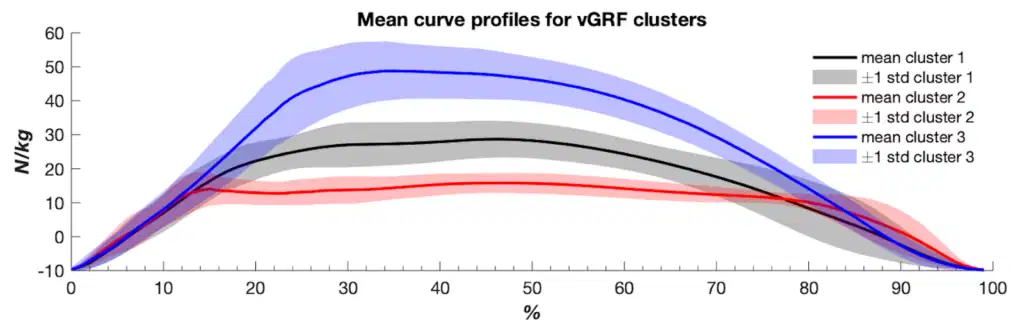
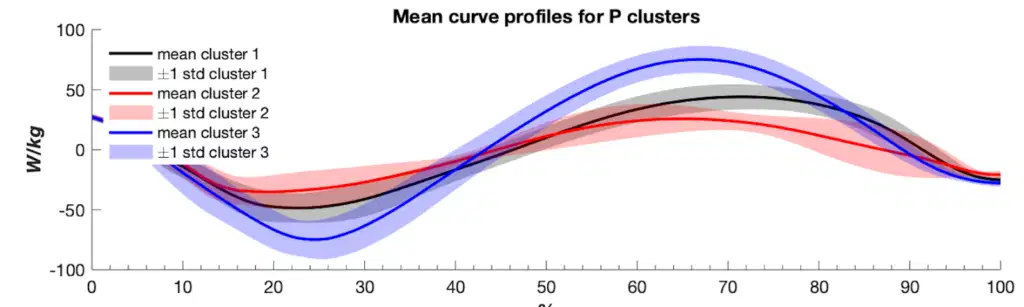
Figure 1: Mean force–time (vGRF) and power (P) curves across all participants in each of the three clusters detected from the clustering analysis. The horizontal axis represents the percentage (%) duration of the entire ground contact phase. The shaded area represents the respective Standard Deviation.
4- Force and Power Curves Align: Stiffness Tells a Different Story
One of the most striking outcomes of this drop jump force-time curve analysis was the strong agreement between force and power performance profiles, and the contrasting behavior of vertical stiffness.
Force and Power Reflect a Shared Performance Strategy
The study found a high level of overlap between athletes classified using force-time and power-time curves.
69% of athletes identified as Top Performers based on their force curves were also classified in the Top cluster based on their power curves
This strong alignment suggests that force production capacity and power output patterns are tightly linked when defining high-level drop jump performance. Athletes who can apply large amounts of force effectively during ground contact also tend to generate greater mechanical power.
From a neuromuscular performance perspective, force and power curves appear to describe a similar explosive strategy during the stretch-shortening cycle.
The Stiffness Anomaly
Vertical stiffness, however, did not follow the same pattern.
While top performers generally showed higher stiffness values, the clustering consistency was much lower when stiffness curves were compared to force and power.
- Only 52.4% of cases matched between force and stiffness clusters
- The athletes grouped based on stiffness were often different from those grouped by force and power
This means stiffness represents a distinct biomechanical quality, not simply a by-product of force or power capacity.
Key Takeaway for Performance Profiling
While vertical stiffness is a crucial component of plyometric and stretch-shortening cycle performance, it does not independently define overall drop jump ability.
An athlete may demonstrate high stiffness but still fail to reach the Top Performer category if:
- Force application is insufficient
- Power production during ground contact is suboptimal
In other words, optimal drop jump performance requires a coordinated interaction between force production, power output, and stiffness regulation, not just one of these qualities in isolation.
5- Drop Jump Performance Is Not Sport-Specific
A common assumption in sports performance is that athletes from “jump-dominant” sports such as volleyball or basketball will naturally display superior drop jump biomechanics and more efficient force-time curves than athletes from other disciplines.
However, this study challenges that idea.
No Sport-Specific Silos in Kinetic Profiles
When the researchers examined the distribution of athletes across the three clusters, they found that sport background did not strictly determine drop jump performance level.
Athletes from the same sport were spread across different performance groups, meaning that:
- Being part of a jumping sport did not guarantee placement in the Top Performer cluster
- Athletes within the same team or discipline could display very different kinetic curve patterns
- Individual neuromuscular strategies varied more than sport-specific demands might suggest
Example: Track and Field Athletes
Track and field athletes were strongly represented in the Top performance clusters, but not uniformly.
- 76% of track athletes in the Top force cluster were also in the Top power cluster
- Yet only 28% of those same athletes appeared in the Top stiffness cluster
This highlights that even within a population expected to have high explosive strength and reactive ability, force, power, and stiffness strategies can differ substantially.
What This Means for Athlete Profiling
These findings reinforce the value of individual biomechanical profiling using force-time curve analysis.
Two athletes with similar training backgrounds or even identical jump heights may rely on completely different movement strategies:
- One may be more force-dominant, producing high levels of active force
- Another may be more stiffness-dominant, relying on elastic energy return and joint rigidity
Without drop jump kinetic analysis, these differences remain invisible, making it harder to design truly individualized training programs.
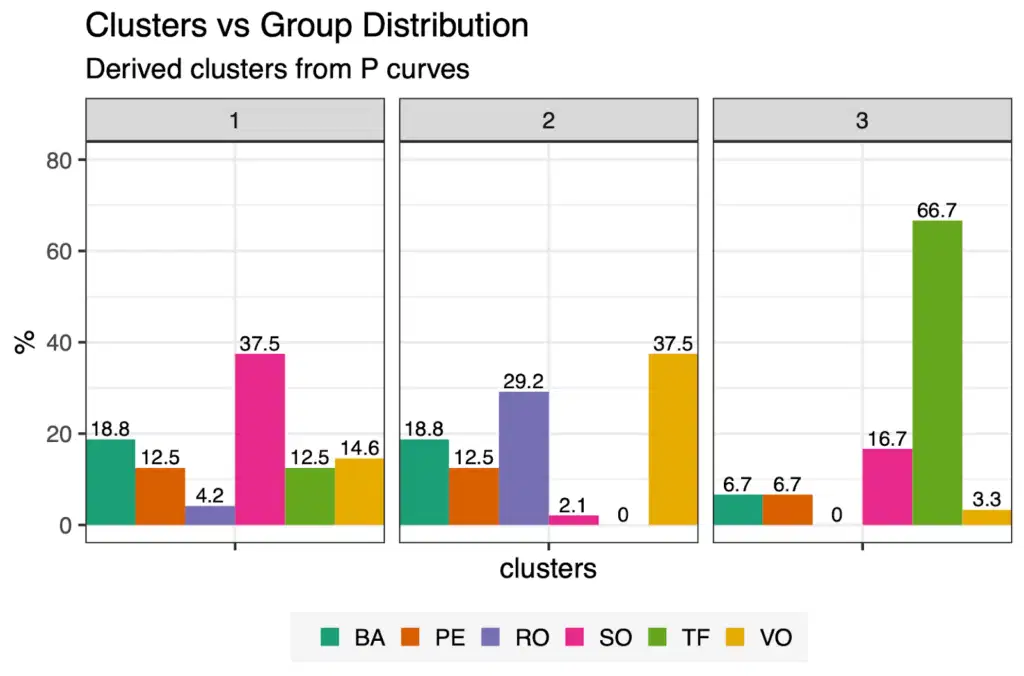
Figure 2: Distributions of groups within each cluster for the power output (P). Clusters 1, 2 and 3 represent average, poor and top drop jump performers, respectively. NOTE: BA: basketball players; PE: Physical Education students; RO: rowers; SO:soccer players; TF: track and field athletes; VO: volleyball players.
6- Practical Applications: How Coaches Should Use Force-Time Curve Analysis
Understanding drop jump force-time curves is not just a scientific exercise; it has direct implications for training design, plyometric programming, and athlete performance profiling.
The study’s findings help coaches move beyond generic jump training and toward targeted neuromuscular development.
Train the Force Application Phase
The main differences between performance levels occurred between 25–70% of ground contact time, the phase largely associated with voluntary force production.
This suggests that improving drop jump performance is not only about tolerating impact forces, but about enhancing the athlete’s ability to:
- Rapidly generate high levels of active force
- Transition efficiently from eccentric to concentric action
- Produce force quickly during the propulsion phase
Training strategies may therefore emphasize:
- Fast stretch-shortening cycle plyometrics
- Reactive strength drills
- Exercises targeting rate of force development (RFD)
The goal is to improve how force is applied over time, not just how high the athlete jumps.
Develop Stiffness as an Independent Quality
Because vertical stiffness did not cluster consistently with force and power, it should be considered a separate neuromuscular characteristic.
Coaches should not assume that increasing strength or power will automatically optimize stiffness behavior during ground contact.
Instead, stiffness may need to be trained more specifically through:
- Low-amplitude, high-frequency plyometrics
- Ankle and lower-limb reactive drills
- Exercises emphasizing short ground contact times
Importantly, the study suggests that more stiffness is not always better. Performance appears to depend on optimal stiffness regulation, rather than maximal rigidity.
Profile Athletes Individually, Not by Sport
Since sport background did not reliably predict drop jump strategy, individual testing is essential.
Two athletes from the same sport may present:
- Similar jump heights
- Similar contact times
- Completely different force-time curve patterns
One athlete may lack force production capacity, while another may show inefficient stiffness control. Without kinetic curve analysis, both athletes could receive the same training, despite needing very different interventions.
Using drop jump biomechanical profiling, coaches can tailor programs to:
- Address specific force or power deficits
- Modify stiffness strategies
- Improve overall stretch-shortening cycle efficiency
7- Conclusion: What Kinetic Curve Analysis Adds to Drop Jump Testing
The study by Panoutsakopoulos et al. demonstrates that force-time and power-time curve analysis are powerful tools for classifying drop jump performance levels. Rather than focusing only on jump height or contact time, this approach reveals the underlying movement strategies that differentiate athletes.
By examining kinetic curves across the full ground contact phase, practitioners can see how performance is produced, not just the outcome. The findings show that top performers are characterized by their ability to:
- Apply large amounts of force during the middle phase of ground contact
- Generate high levels of mechanical power
- Regulate vertical stiffness effectively, though not in isolation
Importantly, these performance strategies were not strictly sport-dependent, reinforcing the need for individual biomechanical profiling rather than assumptions based on athletic background.
For coaches and sports scientists, integrating drop jump force-time curve analysis into testing protocols provides a deeper understanding of neuromuscular performance, supports more precise athlete classification, and enables targeted plyometric training interventions.
The integration of force platforms and kinetic analysis tools into testing protocols now makes it possible to apply this knowledge in the field and refine individual athlete profiling.
In short, kinetic curve analysis reveals the true “DNA” of drop jump performance, the specific force, power, and stiffness patterns that separate top performers from the rest.
8- FAQ: Drop Jump Force-Time Curve Analysis
What is a force-time curve in a drop jump?
A force-time curve shows how vertical ground reaction force changes throughout ground contact during a drop jump. It helps identify how an athlete applies force over time, not just how high they jump.
Why is force-time curve analysis more useful than jump height alone?
Jump height measures the outcome of performance, while force-time curve analysis reveals the strategy behind it. This allows coaches to understand how force and power are produced during the stretch-shortening cycle.
What does vertical stiffness mean in a drop jump?
Vertical stiffness reflects how the lower limbs resist deformation during ground contact. It influences how effectively elastic energy is stored and reused during plyometric movements.
Can two athletes have the same jump height but different force-time curves?
Yes. Athletes can achieve similar jump heights using different force, power, and stiffness strategies. Kinetic curve analysis helps reveal these hidden differences.
How can coaches use drop jump kinetic analysis in training?
Coaches can use force-time curve data to identify whether an athlete needs to improve force production, power output, or stiffness control, and then tailor plyometric training accordingly.


