


In modern sprinting, hundredths of a second make the difference, and precision is no longer optional. Traditional tools such as split times, GPS data or percentage-based strength prescriptions provide partial information: they describe what happened, but not how an athlete actually produces speed.
Force-Velocity Profiling in sprint fundamentally changes this perspective. By analysing the relationship between horizontal force and running velocity throughout acceleration, it reveals whether an athlete lacks early-phase force, maximal velocity, or mechanical effectiveness.
Thanks to the K-Power hybrid Sprint & VBT sensor, this biomechanical insight, previously limited to laboratory setups, is now available in real time on the field. The device measures velocity, acceleration and horizontal power continuously, allowing coaches to tailor training sessions immediately based on each athlete’s mechanical profile
In this article, we explore how Force-Velocity Profiling in sprint, combined with K-Power’s advanced measurement technology, makes it possible to precisely diagnose an athlete’s needs, individualize sprint and strength training through VBT, and accelerate improvements in both early acceleration and maximal velocity.
CONTENTS
1- What Is Force-Velocity Profiling?
2- Understanding Force-Velocity Profiling in Sprint
3- How Force-Velocity Profiling Improves Performance
4- The Limitations of Traditional Methods
5- Our Solution: K-Power, Hybrid Sprint & VBT Sensor
6- VBT and Force-Velocity Profiling: A Complete Training System
7- Building an Individualised Training Program in 4 Steps
8- FAQ: Force-Velocity Profiling in Sprint
9- Conclusion
10- References
1- What Is Force-Velocity Profiling?
Force-Velocity Profiling in sprint is a method used to understand how an athlete produces speed. It measures the relationship between the horizontal force applied to the ground and the running velocity at every moment of the acceleration phase. This relationship reveals two fundamental parameters:
- F₀: the ability to generate high horizontal force during the initial steps,
- V₀: the ability to reach and express high running velocity as stride length and frequency increase.
By analysing an athlete’s F–V profile, it becomes possible to identify whether they present a force deficit (insufficient horizontal force at the start) or a velocity deficit (difficulty maintaining high stride frequency at increasing speeds). This immediate diagnostic shows what truly limits performance and guides the direction of training accordingly.
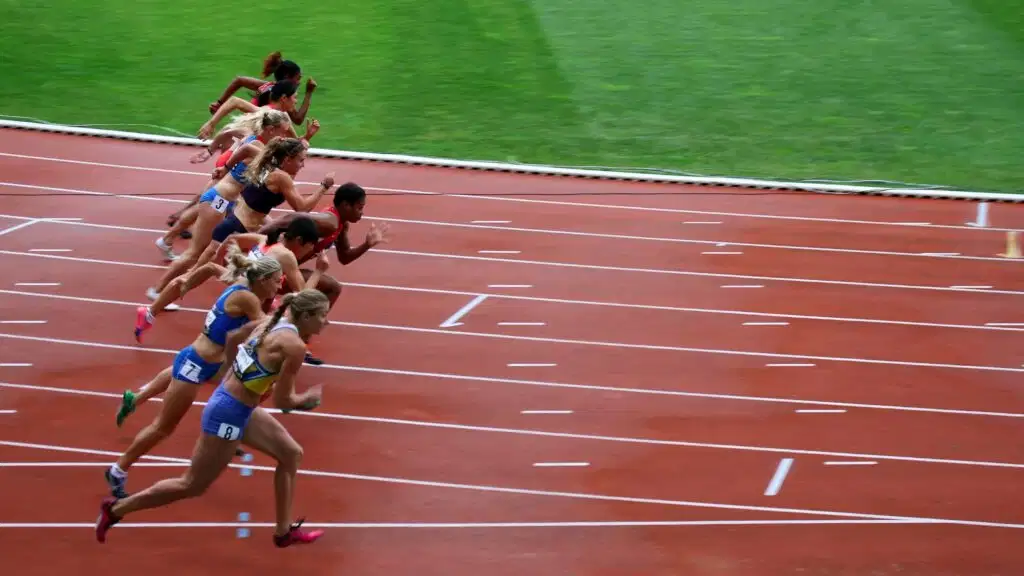
Understanding Force-Velocity Profiling in sprint is essential, but it is only the first step. Its real value appears when we observe how this information transforms training. Once the limiting factor is identified, programming becomes precise and targeted: no more approximations, only interventions that directly address the athlete’s mechanical needs. This is why F–V profiling represents a major evolution in sprint science.
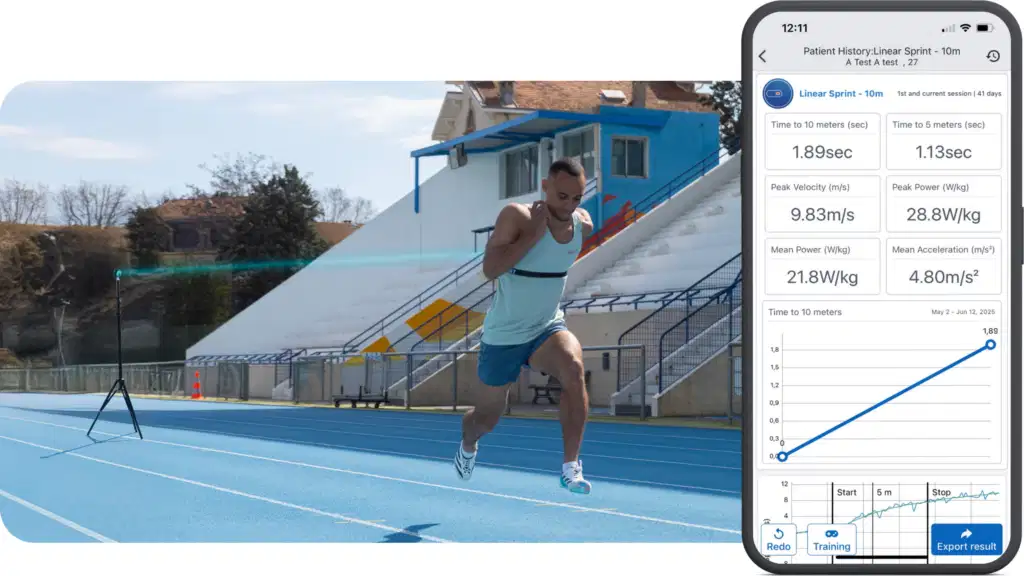
The emergence of modern measurement technologies, such as the K-Power sensor combining UWB and IMU signals, now makes it possible to collect continuous, reliable and reproducible data directly in the field. This level of precision enables a complete mechanical analysis of sprint acceleration, formerly limited to laboratory-grade systems.
By integrating this information into training planning, coaches can now tailor training content toward the qualities that are truly decisive for each athlete, improve the effectiveness of the work performed, and accelerate performance gains measured over 5 m, 10 m and beyond, as well as in average acceleration and maximal speed.
2- Understanding Force-Velocity Profiling in Sprint
Force-Velocity Profiling in sprint provides a complete mechanical framework for analysing an athlete’s acceleration capabilities.
Key parameters of the Force-Velocity model
According to the modelling proposed by Samozino and Morin, the relationship between horizontal force and running velocity can be described linearly from continuous measurements of velocity v(t) and acceleration a(t).
The main parameters derived from this model are:
- F₀ – Theoretical maximal force
The ability to produce high horizontal force at low velocities, essential during the first steps of acceleration. - V₀ – Theoretical maximal velocity
Indicates the athlete’s ability to maintain high running velocity as horizontal force decreases. - Pmax – Maximal mechanical power
Calculated as Pmax=14F0⋅V0, representing the optimal balance between force production and running velocity. - RFmax and DRF – Mechanical effectiveness
These parameters describe the proportion of total force that is effectively oriented horizontally, and how this ratio decreases as velocity increases.
Identifying mechanical profiles
Analysing the Force-Velocity profile makes it possible to distinguish two major forms of mechanical limitation:
- Force deficit: Insufficient ability to generate horizontal force during the initial acceleration steps.
- Velocity deficit: Difficulty reaching or sustaining high running velocities in the later phase of acceleration.
This distinction provides an objective basis for designing training interventions and ensuring better transfer to sprint performance.
The role of modern technologies in F–V profiling
Current technologies greatly simplify the computation of the F–V profile through:
- continuous measurement of velocity v(t) and acceleration a(t),
- UWB + IMU fusion ensuring high precision and reproducibility,
- automated calculations of horizontal forces, force ratios, and all necessary mechanical parameters.
These innovations make on-field assessment accessible, whereas such analyses were previously limited to laboratory settings requiring complex or expensive equipment.
A new way to understand sprint performance
The major benefit of the Force-Velocity profile is that it helps analyse how performance is produced, rather than only measuring the outcome (e.g., a split time). This provides a deeper understanding of the determinants of acceleration and supports a rigorously individualized training approach.

💡 To explore mechanical models, practical applications, and sprint/VBT protocols in more detail, download the FREE “K-Power: The smart way to measure speed and power” ebook.
3- How Force-Velocity Profiling Improves Performance
Force-Velocity Profiling is a decisive tool for understanding and optimising acceleration because it identifies the specific mechanical factors that limit an athlete’s performance. While traditional indicators (split times, estimated maximal velocity, visual analysis) describe only the outcome, the F–V profile reveals the mechanics behind the performance. This provides several major advantages for short- and long-term progression.
Precise identification of performance limitations
By characterising F₀, V₀, Pmax, RFmax and DRF, coaches can determine whether the primary limitation comes from:
- a force deficit (insufficient horizontal force during the initial steps),
- a velocity deficit (difficulty sustaining velocity increase in the later phase),
- a mechanical effectiveness issue (horizontal force ratio decreasing too rapidly).
This level of precision allows training to be targeted far more effectively than with generic approaches.
Faster improvements in early acceleration
The 5 m and 10 m splits, highly dependent on horizontal force production in the first steps, are particularly sensitive to training focused on F₀ and Pmax.
Data from the K-Power sensor shows that analysing average acceleration ā and changes in horizontal force helps track improvements in propulsion effectiveness throughout the entire acceleration phase.
A balanced Force-Velocity profile typically leads to measurable gains in the early phases of sprinting.
Better development of maximal velocity
Understanding V₀ and the progressive decrease of the force ratio (DRF) guides training toward optimising mechanics at higher velocities. Strengthening the athlete’s ability to maintain effective horizontal propulsion as speed increases improves maximal velocity potential, a key determinant of sprint performance.
Reduced unnecessary training volume and better planning
Because the F–V profile identifies the most relevant mechanical qualities to develop, it allows coaches to:
- avoid non-specific programmes,
- reduce low-value repetitions,
- improve transfer between strength work, technical drills, and sprinting.
Training interventions become more targeted, more efficient, and better integrated into the preparation cycle.
A continuous evaluation tool to monitor training impact
With fast and reproducible measurements, athletes can be reprofiled regularly to:
- confirm changes in mechanical parameters,
- adjust training content based on observed responses,
- validate the relevance of exercises and loading strategies.
This feedback loop represents a major step forward for load management, fatigue monitoring, and long-term optimisation of sprint development.
4- The Limitations of Traditional Methods
Traditional tools for analysing sprint performance provide only a partial view and do not allow precise characterisation of the mechanical parameters required for Force-Velocity Profiling in sprint.
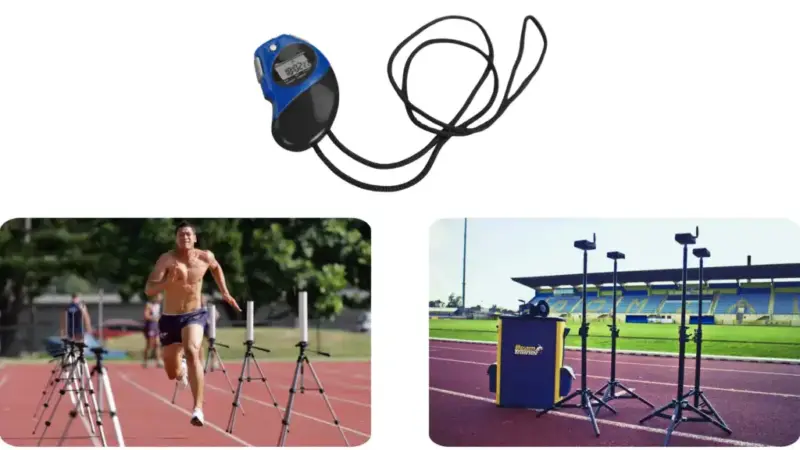
Manual timing
Although widely used, manual timing lacks precision and provides no continuous data on velocity or acceleration. It cannot estimate horizontal force or the actual dynamics of acceleration.
GPS and tracking systems
GPS devices have sampling frequencies that are too low to accurately analyse the first steps, a critical phase for Force-Velocity Profiling. Their precision decreases even further in indoor environments, limiting their usefulness for assessing linear acceleration.
Video analysis
Video enables technical assessment but requires equipment, manual processing and strict standardisation. It does not provide continuous mechanical variables such as horizontal force, DRF or Pmax.
A lack of usable mechanical data
Traditional approaches mainly measure outcomes (time, estimated maximal speed), not the process that produces performance. They do not capture v(t), a(t), or horizontal force, the foundations of F–V profiling according to the methodology presented in the K-Power ebook.
As a result, it becomes difficult to individualise training or precisely identify an athlete’s mechanical limitations.
5- Our Solution: K-Power, Hybrid Sprint & VBT Sensor
The K-Power sensor was designed to make full mechanical sprint analysis accessible on the field, not just in the laboratory. Its technology is based on UWB + IMU fusion, enabling continuous measurement of velocity v(t), acceleration a(t), and the calculation of horizontal force and all key Force-Velocity profile parameters.
Core technology and main features
- High-resolution measurements: velocity, acceleration, horizontal force and mechanical power.
- Real-time transmission: immediate feedback for track or weight-room analysis.
- High reproducibility: robust interference management and built-in calibration ensure reliable data.
- Cloud and performance history: automatic storage, longitudinal monitoring and trend analysis.
- Versatility: usable for sprint F–V profiling as well as VBT (barbell velocity measurement).
This hardware and software architecture transforms athlete monitoring by providing continuous, objective and actionable data to guide training.
Key metrics provided by K-Power
Based on the mechanical models of Samozino and Morin, K-Power automatically calculates all parameters required for Force-Velocity Profiling:
- 5 m, 10 m, and beyond times: indicators of early-acceleration effectiveness.
- Maximal velocity (Vmax): ability to reach and sustain high speed.
- Average acceleration: reflects continuous propulsion capacity.
- Horizontal power (Pₕ) and Pmax: estimation of the optimal force–velocity balance.
- F₀ and V₀: theoretical values essential for mechanical diagnosis.
- RFmax and DRF: measures of horizontal propulsion effectiveness and its decline across acceleration.
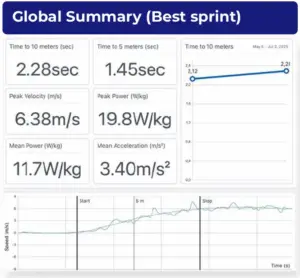
K-Power also displays full curves (velocity–time, acceleration–time, F–V and power–velocity), providing a detailed visualisation of mechanical behaviour during sprinting.
Why is this combination decisive?
K-Power’s strength lies in its ability to combine continuous measurement, mechanical interpretation, and longitudinal monitoring. Coaches gain access to:
- an objective diagnosis (force deficit, velocity deficit, mechanical effectiveness),
- precise indicators to track progress,
- a tool that connects on-track sprint work with weight-room training through VBT.
This integrated approach forms a solid foundation for individualised programming and maximising performance gains.
6- VBT and Force-Velocity Profiling: A Complete Training System
Integrating Velocity-Based Training (VBT) with Force-Velocity Profiling creates a coherent training framework that connects weight-room work with the mechanical demands of sprinting.
The F–V profile identifies where an athlete’s mechanical limitations lie (force deficit or velocity deficit), while VBT determines how to develop these qualities through precise control of training intensity.
The limitations of %1RM-based load prescription
1RM values can fluctuate by ±18% depending on fatigue, daily readiness or training context, making percentage-based prescriptions often inaccurate and sometimes unsuitable for the intended stimulus.
VBT overcomes this variability by relying directly on movement velocity, a reliable indicator of the athlete’s real effort level.
Velocity zones: direct links to specific adaptations
Each velocity zone corresponds to a distinct neuromuscular adaptation:
- < 0.5 m/s — maximal strength development
- 0.5 to 0.75 m/s — power zone
- 1.0 to 1.3 m/s — speed-strength
- > 1.3 m/s — velocity and minimal force-time development
These zones, supported by VBT literature, allow training to target precisely the needs revealed by the athlete’s F–V profile.
Continuous autoregulation to optimise training quality
Monitoring movement velocity enables instant adjustments:
- if velocity is lower than expected, excessive fatigue is present → reduce load or volume;
- if velocity is higher than expected, the athlete is in a good state → load may be increased.
VBT ensures that every repetition stays within the optimal intensity zone, preserving training quality and reducing the risk of overtraining.
A seamless link between track work and strength training
Horizontal force production during acceleration depends on neuromuscular qualities that VBT can develop in a highly targeted way. Thus:
- a force deficit requires more work at low execution velocities (< 0.5 m/s),
- a velocity deficit benefits from lighter loads moved rapidly (> 1.0 m/s).
Through combined sprint and VBT measurement, K-Power aligns both training environments with precision, providing a major advantage for performance progression.
7- Building an Individualised Training Program in 4 Steps
Integrating Force-Velocity Profiling and VBT provides a fully data-driven framework for training. The proposed model follows a four-step loop that ensures consistency between diagnosis, prescription and monitoring.
Step 1: Profile the athlete
The first step is to perform an instrumented sprint test with K-Power to obtain:
- the velocity curve v(t),
- derived horizontal forces,
- key mechanical parameters (F₀, V₀, Pmax, RFmax, DRF),
- split times (5 m, 10 m, etc.),
- maximal velocity (Vmax).
This diagnostic identifies whether the athlete presents a force deficit, a velocity deficit, or a mechanical inefficiency (e.g., excessively high DRF).
Step 2: Select exercises and velocity zones accordingly
Exercise selection must target the qualities to be developed:
- Force deficit → low-velocity strength work (< 0.5 m/s), heavy loads, horizontal-force-oriented exercises.
- Velocity deficit → light loads moved quickly (> 1.0 m/s), fly sprints, explosive exercises.
- Mechanical inefficiency → technical work, stability, posture and coordination drills.
Using defined VBT velocity zones ensures that each exercise produces the intended neuromuscular stimulus.
Step 3: Monitor every repetition with VBT
Using the K-Power sensor in the weight room makes it possible to control:
- mean or peak velocity,
- execution quality,
- fatigue-related velocity loss.
If velocity drops excessively, the load can be reduced, or the set stopped to maintain the optimal stimulus. This autoregulation improves training quality and avoids unnecessary volume.
Step 4: Re-profile to track progress
Regular reassessment (every 4–6 weeks, depending on the training cycle) enables coaches to:
- observe changes in the F–V profile,
- validate the effectiveness of interventions,
- adjust programming when expected adaptations do not appear,
- maintain alignment between track work and strength training.
This diagnosis–intervention–reassessment loop forms a training model grounded in reproducible, scientifically validated data.
8- FAQ: Force-Velocity Profiling in Sprint
What is Force-Velocity Profiling in sprint?
Force-Velocity Profiling is a mechanical model describing the relationship between the horizontal force applied to the ground and running velocity during acceleration. It allows the estimation of key parameters such as F₀, V₀, Pmax, RFmax and DRF, which help identify the mechanical determinants of sprint performance. This provides a precise diagnosis of whether an athlete presents a force deficit, a velocity deficit, or a mechanical inefficiency.
Why is the F–V profile important for acceleration?
Acceleration depends on the ability to apply high horizontal force and to maintain an optimal force–velocity relationship throughout the run. The F–V profile shows how force decreases as velocity increases and helps identify the specific limitations affecting early steps and the build-up of speed. It guides training towards the qualities that are truly decisive for sprint acceleration.
How does K-Power accurately measure sprint force?
K-Power uses UWB + IMU fusion to continuously measure velocity v(t) and acceleration a(t). From these data, horizontal force is calculated indirectly but reliably using validated mechanical models. This method provides precise, reproducible, on-field force estimates without requiring heavy equipment like a force platform.
Is velocity-based training more effective than %1RM?
1RM values can fluctuate by ±18% depending on fatigue, readiness and training context. Percentage-based prescriptions, therefore, introduce significant uncertainty.
VBT relies instead on actual movement velocity, a direct indicator of neuromuscular effort and the intended training stimulus. It allows immediate autoregulation and ensures higher quality in strength training sessions.
What is the best way to correct a force or velocity deficit?
- Force deficit → horizontal-force–oriented work (resisted sprints), heavy loads, low execution velocities (< 0.5 m/s).
- Velocity deficit → light loads, fast execution (> 1.0 m/s), frequency-focused technical work.
- Mechanical inefficiency → technique optimisation, posture, coordination and specific reinforcement.
Combining F–V Profiling with VBT allows these interventions to be adjusted precisely according to each athlete’s responses.
9- Conclusion
Force-Velocity Profiling has become a central tool for understanding the mechanical determinants of sprint performance. By analysing the relationship between horizontal force and running velocity, coaches can clearly identify limiting factors, whether they stem from a force deficit, a velocity deficit or a mechanical inefficiency. Combined with continuous, reliable measurement technologies such as K-Power’s UWB–IMU system, this model becomes fully operational in the field and accessible to all performance professionals.
Integrating Velocity-Based Training (VBT) further enhances this approach by allowing real-time adjustment of loads and intensities. This ensures direct alignment between the needs identified through the F–V profile and the strength work performed in the weight room. The result is an individualised training strategy built on objective, reproducible data, while simplifying longitudinal monitoring of an athlete’s progression.
Together, Force-Velocity Profiling and technologies such as K-Power pave the way for sprint preparation that is more precise, more efficient and better matched to the neuromuscular demands of high-level acceleration. They turn isolated measurements into a complete performance-optimisation tool, enabling a modern, scientific and results-driven approach to sprint training.
10- References
- Morin JB, Samozino P, Murata M, Cross MR, Nagahara R. A simple method for computing sprint acceleration kinetics from running velocity data: replication study with improved design. J Biomech. 2019; 94: 82-87.
- Samozino P, Rabita G, Dorel S, et al. A simple method for measuring power, force, velocity properties, and mechanical effectiveness in sprint running. Scand J Med Sci Sports. 2016; 26(6): 648-658.
- DEVELOPING EXPLOSIVE ATHLETES: USE OF VELOCITY BASED TRAINING IN TRAINING ATHLETES: Bryan Mann: 9781540558824: Amazon.com: Books. 2017. DEVELOPING EXPLOSIVE ATHLETES: USE OF VELOCITY BASED TRAINING IN TRAINING ATHLETES: Bryan Mann: 9781540558824
- Ormsbee MJ, Carzoli JP, Klemp A, Allman BR, Zourdos MC, Kim JS, Panton LB. Efficacy of the Repetitions in Reserve-Based Rating of Perceived Exertion for the Bench Press in Experienced and Novice Benchers. J Strength Cond Res. 2019 Feb;33(2):337-345. doi: 10.1519/JSC.0000000000001901. PMID: 28301439.
- González-Badillo, J.J., Sánchez-Medina, L. Movement velocity as a measure of loading intensity in resistance training. International Journal of Sports Medicine. 31: 347 – 352. 2010.
- Sánchez-Medina L, González-Badillo, Pérez CE & Pallarés JG. Velocity- and Power-Load Relationships of the Bench Pull vs. Bench Press Exercises. Int J Sports Med 2014; 35: 209–216.
- Jovanovic M, and Flanagan EP. (2014). Researched applications of velocity-based strength training. J. Aust. Strength Cond. 22(2)58-69.
- org – The Official Site of the NCAA. 2017. Velocity Based Training | NCAA.org – The Official Site of the NCAA. [ONLINE] Available at: http://www.ncaa.org/health-and-safety/sport science-institute/velocity-based-training.
- Zourdos MC, Dolan C, Quiles JM, Klemp A, Jo E, Loenneke JP, Blanco R, Whitehurst M. Efficacy of daily 1RM training in well-trained powerlifters and weightlifters: a case series. Nutr Hosp 2016;33:437-443.
- Sánchez-Medina L, Pallarés JG, Pérez CE, Morán-Navarro R, González-Badillo JJ. Estimation of Relative Load From Bar Velocity in the Full Back Squat Exercise. Sports Med Int Open. 2017 Mar 28;1(2):E80-E88. German. doi: 10.1055/s-0043-102933. PMID: 30539090; PMCID: PMC6226068.


