


Understanding how to measure muscle strength is central to modern performance training, injury prevention, and rehabilitation. From elite athletes looking to optimize power output to patients recovering from serious injuries, reliable muscle strength data is essential for making informed decisions.
Traditionally, the gold standard for strength evaluation has been the isokinetic dynamometer, a large and costly machine typically found in high-tech laboratories. But for everyday practice, this equipment is often inaccessible. As a result, many clinicians and coaches rely on handheld dynamometers (HHDs), which are portable and affordable tools designed to measure muscle strength in any setting.
However, a critical question has persisted for years: Can handheld dynamometers deliver laboratory-level reliability? If two different physical therapists measure the same patient, will they get the same result?
A new peer-reviewed study tested the Kinvent K-Push handheld dynamometer to examine whether it can provide accurate, reproducible measurements comparable to gold-standard equipment. The findings offer strong, evidence-based answers.
CONTENTS
1- Why Measuring Muscle Strength Is Important
2- Who Should Use Muscle Strength Testing?
3- Why the study is important
4- Study Design: How Researchers Measured Muscle Strength
5- Breakthrough: A Portable Tool with Lab-Level Accuracy
6- The Results: Reliable, Reproducible, and Highly Sensitive
7- What This Means for Patients and Clinicians
8- FAQ: How to Measure Muscle Strength
9- Conclusion
10- Reference
1- Why Measuring Muscle Strength Is Important
Measuring muscle strength is far more than just a performance metric; it’s a cornerstone of injury prevention, rehabilitation, and long-term health. Here’s why:
- Injury Prevention & Imbalance Detection
By quantifying strength, clinicians and coaches can detect asymmetries (e.g., left vs right leg) that might predispose an athlete to injury. These imbalances, if left unaddressed, can lead to overuse injuries or acute traumas. - Rehabilitation Monitoring
In a rehab context, strength measurement is essential for tracking progress. Rather than relying on subjective observations, therapists can use objective data to decide when a patient has made meaningful gains and when it’s safe to advance their protocol. - Return-to-Play Decisions
For athletes recovering from injury, strength thresholds are often part of return-to-play criteria. Reliable data ensures decisions are evidence-based rather than intuitive. - Performance Optimization
Strength isn’t just about how much force you can produce, but how quickly you can produce it (rate of force development). Measuring both maximum force (MVC) and speed of force generation helps tailor training programs for explosive sports. - Long-Term Health & Ageing
Muscle strength is a key indicator of functional capacity in older adults. Regular strength assessments can help monitor sarcopenia (muscle loss) and guide interventions to preserve mobility and independence.
2- Who Should Use Muscle Strength Testing?
Muscle strength testing is not reserved for elite athletes; its utility spans a broad range of professionals and populations:
- Physical Therapists and Clinicians
They can use strength measurements to assess injury, plan rehabilitation, monitor improvement, and make return-to-play decisions based on objective criteria. - Strength & Conditioning Coaches
Coaches use strength data to design individualized training programs, set targets, and monitor how an athlete’s neuromuscular capacity evolves. - Performance & Sports Medicine Teams
In high-performance environments, strength testing helps identify risk factors, optimize training loads, and ensure athletes are ready to perform. - Physicians and Orthopaedic Specialists
Objective strength data can guide diagnosis, surgical decision-making, and post-surgical follow-up. - Researchers
For biomechanics, sports science, or rehab research, validated strength measurements are crucial for high-quality, reproducible studies. - Patients & Athletes Themselves
Even non-professionals benefit: strength testing empowers individuals to see real, quantifiable progress, stay motivated, and understand when interventions (training, physical therapy) are making a difference.
3- Why the study is important
Before choosing any method to measure muscle strength, clinicians and coaches must know whether the tool is both reliable and reproducible:
- Reliability: Does the device give consistent results across repeated measurements?
- Reproducibility: Can different testers achieve the same results using the same protocol?
These factors matter because muscle strength measurements support:
- Tracking progress during rehabilitation
- Making safe return-to-play decisions
- Identifying muscle imbalances and asymmetries
- Preventing injuries
- Designing targeted training and strength-conditioning programs
The study’s purpose was to determine whether the Kinvent K-Push can meet these high standards.
💡What is the K-Push Dynamometer?
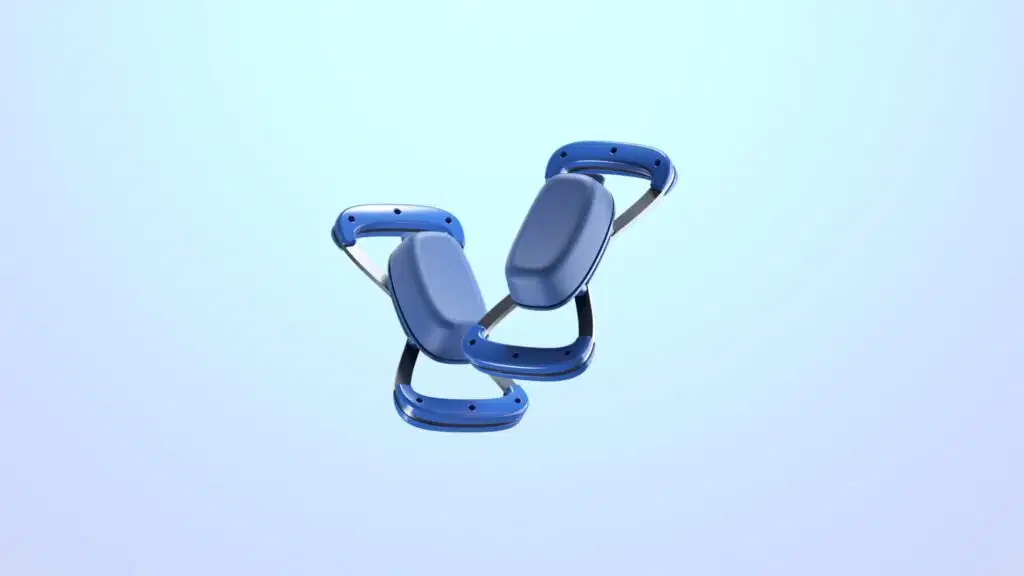
The K-Push by Kinvent is a high-precision, connected handheld dynamometer designed for both clinical and sports applications.
- Light & Ergonomic: With a sleek, compact design, the K-Push is easy to handle, whether in a clinic, on the field, or mounted to a fixed position.
- Accurate Force Sensing: It has load cells validated to measure isometric force with very fine precision, up to 90 kg, with a resolution of 0.1 kg.
- Wireless Connectivity (Bluetooth): The device pairs with the Kinvent app via Bluetooth, allowing real-time feedback, data logging, and analysis.
- Magnetic & Modular Attachments: Thanks to magnetic fixings and interchangeable accessories (straps, handles), the K-Push can assess nearly 40 different muscle groups in diverse testing setups.
- Validated Performance: It has been benchmarked against lab-grade systems (such as Electroforce) to ensure its measurements are reliable and consistent.
- User Feedback & Biofeedback: Through its app, it provides real-time acoustic and visual feedback, helping both clinicians and patients track force development, peak force, endurance, and symmetry.
- Portable & Long Battery Life: Lightweight and with a battery life of ~12 hours (2h charging), it supports mobile testing all day.
- Clinical Calibration: Before each test, the K-Push performs a quick calibration to establish a resting force baseline, ensuring more accurate readings.
Whether you’re a clinician, coach, or sports scientist, seeing the device in real time is the best way to understand how it can transform your assessments. Book a free live demo with our team. We’ll walk you through real measurement protocols, show you how to interpret the data, and answer all your questions so you can decide if it’s the right fit for your practice.
4- Study Design: How Researchers Measured Muscle Strength
The researchers conducted a blinded, comparative study on 44 men, who were divided into three distinct groups based on their training level:
- Elite Mixed Martial Arts (MMA) athletes
- Amateur football players
- Untrained healthy volunteers
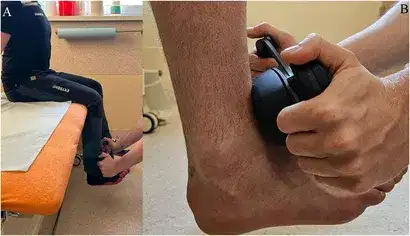
Figure 1. Test position of the Kinvent K-Push handheld dynamometer during the testing procedure (A) and the measurement point (B).
Two independent researchers, who were blinded to each other’s results, used the Kinvent K-push dynamometer to measure the muscle strength of each participant’s quadriceps (the big muscle on the front of the thigh). To understand how to measure muscle strength objectively, they evaluated two essential metrics:
- Maximum Voluntary Contraction (MVC): The absolute peak force the muscle can produce.
- Rate of Force Development (RFD): How fast the muscle can reach that peak force (a key indicator of explosive power).
By comparing results across different populations and testers, the researchers could assess both reliability and reproducibility.
5- Breakthrough: A Portable Tool with Lab-Level Accuracy
The most significant outcome of this study is the validation of a portable device capable of delivering high-precision, research-grade strength data. The Kinvent K-Push demonstrated that handheld dynamometry is not merely a convenient alternative; it is a scientifically validated method for objective strength assessment.
This bridges the long-standing gap between expensive laboratory equipment and practical, everyday clinical tools.
6- The Results: Reliable, Reproducible, and Highly Sensitive
The results were overwhelmingly positive. The study found that the Kinvent K-push dynamometer is highly reliable and consistent.
- High Reproducibility: There was “nearly perfect agreement” between the two different researchers. Statistical tests (like ICC and Bland-Altman plots) confirmed that there was minimal, non-significant variability between their measurements.
- Proven Accuracy: The tool was sensitive enough to easily tell the difference between the groups. As expected, the elite MMA fighters and amateur footballers had significantly higher strength (MVC) and explosive power (RFD) than the untrained group. Such sensitivity is crucial for monitoring progress, comparing baseline values, and understanding the physical demands of different sports.
- Overall Reliability: The device provided consistent and accurate results for both peak strength and rate of force development, validating it as a trustworthy tool.

Figure 2. Comparative analysis of MVC measurements for the Right quadriceps across participants, performed by two measurers, sorted in descending order based on the measurement differences between measurers.
7- What This Means for Patients and Clinicians
For Patients, Athletes, and Fitness Clients
This is great news for your progress. It means your therapist or trainer can get a truly objective number for your muscle strength, not just a subjective guess. This allows them to:
- Accurately track your recovery from an injury (like an ACL tear).
- Pinpoint specific muscle imbalances (e.g., your left leg being weaker than your right) that could lead to future injuries.
- Tailor your training program to focus on exactly what you need, whether it’s peak strength or explosive power.
For Clinicians (Physical therapists, Doctors, and Trainers)
This study provides the confidence to trust the data coming from this sensor. You can now use the K-push to:
- Get reliable baseline strength measurements for new patients.
- Make informed, evidence-based decisions about a patient’s rehabilitation protocol.
- Confidently assess an athlete’s return to play status after an injury.
- Gather objective data in any setting, from the clinic to the sports field, without needing access to a multi-thousand-dollar isokinetic lab.
8- FAQ: How to Measure Muscle Strength
What is the most accurate way to measure muscle strength?
Isokinetic dynamometers are the gold standard, but validated handheld dynamometers like the K-Push now offer clinically reliable, portable strength measurements.
How do handheld dynamometers measure muscle strength?
They record the force produced during a muscle contraction, typically during isometric testing, providing objective MVC and RFD values.
Is handheld dynamometry reliable?
Yes. This study confirms that the Kinvent K-Push delivers high reliability and reproducibility across different testers and populations.
What are MVC and RFD?
- MVC (Maximum Voluntary Contraction): Peak force output
- RFD (Rate of Force Development): How quickly force is produced (explosive power)
Who should measure muscle strength?
- Physical therapists
- Athletic trainers
- Strength & conditioning coaches
- Physicians
- Researchers
- Athletes and rehab patients
Can handheld dynamometers help determine return-to-play readiness?
Absolutely. They provide objective force metrics essential for safe, evidence-based return-to-play decisions.
9- Conclusion
If you want to know how to measure muscle strength accurately in real-world settings, this study provides the answer. The Kinvent K-Push handheld dynamometer is validated as a reliable, reproducible, and sensitive tool capable of delivering laboratory-level measurements.
Whether you’re treating patients, training athletes, or tracking recovery, the K-Push offers a modern, scientifically backed solution for objective strength assessment, without the limitations of high-cost laboratory equipment.


