





Objective measurement has become an essential part of modern physical therapy, sports performance, and sports science. By complementing clinical expertise with reliable, reproducible data, it enables professionals to accurately quantify physical capabilities, monitor progress, and make more informed decisions throughout rehabilitation and performance training.
Today, a wide range of parameters, including muscle strength, power, balance, range of motion, and muscle activity, can be assessed through objective measurement. In this article, you’ll discover why objective measurement is essential, which technologies make it possible, and how solutions like Kinvent help clinicians and performance professionals integrate objective data into their daily practice.
CONTENTS
1- What Is Objective Measurement?
2- Why Has Objective Measurement Become Essential?
3- What Can Be Measured Objectively Today?
4- Which Tools Can You Use for Objective Measurement?
5- How to Integrate Objective Measurement into Daily Practice
6- FAQ: Answer Your Questions about Objective Measurement
1- What Is Objective Measurement?
Objective measurement is the process of quantifying a physical capacity or biomechanical parameter using tools that provide reliable, reproducible, and comparable data over time. Unlike subjective observation, it relies on measurable values rather than visual assessment or personal perception.
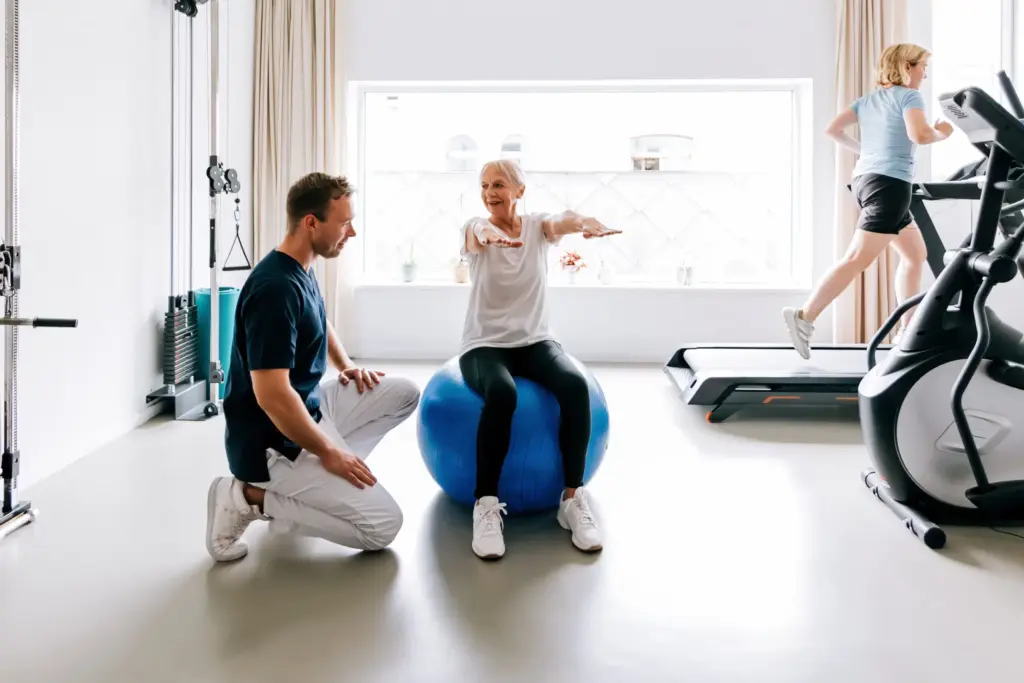
In physical therapy and sports science, objective measurement can be used to assess muscle strength, power, balance, range of motion, speed, and muscle activity. These data provide a more accurate picture of a patient’s or athlete’s physical condition and make it easier to monitor progress throughout rehabilitation, training, and return-to-sport programs.
Objective measurement does not replace clinical expertise. Instead, it complements it by providing quantifiable indicators that help confirm clinical observations, track progress, and support more informed, data-driven decisions.
2- Why Has Objective Measurement Become Essential?
Reduce Subjectivity in Assessments
Clinical observation and professional experience remain fundamental, but they can vary from one evaluator to another. Objective measurement provides quantifiable data that complement clinical observations, making assessments more reliable, consistent, and reproducible.
Accurately Quantify Physical Capabilities
Whether assessing muscle strength, power, balance, range of motion, or speed, objective measurement provides precise values for each parameter. These data help identify deficits, detect asymmetries, and highlight areas for improvement.
Track Patient and Athlete Progress
Comparing data over time makes it possible to monitor progress and adapt rehabilitation or training programs based on measurable outcomes. Objective measurement provides a clear picture of how patients and athletes evolve throughout their recovery or performance journey.
Support Clinical and Performance Decision-Making
Objective data help clinicians, sports scientists, and strength and conditioning coaches adjust training loads, progress rehabilitation programs, and support return-to-sport decisions. Rather than relying solely on observation, decisions can be backed by measurable indicators.
Improve Communication with Patients and the Performance Team
Sharing objective results makes it easier to communicate progress with patients, athletes, physicians, and the wider performance team. Objective measurement helps explain improvements, define realistic goals, and support clinical and performance decisions with clear, quantifiable data.
3- What Can Be Measured Objectively Today?
Advances in technology now make it possible to perform objective measurement across a wide range of physical and functional parameters. These data provide a comprehensive picture of a patient’s or athlete’s capabilities and make it easier to monitor progress over time.
Muscle Strength
Muscle strength is one of the most commonly assessed parameters through objective measurement. It helps identify strength deficits, detect limb asymmetries, and monitor improvements throughout rehabilitation or performance training.
Power and Jump Performance
Jump testing provides valuable insights into lower-body power, propulsion strategy, ground contact time, and limb asymmetries. These metrics are widely used for performance monitoring and return-to-sport decision-making.
Balance and Postural Control
Objective measurement of balance helps assess stability, postural control, and compensation strategies. These data are valuable in rehabilitation, injury prevention, and performance optimization.
Range of Motion
Range of motion can be measured with precision to monitor mobility improvements, evaluate treatment effectiveness, and objectively identify functional limitations.
Speed, Acceleration, and Change of Direction
In sports performance, objective measurement can also be used to analyze sprint speed, acceleration, deceleration, and change-of-direction ability. These metrics help optimize athletic performance while supporting injury risk management.
Muscle Activity (Surface EMG)
Surface electromyography (EMG) measures the electrical activity of muscles during movement or exercise. It provides valuable insights into muscle recruitment, coordination, and neuromuscular control.
4- Which Tools Can You Use for Objective Measurement?
Today, a wide range of technologies enables objective measurement of physical performance and function. By combining different sensors and assessment tools, clinicians and performance professionals can gain a comprehensive understanding of a patient’s or athlete’s capabilities, monitor progress, and make more informed clinical and training decisions.
At Kinvent, a complete ecosystem of connected devices and software makes it possible to objectively measure key physical parameters throughout the entire rehabilitation and performance journey.
Dynamometers
Dynamometers are used to measure muscle strength accurately and consistently. They help identify strength deficits, detect limb asymmetries, and monitor progress over time.
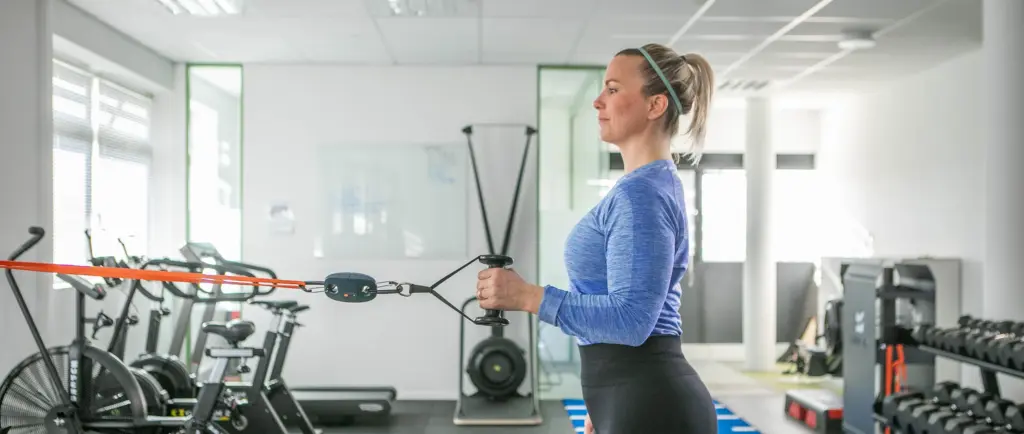
Kinvent’s K-Push, K-Pull, and K-Grip provide precise, reliable muscle strength measurements across a wide range of clinical and sports performance applications.
Force Plates
Force plates measure the forces applied to the ground during movement, making them ideal for assessing balance, jump performance, postural control, and movement strategies.
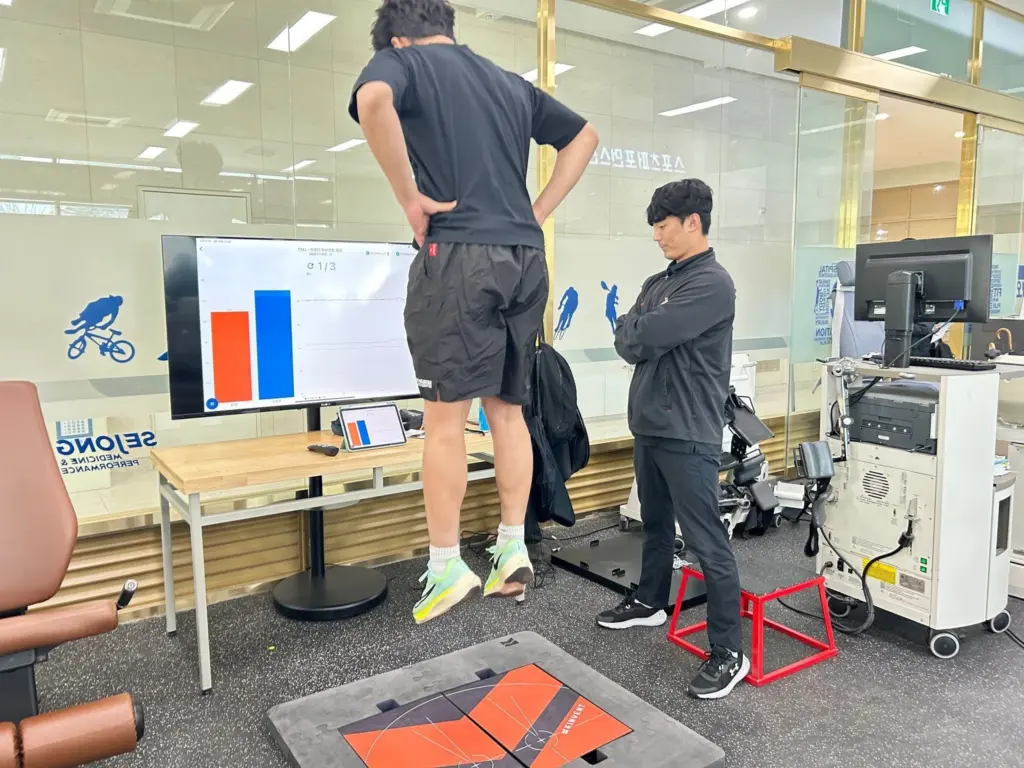
Kinvent’s Force Plates enable objective measurement across a wide variety of functional tests used in rehabilitation, performance testing, and return-to-sport decision-making.
Digital Goniometers
Digital goniometers provide accurate range of motion measurements, making it easier to monitor mobility throughout rehabilitation.
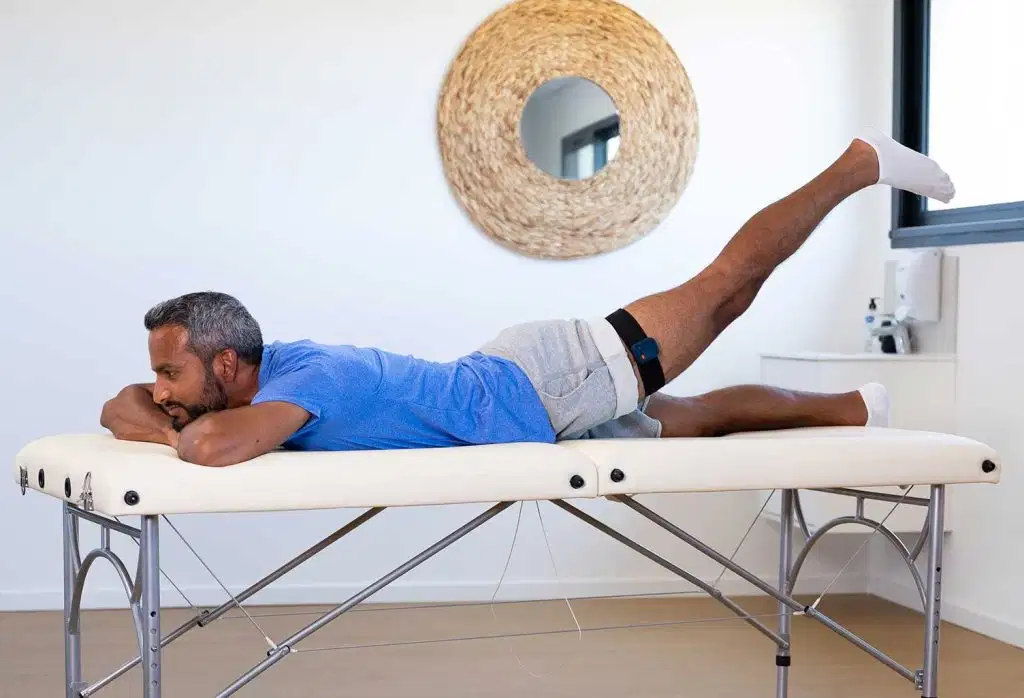
With K-Move, clinicians can quickly collect reliable range of motion data and compare results over time.
Speed Sensors
Speed sensors measure key performance metrics such as velocity, acceleration, deceleration, power, and force-velocity profiling.
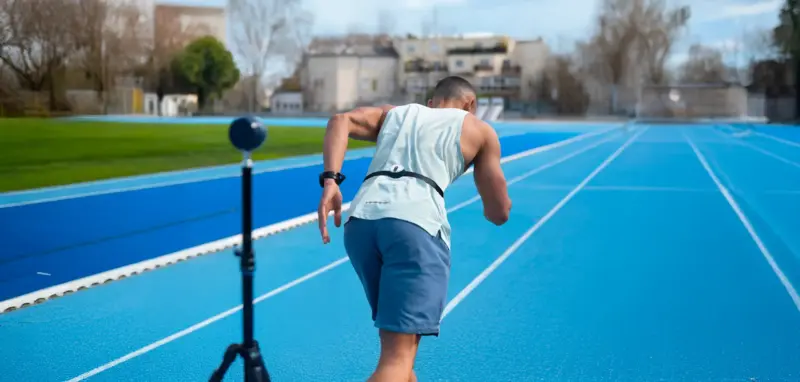
Kinvent’s K-Power delivers objective measurement of these performance indicators, helping strength and conditioning coaches, sports scientists, and coaches monitor athletic development with confidence.
Surface Electromyography (EMG)
Surface EMG measures the electrical activity of muscles during movement, providing valuable insights into muscle recruitment and neuromuscular coordination.
K-Myo delivers objective measurement of muscle activation, helping clinicians and performance professionals better understand movement strategies and monitor neuromuscular function.
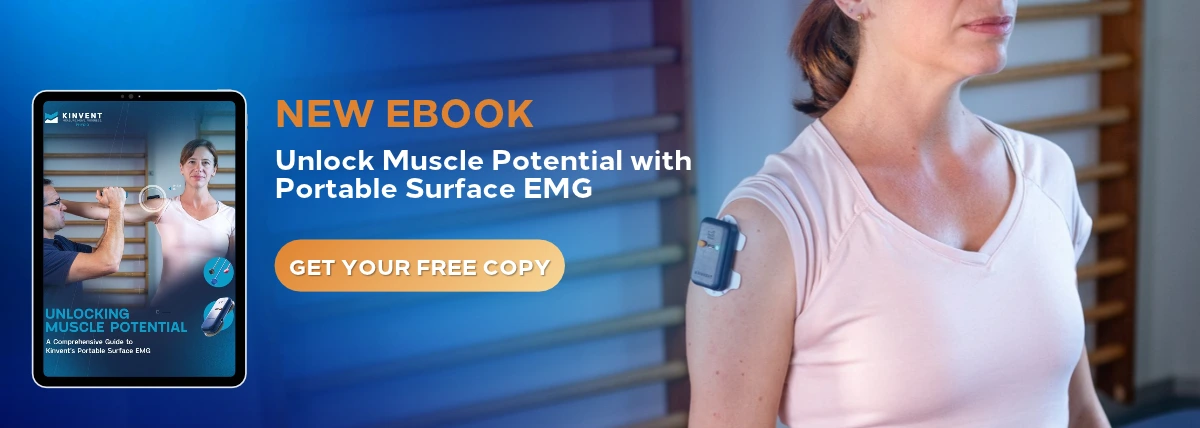
💡 Want to learn more about surface EMG? Download our free ebook to discover how EMG can enhance your clinical practice.
The Kinvent App: Centralize and Unlock the Value of Your Data
Collecting data is only the first step. To fully benefit from objective measurement, professionals need a platform that makes data easy to analyze, compare, and share.
The Kinvent App centralizes data collected from all Kinvent devices, providing a complete overview of patient or athlete progress. It includes an Assessment Mode for standardized testing and longitudinal tracking, as well as a Training Mode that transforms objective data into real-time biofeedback during exercise sessions.
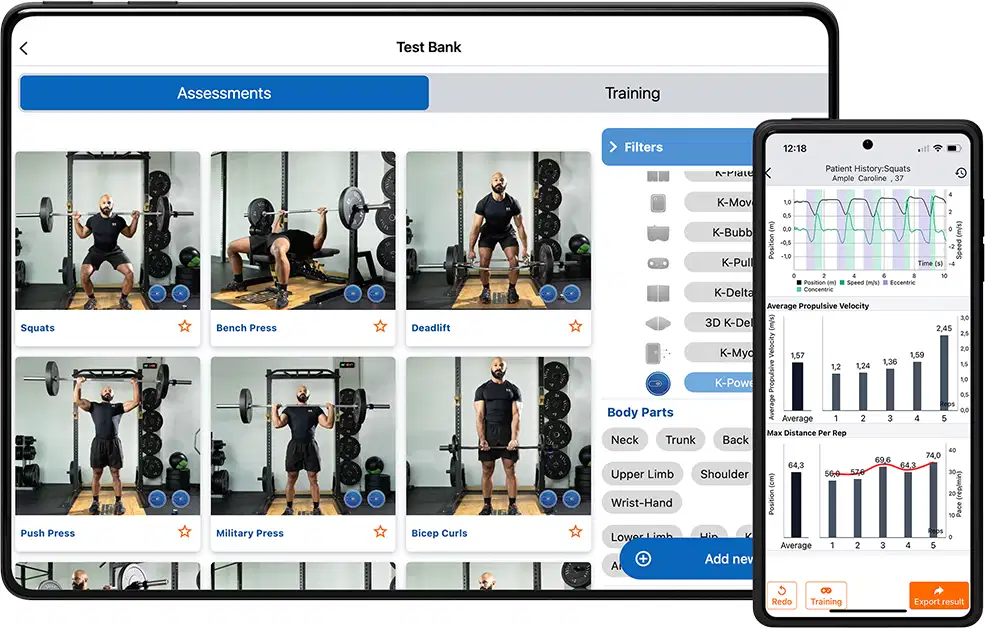
Combined with K-Apture video analysis, the app synchronizes movement footage with objective measurements, giving clinicians and coaches a deeper understanding of movement quality. This integrated approach makes it easier to personalize rehabilitation and training while continuously monitoring progress.
The Kinvent App also improves communication by allowing professionals to generate detailed reports and easily share objective results with patients, physicians, and the wider performance team.
Artificial Intelligence for Smarter Data Analysis
Integrated into the Kinvent App, Kassandra AI helps professionals interpret results, generate reports faster, and highlight the most relevant performance indicators.
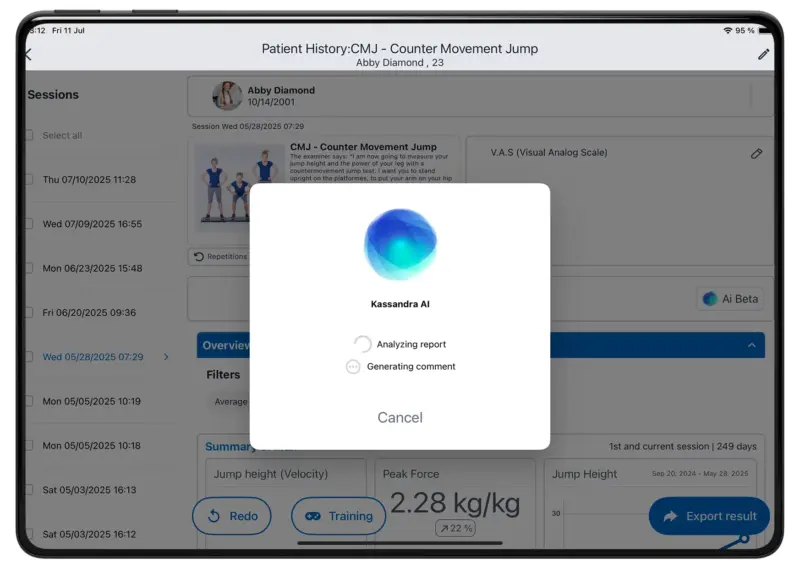
It also functions as a conversational AI assistant. Users can ask questions about a patient’s or athlete’s data, request deeper insights into assessment results, receive explanations of specific metrics, and get guidance to support data interpretation. This saves valuable time while keeping clinical expertise at the center of every decision.
5- How to Integrate Objective Measurement into Daily Practice
Objective measurement can be integrated at every stage of the rehabilitation and performance journey, from the initial assessment to return to sport. By collecting data at key milestones, clinicians and performance professionals gain reliable insights that help guide decisions and monitor progress over time.
During the Initial Assessment
Objective measurement establishes a baseline by evaluating key parameters such as muscle strength, range of motion, balance, and power. This initial assessment helps identify deficits, detect asymmetries, and define individualized rehabilitation or training goals.
Throughout Rehabilitation or Training
Regular objective measurements make it possible to track progress, adjust exercise programs, and evaluate the effectiveness of interventions. Combined with clinical expertise, objective data support a more personalized and evidence-based approach to rehabilitation and performance development.
Before Return to Sport
Objective measurement provides valuable information to determine whether a patient or athlete has regained the physical capacities required for a safe return to sport. Comparing performance over time helps professionals make more informed decisions based on measurable criteria rather than subjective impressions alone.
For Injury Prevention
Even in the absence of pain or injury, objective measurement can identify asymmetries, movement deficits, or performance changes that may increase injury risk. Regular monitoring allows clinicians and coaches to detect potential issues early, optimize performance, and support long-term athlete health.
6- FAQ
What is objective measurement?
Objective measurement is the process of quantifying physical or functional capabilities using tools that provide reliable, reproducible, and comparable data over time. Unlike subjective observation, it relies on measurable values to support clinical and performance decision-making.
Why is objective measurement important in physical therapy?
Objective measurement helps physical therapists establish a baseline, monitor patient progress, adjust rehabilitation programs, and make more informed clinical decisions. It complements clinical expertise by providing quantifiable data throughout the rehabilitation process.
What can be measured objectively?
A wide range of physical parameters can be assessed through objective measurement, including muscle strength, power, balance, range of motion, speed, acceleration, deceleration, change-of-direction ability, and muscle activity using surface EMG.
Which tools are used for objective measurement?
Objective measurement can be performed using dynamometers, force plates, digital goniometers, speed sensors, surface EMG systems, and software platforms that centralize, analyze, and visualize performance data.
How often should objective measurements be performed?
Objective measurements should be taken during the initial assessment and repeated regularly throughout rehabilitation or training. The ideal frequency depends on the patient’s or athlete’s goals, progress, and the clinical or performance setting.
Does objective measurement replace clinical expertise?
No. Objective measurement is designed to complement, not replace clinical expertise. It provides reliable data that support clinical observations and help professionals make more confident, evidence-based decisions.
Why is objective measurement important for return to sport?
Objective measurement allows clinicians to monitor physical recovery, identify asymmetries, and evaluate whether an athlete has regained the capacities required for a safe return to sport. It supports return-to-sport decisions with measurable criteria rather than subjective impressions alone.
How does Kinvent support objective measurement?
Kinvent offers a complete ecosystem of connected assessment tools, an integrated application that centralizes objective data, and advanced analysis features. Professionals can perform standardized assessments, monitor progress over time, generate detailed reports, share results with patients and healthcare teams, use video analysis with K-Apture, and leverage Kassandra AI to interpret data and ask questions about patient or athlete performance.


