


Biomechanical movement analysis has become essential for understanding movement quality, identifying compensations, and supporting decision-making in both rehabilitation and performance. Yet measuring force or power alone does not always explain how a movement is actually produced.
Through its partnership with Model Health, KINVENT is expanding its ecosystem with a new layer of biomechanical movement analysis directly integrated into the Kinvent App. By combining 3D force data from the 3D Deltas with markerless motion capture technology, practitioners can now visualize movement and analyze joint angles, movement strategies, and joint kinetics within a single platform.
In this article, discover how this new feature enhances biomechanical movement analysis, what new insights it provides, and how combining force and movement opens up a new dimension in the functional assessment of patients and athletes.
CONTENTS
1- Why Measuring Force Alone Is Not Enough for Biomechanical Movement Analysis
2- KINVENT × Model Health: A New Dimension for Biomechanical Movement Analysis
3- How to Interpret Biomechanical Movement Analysis Data
4- FAQ: Biomechanical Movement Analysis
1- Why Measuring Force Alone Is Not Enough for Biomechanical Movement Analysis
Biomechanical movement analysis is not only about measuring performance. In rehabilitation and strength and conditioning, it is equally important to understand how that performance is produced.
Today, force plates provide objective data on force, power, asymmetries, load distribution, and support strategies. These metrics are essential for monitoring the progress of a patient or athlete and objectively assessing functional capabilities.
However, two individuals can achieve similar results on the same test while using very different movement strategies. One may produce the expected force with a smooth and efficient movement, while another may compensate through the trunk, pelvis, knee, or ankle without these strategies being visible from force data alone.
This is particularly relevant during functional assessments such as:
- gait analysis;
- jump testing;
- change-of-direction testing;
- explosive movements.
In these situations, biomechanical movement analysis provides a much more complete understanding of how the movement is performed. It allows practitioners to observe how the body organizes itself during movement, identify compensations, monitor changes in movement strategies, and better inform clinical decisions or training programs.
To take the analysis further, it can be particularly valuable to combine force data with biomechanical movement analysis to understand not only the outcome of a test, but also how that outcome was achieved. This is precisely the purpose of integrating Model Health into the KINVENT ecosystem.
2- KINVENT × Model Health: A New Dimension for Biomechanical Movement Analysis
🆕 Enhanced Biomechanical Movement Analysis with Markerless Motion Capture
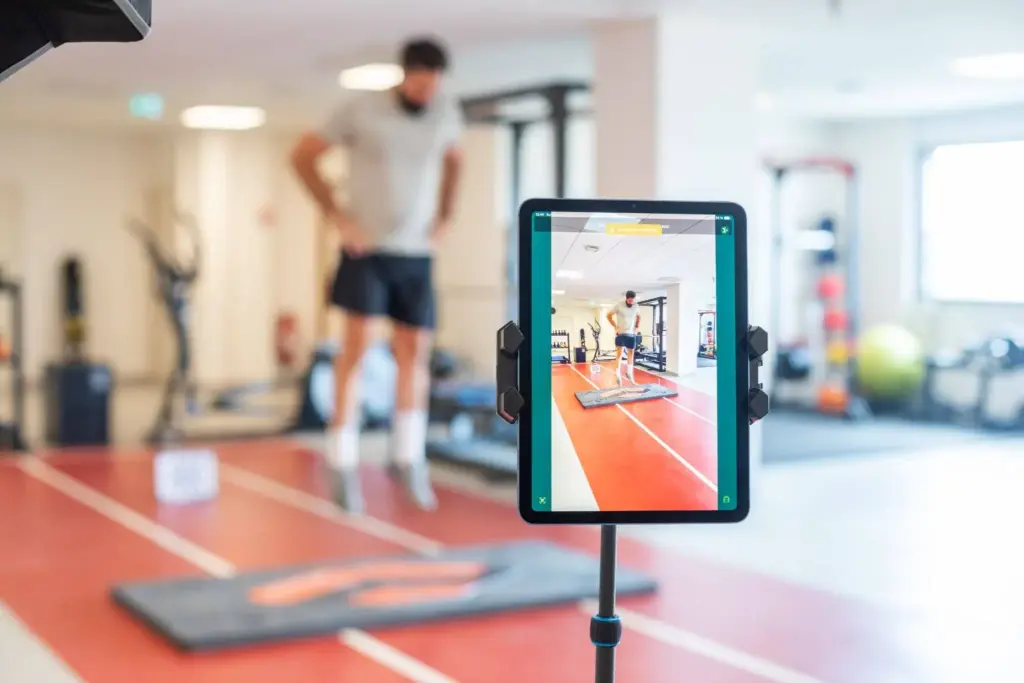
With Model Health technology, the Kinvent App now integrates 3D biomechanical movement analysis using markerless motion capture, directly synchronized with force data from the 3D Deltas.
This new layer of analysis provides access to:
- upper- and lower-limb joint angles;
- center of mass trajectory;
- global displacement;
- angular velocities;
- spatiotemporal parameters;
- asymmetries and compensations;
- test-specific metrics.
All these data are available directly in the Kinvent App, alongside force measurements from the 3D Deltas.
When Movement Meets Force
Combining 3D Deltas with Model Health takes biomechanical movement analysis one step further.
- Motion shows the pattern.
- Force shows the load.
- Their fusion reveals what happens at the joint.
By combining kinematic and force data, practitioners can access more advanced insights, including:
- joint moments;
- joint power;
- contact forces;
- force vectors;
- load distribution throughout the movement.
This approach helps explain why two patients or athletes can achieve similar performance outcomes while using very different movement strategies.
Technology Designed for Real-World Assessments
Unlike traditional motion analysis systems, which often require a dedicated laboratory, multiple specialized cameras, and markers placed on the body, Model Health uses markerless motion capture technology.
To perform the capture, the setup requires two devices: either two iPads, or one iPad paired with an iPhone. The two viewing angles are used to record the movement, after which the biomechanical data are automatically analyzed and combined with force measurements from the 3D Deltas in the Kinvent App.
The process remains simple:
- Set up the 3D Deltas and video capture system.
- Perform the functional test.
- Automatically visualize the biomechanical data in just a few minutes.
- Combine movement data with force measurements.
- Track results across assessments.
The entire process is integrated into the Kinvent App and can be used in clinics, rehabilitation centers, and sports performance environments.
💡Watch this video to know How to Use Model Health for Gait Analysis in the Kinvent App
Biomechanical Analysis Across Multiple Functional Tests
This new feature is compatible with several protocols performed on the 3D Deltas, including:
- Gait Analysis;
- Countermovement Jump (CMJ);
- Skater Jump;
- Change of Direction (COD);
- Forward Jump;
- Drop and Side Jump.
Each protocol provides test-specific metrics, allowing biomechanical movement analysis to be adapted to the movement being assessed and providing a more complete understanding of both performance and function.
For gait analysis, practitioners can examine metrics such as:
- walking speed;
- cadence;
- step length and width;
- double-support time;
- step symmetry;
- hip, knee, and ankle angles;
- center of mass trajectory;
- force vectors;
- loading and compensation strategies.
These data go beyond visual observation of gait to provide a deeper understanding of how the patient moves, distributes load, and organizes movement.
For jump and change-of-direction tests, the analysis goes beyond performance metrics such as jump height, contact time, or impulse.
The integration of Model Health also enables practitioners to examine movement organization, joint angles, and force absorption or production strategies.
This makes it possible to connect the performance outcome with how the movement was performed, helping identify potential asymmetries, compensations, or specific movement strategies.
3- How to Interpret Biomechanical Movement Analysis Data
The value of biomechanical movement analysis lies not only in the amount of data available, but above all in how these data help practitioners better understand movement quality.
By combining force measurements from the 3D Deltas with biomechanical data from Model Health, professionals gain a more complete view of movement and how the body organizes itself during a task.
Objectively Assess Movement Quality
The joint angles and ranges of motion provide a detailed view of how a movement is performed.
These insights can help determine whether a patient or athlete is using an efficient movement strategy or showing limitations that may influence performance or recovery.
Identify Compensations
Some compensation strategies can be difficult to detect with the naked eye.
Biomechanical movement analysis can help identify:
- trunk compensations;
- pelvic imbalances;
- knee or ankle movement strategies;
- asymmetries between limbs.
These insights provide a more detailed understanding of movement and help identify potential functional deficits.
Connect Movement with Force Data
One of the main advantages of this approach is the ability to connect what the body is doing with how force is being produced or absorbed.
For example, an asymmetry identified on the force plates may be associated with a compensatory joint strategy or a change in movement kinematics.
Combining these data helps practitioners understand the factors behind a performance outcome rather than looking at the result alone.
Track Progress Over Time
All metrics are recorded in the Kinvent App and can be compared from one assessment to the next.
This makes it possible to:
- track changes in movement quality;
- measure the impact of a rehabilitation or training program;
- objectively monitor reductions in compensations;
- document functional progress over time.
Support Clinical and Performance Decisions
By providing a more complete view of movement, biomechanical movement analysis can help professionals make more informed decisions.
The collected data can be used to:
- adapt exercise selection;
- adjust training loads;
- define more objective progression criteria;
- support return-to-activity or return-to-sport decisions.
By combining movement and force, KINVENT provides a more comprehensive approach to functional assessment, going beyond performance outcomes to better understand movement as a whole.
4- FAQ: Biomechanical Movement Analysis
What Is Biomechanical Movement Analysis?
Biomechanical movement analysis examines how the body produces and controls movement by assessing parameters such as joint angles, trajectories, velocities, compensations, and forces.
It provides a more objective understanding of movement quality and can support decision-making in both rehabilitation and sports performance.
Which Tests Are Compatible with Biomechanical Movement Analysis?
The Model Health integration is available for several protocols performed with the 3D Deltas, including:
- Gait Analysis
- Countermovement Jump (CMJ)
- Skater Jump
- Change of Direction
- Forward Jump
- Drop and Side Jump
Each protocol provides biomechanical movement analysis adapted to the specific task, with dedicated metrics for a more detailed understanding of movement, function, and performance.
Are Markers Required for Biomechanical Movement Analysis?
No. With Model Health, biomechanical movement analysis uses markerless motion capture technology.
The capture requires two iPads, or one iPad and one iPhone. Movement is captured through video without placing physical markers on the patient or athlete. The biomechanical data are then automatically analyzed and synchronized with force measurements from the 3D Deltas directly in the Kinvent App.


