





Kardiale Rehabilitation gilt heute als zentraler Bestandteil der Versorgung von Menschen, die sich von einer Herz-Kreislauf-Erkrankung erholen. Während sie früher überwiegend in spezialisierten Kliniken durchgeführt wurde, findet sie heute in unterschiedlichen Versorgungssettings statt – darunter Rehabilitationszentren, physiotherapeutische Praxen, ambulante Bewegungsprogramme und Telehealth-Angebote.
Ob nach einem Myokardinfarkt, einer Koronarangioplastie, einer Koronararterien-Bypass-Operation (CABG), einer Herzklappenoperation oder bei Patienten mit stabiler Herzinsuffizienz: Ziel der kardialen Rehabilitation ist es, eine sichere und schrittweise Rückkehr zu körperlicher Aktivität zu unterstützen. Neben der Verbesserung der funktionellen Leistungsfähigkeit kann sie dazu beitragen, Wiedereinweisungen ins Krankenhaus zu reduzieren, die Lebensqualität zu verbessern und Patienten wieder mehr Sicherheit bei ihren Alltagsaktivitäten zu geben.
In diesem Artikel erfahren Sie, wer von einer kardialen Rehabilitation profitieren kann, wie ein evidenzbasiertes Rehabilitationsprogramm aufgebaut wird und warum objektive Assessment-Tools für eine personalisierte Patientenversorgung und die langfristige Verlaufskontrolle zunehmend unverzichtbar werden.
INHALT
1- What Is Cardiac Rehabilitation?
2- Why Is Cardiac Rehabilitation Essential?
3- How to Build an Effective Cardiac Rehabilitation Program
4- How to Objectively Measure Progress During Cardiac Rehabilitation
5- Current Evidence-Based Recommendations for Cardiac Rehabilitation
6- Frequently Asked Questions About Cardiac Rehabilitation
7- Literatur
1- What Is Cardiac Rehabilitation?
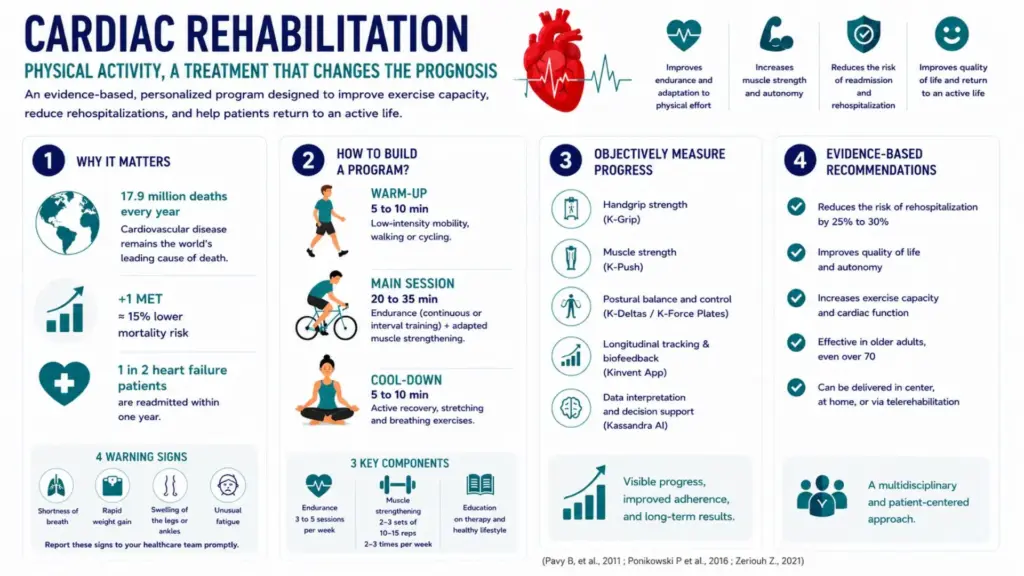
Kardiale Rehabilitation ist ein multidisziplinäres, evidenzbasiertes Programm, das Bewegungstraining, Patientenedukation, Lebensstiländerungen und individuelle Betreuung kombiniert, um die langfristige Gesundheit von Menschen mit Herz-Kreislauf-Erkrankungen zu verbessern. Sie wird von führenden internationalen Fachgesellschaften empfohlen und gilt heute nach kardialen Ereignissen sowie bei vielen Patienten mit chronischen Herzerkrankungen als wesentlicher Bestandteil der Behandlung.
Das Ziel geht weit über eine reine Verbesserung der Fitness hinaus. Die kardiale Rehabilitation trägt dazu bei, Symptome zu reduzieren, Komplikationen vorzubeugen, das Vertrauen in körperliche Aktivität wiederherzustellen und eine sichere Rückkehr in den Alltag zu ermöglichen. Gleichzeitig unterstützt sie die langfristige Therapietreue und fördert gesundheitsbewusste Lebensgewohnheiten, die das Risiko zukünftiger kardiovaskulärer Ereignisse senken können.

The Goals of Cardiac Rehabilitation
Jedes Programm der kardialen Rehabilitation sollte an den klinischen Zustand, die körperliche Leistungsfähigkeit und die individuellen Ziele des Patienten angepasst werden. Zu den wichtigsten Zielen gehören:
- Belastbarkeit und kardiovaskuläre Ausdauer verbessern;
- Muskelkraft und funktionelle Selbstständigkeit wiederherstellen;
- Fatigue und Atemnot reduzieren;
- das Risiko erneuter kardiovaskulärer Ereignisse und Krankenhausaufnahmen senken;
- die langfristige Integration regelmäßiger körperlicher Aktivität unterstützen.
Die kardiale Rehabilitation ist weit mehr als ein Trainingsprogramm. Sie kombiniert Ausdauer- und Krafttraining, Patientenedukation, Lebensstilberatung und kontinuierliche medizinische Betreuung, um nachhaltige Verbesserungen der kardiovaskulären Gesundheit zu erreichen.
Who Can Benefit from Cardiac Rehabilitation?
Eine kardiale Rehabilitation wird für ein breites Spektrum von Patienten empfohlen, unter anderem nach:
- Myokardinfarkt (Herzinfarkt) oder akutem Koronarsyndrom;
- Koronarangioplastie mit Stentimplantation;
- Koronararterien-Bypass-Operation (CABG);
- Herzklappenoperation;
- Implantation eines Herzschrittmachers oder implantierbaren Kardioverter-Defibrillators (ICD);
- stabiler chronischer Herzinsuffizienz.
Bei Patienten mit chronischer Herzinsuffizienz kann das Herz nicht ausreichend Blut pumpen, um den Bedarf des Körpers zu decken. Dies führt unter anderem zu Fatigue, Atemnot und einer zunehmend eingeschränkten körperlichen Leistungsfähigkeit. Der Schweregrad wird häufig anhand der funktionellen Klassifikation der New York Heart Association (NYHA) eingestuft, die medizinischen Fachkräften dabei hilft, das Rehabilitationsprogramm an die funktionellen Einschränkungen des jeweiligen Patienten anzupassen.
Nach herzchirurgischen Eingriffen müssen zudem operationsspezifische Vorsichtsmaßnahmen berücksichtigt werden. Nach einer medianen Sternotomie im Rahmen einer CABG- oder Herzklappenoperation wird die Belastung der oberen Extremitäten beispielsweise in der Regel für mehrere Wochen eingeschränkt, um eine adäquate Knochenheilung zu ermöglichen. Die Trainingsprogression sollte stets individuell gestaltet und mit dem multidisziplinären Behandlungsteam abgestimmt werden.
2- Why Is Cardiac Rehabilitation Essential?
Herz-Kreislauf-Erkrankungen sind weiterhin die häufigste Todesursache weltweit und verursachen schätzungsweise 17,9 Millionen Todesfälle pro Jahr. Trotz der überzeugenden Evidenz für bewegungsbasierte Rehabilitation nehmen viele geeignete Patienten noch immer nicht an einem Programm zur kardialen Rehabilitation teil. Dies kann ihre Genesung einschränken und das Risiko zukünftiger kardiovaskulärer Ereignisse erhöhen.
Bessere Behandlungsergebnisse durch Bewegung
Die kardiale Rehabilitation ist weit mehr als überwachtes Training. Sie ist eine evidenzbasierte Intervention, die die körperliche Funktion und Lebensqualität verbessert und das Risiko von Wiedereinweisungen sowie vorzeitigem Tod reduziert.
Following hospitalization for heart failure, nearly one in two patients is readmitted within one year, and mortality remains high. Patients recovering from acute coronary syndrome also remain under-referred to kardiale Rehabilitation programs, despite the well-established benefits of structured exercise training and secondary prevention strategies.
These findings highlight the importance of integrating kardiale Rehabilitation into routine cardiovascular care rather than considering it an optional component of recovery.
Bewegung ist Medizin
Einer der stärksten Prädiktoren für das langfristige Überleben ist die kardiorespiratorische Fitness.
Research has shown that every 1-MET increase in exercise capacity (approximately 3.5 mL/kg/min of VO₂) is associated with an approximately 15% reduction in all-cause mortality. This is one of the reasons why exercise is now recognized as a cornerstone of cardiovascular disease management.
By progressively improving aerobic capacity, muscle strength, and functional independence, kardiale Rehabilitation enables patients to safely return to everyday activities while reducing their risk of future cardiovascular complications.
Vier Warnzeichen einer Herzinsuffizienz
Physical therapists and other healthcare professionals involved in kardiale Rehabilitation should be able to recognize the early signs of worsening heart failure and refer patients promptly when necessary.
Zu den wichtigsten Warnzeichen gehören:
- Atemnot
- Rasche Gewichtszunahme
- Schwellungen der Beine oder Knöchel
- Ungewöhnliche Fatigue
Educating patients to recognize these symptoms is an essential part of kardiale Rehabilitation. Early identification can help prevent clinical deterioration, reduce hospitalizations, and improve long-term outcomes.
3- How to Build an Effective Cardiac Rehabilitation Program
An effective kardiale Rehabilitation program should always be individualized according to the patient’s medical condition, functional capacity, and rehabilitation goals. Before exercise begins, a comprehensive assessment helps determine a safe training intensity and provides a baseline for monitoring progress throughout the program.
Ein erfolgreiches Rehabilitationsprogramm kombiniert Ausdauertraining, Krafttraining, Patientenedukation und langfristige Veränderungen des Lebensstils.
Erstassessment
The initial evaluation is the foundation of every kardiale Rehabilitation program. It helps clinicians identify the patient’s physical limitations, establish realistic goals, and prescribe exercise safely.
Whenever possible, the assessment should include:
- a cardiopulmonary exercise test (CPET) with peak VO₂ and ventilatory threshold measurements;
- or, when CPET is not available, a 6-Minute Walk Test (6MWT);
- an assessment of muscle strength;
- an educational interview to understand the patient’s knowledge, concerns, and readiness for lifestyle change.
This comprehensive assessment provides the information needed to individualize exercise prescription and objectively monitor progress over time.
A Typical Cardiac Rehabilitation Session
Eine typische Einheit der kardialen Rehabilitation dauert in der Regel 45 bis 60 Minuten und besteht aus drei Phasen.
Aufwärmen (5–10 Minuten)
The session begins with low-intensity mobility exercises, walking, or light cycling to gradually increase heart rate and prepare the cardiovascular and musculoskeletal systems for exercise.
Training (20–35 Minuten)
The main part of the session combines aerobic exercise with resistance training tailored to the patient’s abilities and clinical status.
Cool-down (5–10 Minuten)
The session concludes with active recovery, gentle stretching, and breathing exercises to gradually lower heart rate and promote recovery.

Ausdauertraining
Aerobic training is the cornerstone of kardiale Rehabilitation. Two complementary approaches are commonly used.
Kontinuierliches Ausdauertraining
- Intensity: at or just below the first ventilatory threshold (VT1).
Alternatively, training intensity can be prescribed using the Karvonen formula:
Training HR = Resting HR + [(Max HR − Resting HR) × 0.6]
For patients taking beta-blockers, a coefficient of 0.8 may be used, as the standard formula can underestimate the appropriate training heart rate.
- Perceived exertion: Borg Rating of Perceived Exertion (RPE) 12–14 („somewhat hard“ to „hard“). Patients should still be able to comfortably hold a conversation during exercise (the talk test).
Trainingsdauer: 20–30 Minuten.
Intervalltraining
A simple, evidence-based protocol includes:
- 30 seconds at 80–90% of peak aerobic power (or approximately 85–95% of the peak heart rate achieved during the exercise test);
- followed by 1–2 minutes of active recovery at 20–30% intensity;
- repeat 8–12 times.
Intervalltraining provides a greater muscular stimulus without placing excessive strain on the cardiovascular system. It is often well tolerated and can be more engaging for patients than continuous exercise.
Empfohlene Häufigkeit: 3–5 Einheiten pro Woche.
Mindestumfang: In der Regel werden mindestens 20 betreute Einheiten empfohlen, um klinisch relevante und nachhaltige Verbesserungen zu erzielen. Patienten mit ausgeprägter Dekonditionierung oder chronischer Herzinsuffizienz können ein längeres Rehabilitationsprogramm benötigen.
Krafttraining
Resistance exercise is now recognized as an essential component of kardiale Rehabilitation. It helps improve muscle strength, functional capacity, and the ability to perform daily activities independently.
A typical program includes:
- 8–10 exercises targeting major muscle groups;
- 10–15 repetitions per exercise;
- 2–3 sets using light-to-moderate loads (approximately 30–50% of one-repetition maximum).
Simple equipment such as resistance bands, light dumbbells, resistance machines, or bodyweight exercises is generally sufficient. However, prolonged isometric exercises should be avoided, as they can cause excessive increases in blood pressure.
Following a median sternotomy or cardiac implantable electronic device implantation, upper-limb resistance exercises should be reintroduced gradually, with appropriate precautions during the first few weeks of recovery.
Dehnen, Entspannung und Stressmanagement
The final 5–10 minutes of each session should focus on recovery.
This phase may include:
- gentle stretching of major muscle groups;
- diaphragmatic breathing exercises;
- cardiac coherence breathing (5-second inhalation / 5-second exhalation for 5 minutes).
These strategies help reduce anxiety, promote recovery, and provide patients with practical techniques they can continue independently at home.
Patientenedukation: ein Schlüsselfaktor für langfristigen Erfolg
Exercise alone is not enough. Patient education is a fundamental pillar of kardiale Rehabilitation, empowering individuals to become active participants in managing their cardiovascular health.
Education typically includes:
- recognizing the warning signs of heart failure;
- managing daily physical activities safely;
- understanding prescribed medications;
- nutritional counseling, including reducing sodium intake and adopting a heart-healthy diet;
- smoking cessation support;
- strategies to maintain an active lifestyle after the supervised program ends.
The ultimate goal is to help patients achieve and maintain at least 150 minutes of moderate-intensity physical activity per week, together with two resistance-training sessions, in line with current international recommendations.
4- How to Objectively Measure Progress During Cardiac Rehabilitation
Assessment does not end after the initial evaluation. Throughout a kardiale Rehabilitation program, objectively measuring patient progress is essential for adapting exercise prescription, ensuring safe progression, and maintaining long-term motivation.
Beyond clinical observation and patient-reported outcomes, objective measurement tools provide reliable data that support evidence-based clinical decision-making and allow clinicians to track recovery over time.
Messung der körperlichen Leistungsfähigkeit
Kardiale Rehabilitation aims to improve several key physical capacities that can be assessed regularly throughout the rehabilitation process, including:
- Muskelkraft der oberen und unteren Extremitäten;
- Griffkraft als anerkannter Indikator für die allgemeine körperliche Funktion und das Frailty-Risiko;
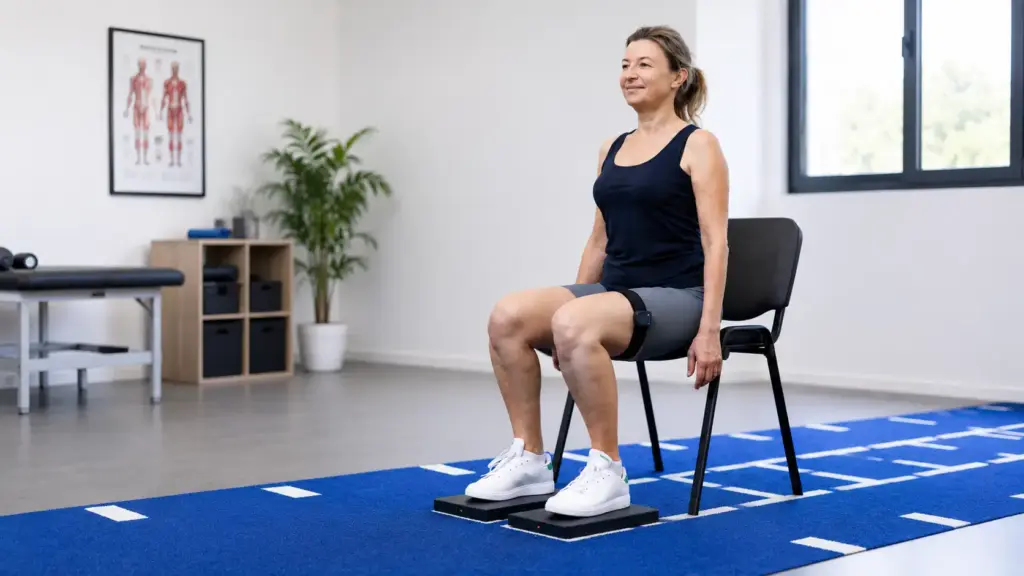
- funktionelle Leistungsfähigkeit, beispielsweise beurteilt mit dem Sit-to-Stand-Test;
- Gleichgewicht und posturale Stabilität, insbesondere bei älteren und dekonditionierten Patienten.
Monitoring these outcomes allows clinicians to verify patient progress, identify plateaus or regressions early, and adjust rehabilitation strategies accordingly.
Fortschritte mit vernetzten Assessment-Tools sichtbar machen
Modern assessment technologies make it easier than ever to monitor patients throughout kardiale Rehabilitation. Connected dynamometers, grip strength devices, force sensors, and balance assessment tools provide objective, reproducible measurements that can be compared across sessions.

Within the Kinvent ecosystem, devices such as K-Grip for grip strength, K-Push for muscle strength assessment, and K-Deltas for balance and functional performance enable clinicians to quantify physical capacity throughout the rehabilitation process.
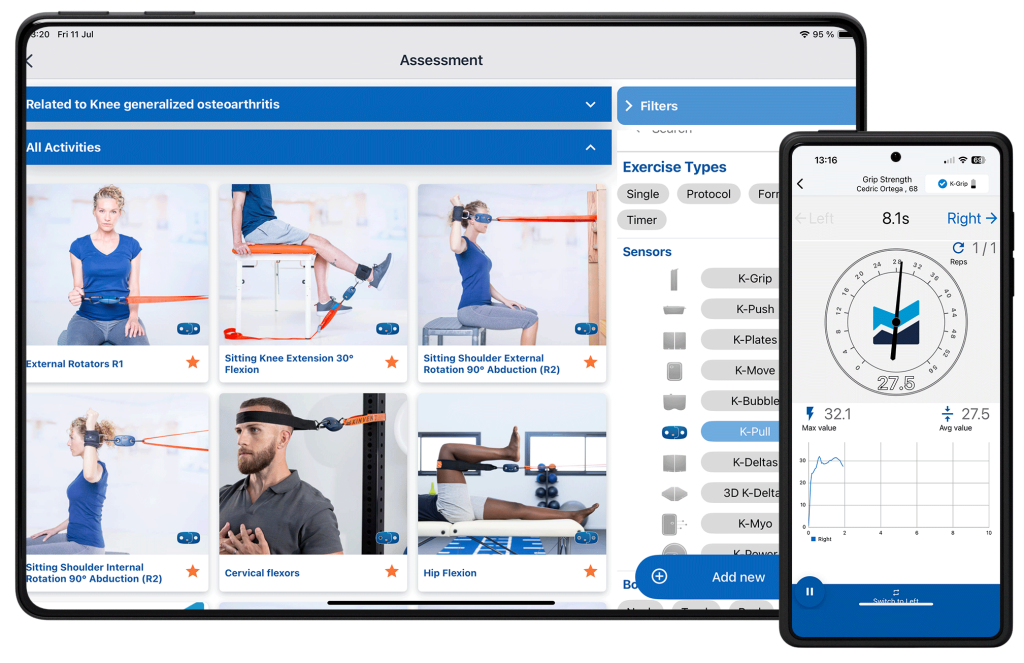
All assessment data are centralized within the Kinvent App, allowing clinicians to visualize patient progress over time, compare results across sessions, standardize testing protocols, and share objective reports with the multidisciplinary care team.
Patientenengagement durch Biofeedback verbessern
Einer der größten Vorteile objektiver Assessments besteht darin, dass Fortschritte sichtbar werden.
When patients can clearly see improvements in their strength, balance, or functional performance, they gain confidence in their recovery and become more engaged in the rehabilitation process.
Echtzeit-Biofeedback further enhances motivation by providing immediate visual feedback during testing and exercise. Combined with longitudinal progress tracking, it helps improve treatment adherence, supports communication between clinicians and patients, and encourages long-term participation in physical activity, an essential factor in maintaining the benefits of kardiale Rehabilitation.
5- Current Evidence-Based Recommendations for Cardiac Rehabilitation
The benefits of kardiale Rehabilitation are now supported by decades of high-quality scientific evidence. International organizations, including the European Society of Cardiology (ESC), the American Heart Association (AHA), and the American Association of Cardiovascular and Pulmonary Rehabilitation (AACVPR), recommend exercise-based kardiale Rehabilitation as a standard component of care for patients recovering from cardiovascular disease.
Research consistently shows that kardiale Rehabilitation:
- reduziert Krankenhauswiedereinweisungen um 25–30 %;
- verbessert die Lebensqualität;
- steigert Belastbarkeit und funktionelle Selbstständigkeit;
- ist auch bei älteren Erwachsenen wirksam;
- can be successfully delivered in hospitals, outpatient clinics, community settings, or through well-structured home-based and telehealth programs.
Key Principles of Evidence-Based Cardiac Rehabilitation
Current international guidelines emphasize several fundamental principles:
- Individualize every program based on a comprehensive clinical assessment and, whenever possible, a cardiopulmonary exercise test.
- Combine aerobic exercise, resistance training, and patient education rather than relying on a single intervention.
- Provide at least 20 supervised rehabilitation sessions, followed by lifelong physical activity.
- Progress exercise gradually according to each patient’s functional capacity and clinical response.
- Monitor patients according to their level of cardiovascular risk, while avoiding unnecessary exclusion of clinically stable individuals.
- Use objective assessments to guide clinical decision-making and optimize exercise prescription over time.
Ein multidisziplinärer Ansatz für eine langfristige Genesung
Successful kardiale Rehabilitation relies on close collaboration between cardiologists, physical therapists, clinical exercise physiologists, nurses, dietitians, and other healthcare professionals.
Within this multidisciplinary team, physical therapists play a central role. Through evidence-based exercise prescription, patient education, and objective functional assessment, they help patients regain confidence, improve physical capacity, and adopt healthier long-term lifestyle habits.
As objective measurement technologies continue to evolve, clinicians can make more informed decisions, personalize rehabilitation programs, and accurately monitor recovery throughout every stage of the patient’s journey.
6- Frequently Asked Questions About Cardiac Rehabilitation
Was ist kardiale Rehabilitation?
Kardiale Rehabilitation is a personalized, multidisciplinary program designed for people recovering from cardiovascular disease or cardiac procedures such as a heart attack, coronary angioplasty, or coronary artery bypass graft surgery. It combines exercise training, patient education, lifestyle counseling, and medical supervision to improve physical function, reduce the risk of future cardiovascular events, and support long-term recovery.
Wie lange dauert ein Programm zur kardialen Rehabilitation?
The length of a kardiale Rehabilitation program varies depending on the patient’s condition, rehabilitation goals, and clinical progress. Most guidelines recommend at least 20 supervised sessions over several weeks to achieve meaningful improvements. Long-term physical activity remains essential to maintain cardiovascular health after the supervised program ends.
Welche Übungen umfasst die kardiale Rehabilitation?
A kardiale Rehabilitation program typically includes:
- aerobic exercise such as walking, cycling, or treadmill training;
- resistance training to improve muscle strength;
- balance and mobility exercises when appropriate;
- breathing and recovery exercises.
Exercise intensity is always individualized according to the patient’s functional capacity and medical condition.
Kann man nach einem Herzinfarkt trainieren?
Yes. Most people can safely return to physical activity after a heart attack under the guidance of healthcare professionals. Kardiale Rehabilitation provides a structured, progressive approach that helps patients regain confidence, improve cardiovascular fitness, and safely return to daily activities or recreational sports.
Wie messen Fachkräfte Fortschritte während der kardialen Rehabilitation?
Progress is commonly assessed using objective outcome measures such as the 6-Minute Walk Test (6MWT), muscle strength testing, grip strength assessment, balance evaluation, and functional tests like the Sit-to-Stand Test. Connected assessment technologies, such as the Kinvent ecosystem, allow clinicians to monitor recovery over time, standardize assessments, and improve patient engagement through real-time biofeedback.
7- Literatur
1. Inserm. Activité physique – Prévention et traitement des maladies chroniques. Expertise collective. 2019 (chapitres “Pathologies coronaires et Insuffisance cardiaque chronique”).
3. Dalal HM, Doherty P, Taylor RS. Kardiale Rehabilitation. BMJ 2015;351:h5000.
12. Ordre des Masseurs-Kinésithérapeutes (CNO MK). Réadaptation cardiaque et kinésithérapie. 2020.
25. Kiné Médical. La kinésithérapie cardio-vasculaire. 2022.


