


The triple hop test is a widely used single-leg functional test in rehabilitation, sports performance, and return-to-sport protocols following lower-limb injuries, particularly after ligament or muscle injuries. It consists of performing three consecutive horizontal jumps on the same leg to assess a patient’s or athlete’s ability to produce force, propel forward efficiently, and control landings.
However, analyzing total distance alone is not always sufficient. To better understand performance, it is essential to observe how the jumps are performed, whether reactivity is maintained, and whether asymmetries persist between limbs.
In this article, discover how the triple hop test with K-Power allows you to objectively assess single-leg power, ground reactivity, and lower-limb control.
CONTENTS
1- Why Use the Triple Hop Test in Rehabilitation and Performance?
2- Triple Hop Test with K-Power: A More Precise and Objective Analysis
3- How to Interpret Triple Hop Test Metrics
4- FAQ: Triple Hop Test
1- Why Use the Triple Hop Test in Rehabilitation and Performance?
The triple hop test is particularly relevant because it reflects real field demands: producing force, chaining movements, absorbing impacts, and maintaining control over repeated efforts.
It is commonly used in contexts such as:
- return to sport after injury
- knee or ankle rehabilitation
- post-operative follow-up
- right/left asymmetry assessment
- performance testing
For physical therapists, this test goes beyond isolated strength measurements by providing a more functional view of how the lower limb is used during dynamic movement.
For strength and conditioning professionals, it provides valuable insights into:
- unilateral power
- impact tolerance
- coordination
- ability to repeat efforts
- neuromuscular control
A patient may show good maximal strength in isolated testing but struggle to maintain efficiency when performing repeated single-leg jumps.
Similarly, two athletes may achieve the same total distance while using very different strategies: one may maintain consistent performance, while the other may progressively lose distance or increase ground contact time.
This is why the triple hop test becomes truly valuable when analyzed objectively and in a standardized way. It allows practitioners not only to measure performance but also to understand how that performance is produced.
2- Triple Hop Test with K-Power: A More Precise and Objective Analysis
🆕 New: Triple Hop Test available with K-Power
With K-Power, the triple hop test becomes a simple, fast, and objective solution.
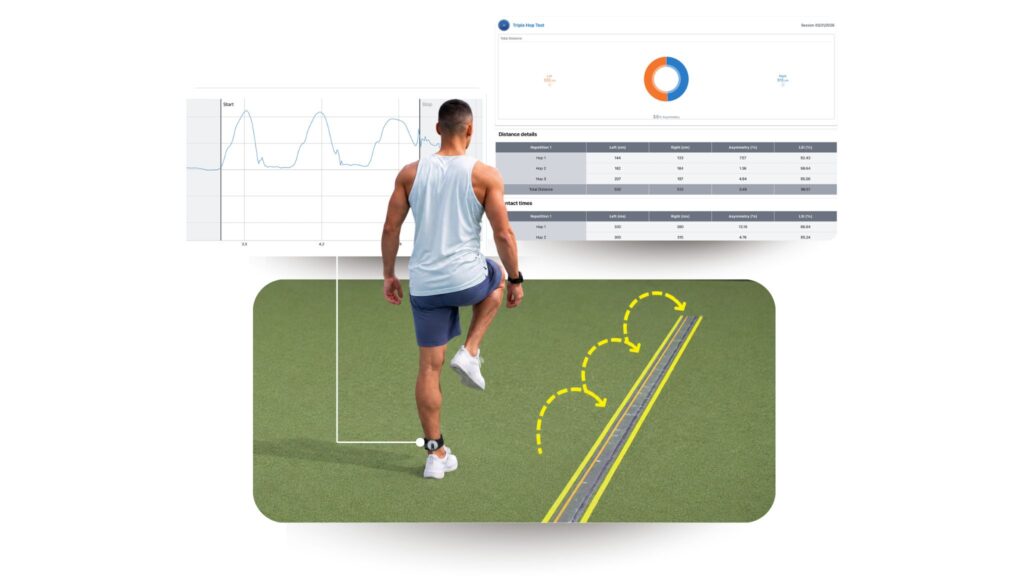
The protocol is easy to perform: the user completes three consecutive forward jumps on the same leg, without a pause between contacts.
Once the test is completed, the Kinvent App provides immediate access to key performance indicators that can be directly used for analysis.
The main advantage of K-Power is that it goes beyond visual observation.
Instead of simply assessing whether the movement “looks good,” practitioners can now precisely measure what happens during each jump.
What does the Triple Hop Test measure?
The Kinvent App provides several key metrics:
- Total distance (cm)
→ cumulative distance of the three jumps, reflecting overall propulsion capacity - Individual jump distance (cm)
→ distance achieved in each jump to analyze performance consistency - Ground contact time (ms)
→ duration of foot contact between jumps, a key indicator of reactivity
These metrics allow practitioners to understand not only the final result, but also how the performance is built across the sequence.
To go even further, the Triple Hop Test can also be combined with motion capture through K-Apture, allowing practitioners to record and review each jump and landing in detail. This synchronized video analysis helps assess movement strategies, landing mechanics, joint control, and potential compensations that may not be visible through numerical metrics alone.
A more detailed field-based analysis
With these indicators, practitioners can answer practical questions:
- Does the athlete maintain performance across all three jumps?
- Is there a drop in distance over time?
- Is ground reactivity preserved?
- Are movements fluid, or is efficiency decreasing?
This level of analysis is essential in both rehabilitation and performance settings.
It helps to:
- objectively track progression
- identify functional deficits
- support return-to-sport decisions
- adapt training programs
The triple hop test with K-Power becomes a key tool to monitor, compare, and better understand single-leg performance over time.
3- How to Interpret Triple Hop Test Metrics
Performing a triple hop test is not enough. Its true value lies in how the data is interpreted. The goal is to understand how performance is produced and maintained across the three jumps.
Total Distance
Total distance represents the sum of the three jumps.
It provides a global indicator of the lower limb’s ability to generate horizontal propulsion.
A higher value generally reflects better force production.
However, this metric should not be analyzed in isolation. Two athletes may achieve a similar total distance using very different movement strategies.
👉 How to analyze:
- compare the right vs. the left
- track progress over time
Individual Jump Distance
Individual jump distance allows a deeper analysis by looking at each jump separately.
It is essential to evaluate performance consistency across the sequence.
👉 Interpretation:
- stable distances → good ability to maintain force and coordination
- progressive decrease → fatigue, loss of control, or reduced efficiency
This metric is particularly useful to identify difficulties in chaining repeated efforts.
Ground Contact Time
Ground contact time corresponds to the duration the foot stays in contact with the ground between jumps.
It is a key indicator of neuromuscular reactivity.
👉 Interpretation:
- short contact time → good ability to absorb and reapply force quickly
- long contact time → deficit in reactivity, apprehension, or lack of stiffness
In rehabilitation, the injured limb often shows longer contact times.
Combined Analysis
The real value comes from combining these metrics.
👉 Examples of profiles:
- high distance + long contact time
→ powerful but not reactive - decreasing distance + increasing contact time
→ loss of efficiency across repetitions - stable distances + short contact time
→ efficient and well-coordinated profile
Asymmetry Analysis
Analysis should always include a comparison between the right and left limbs.
👉 Key insights:
- distance asymmetry → propulsion deficit
- contact time asymmetry → reactivity deficit
- evolution over time → recovery monitoring
The triple hop test becomes especially valuable when used to identify these differences and support decision-making, particularly in return-to-sport contexts.
4- FAQ: Triple Hop Test
What is the triple hop test?
The triple hop test is a single-leg functional test that consists of performing three consecutive horizontal jumps on the same leg. It is used to assess lower-limb power, coordination, and the ability to control repeated landings.
Why is the triple hop test used in rehabilitation?
The triple hop test helps evaluate the functional capacity of the lower limb in dynamic conditions. It is particularly useful to:
- assess return-to-sport readiness
- detect limb asymmetries
- evaluate propulsion and control
- monitor rehabilitation progress
What does the triple hop test measure?
With K-Power, the triple hop test measures:
- total distance
- individual jump distance
- ground contact time
These metrics provide a more detailed and objective analysis of performance.
How do you interpret triple hop test results?
Interpreting the triple hop test requires combining multiple metrics:
- distance → propulsion capacity
- contact time → reactivity
- consistency across jumps → ability to maintain performance
Comparing the right and left limbs is essential to identify asymmetries and support clinical decisions.


