


In elite sport and rehabilitation, the ability to quantify and interpret movement mechanics with precision has become essential. Technologies such as 3D force plates now allow practitioners to analyze how athletes generate, absorb, and transfer force during movement.
The Kinvent 3D Deltas Force Plates bridge the gap between laboratory-grade biomechanics and real-world athlete monitoring. Compact, wireless, and fully integrated into Kinvent’s digital ecosystem, these force plates enable practitioners to conduct high-quality force plate analysis anywhere, from the clinic to the training field.
By measuring three-dimensional ground reaction forces, practitioners gain deeper insight into movement strategies, asymmetries, and neuromuscular performance. This data can support more informed decision-making in athlete monitoring, injury prevention, and rehabilitation.
This article explores four practical applications of the Kinvent 3D Deltas Force Plates in modern sports science:
- Pre-season athlete assessments
- Return-to-play (RTP) protocols
- Change of direction (COD) analysis with video integration
- Broad jump analysis compared with traditional CMJ testing
CONTENT
1- Using 3D Force Plates for Pre-Season Athlete Assessments
2- Using 3D Force Plate Analysis in Return-to-Play Protocols
3- Analyzing Change of Direction with 3D Force Plate Data and Video Integration
4- Broad Jump Force Plate Analysis vs Traditional CMJ Testing
5- Conclusion
6- FAQ
7- References
1- Using 3D Force Plates for Pre-Season Athlete Assessments
Pre-season testing plays a key role in establishing neuromuscular baselines that guide both performance optimization and injury prevention. Traditional testing methods often rely on simple outcome measures, such as jump height or sprint time, without providing insight into how athletes actually generate or absorb force.
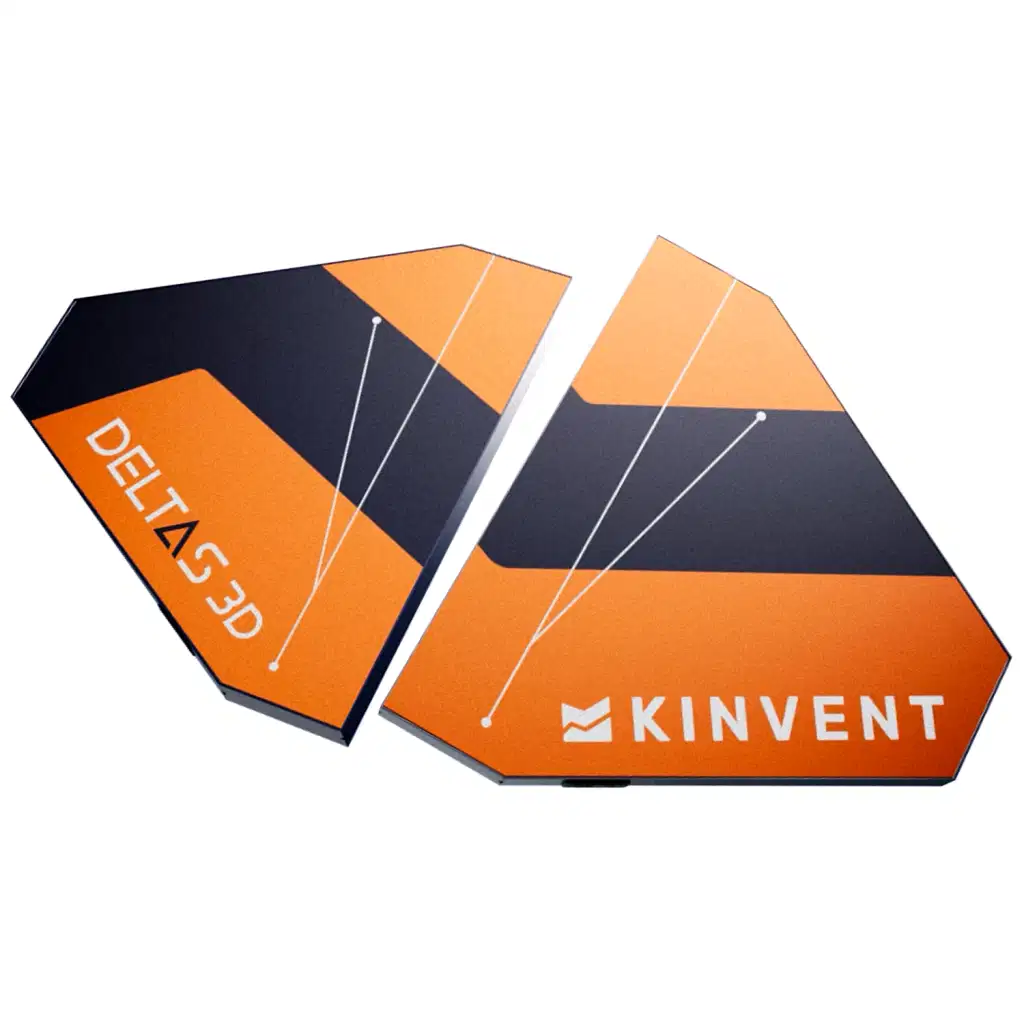
The Kinvent 3D Deltas Force Plates measure three-dimensional ground reaction forces (GRFs) across vertical, horizontal, and lateral planes at high sampling frequencies. This enables practitioners to quantify important performance variables such as:
- Force production
- Rate of force development (RFD)
- Landing asymmetries
Because the system is wireless and portable, testing can be performed directly in real training environments, including gyms, clinics, or on-field settings. The Kinvent app automatically processes and stores the collected data, allowing practitioners to track longitudinal athlete profiles and compare results year over year.
Pre-season 3D force plate analysis helps identify early asymmetries and neuromuscular imbalances before competitive load intensifies. This information becomes part of a broader athlete monitoring framework, combined with tools such as GPS tracking, functional movement screening, and strength testing.

💡To explore these concepts further and discover additional practical protocols, you can download Kinvent’s free ebook “A Practical Guide to 3D Force Plates”, which provides a deeper look at how 3D force plate analysis can support athlete assessment, rehabilitation, and performance monitoring.
Integrating multi-planar force data into this monitoring process supports more accurate injury risk prediction compared with traditional single-plane force plate analysis.
2- Using 3D Force Plate Analysis in Return-to-Play Protocols
Return-to-play (RTP) decisions are often influenced by subjective factors. Visual movement assessments or athlete-reported readiness may overlook subtle kinetic deficits that increase the risk of reinjury.
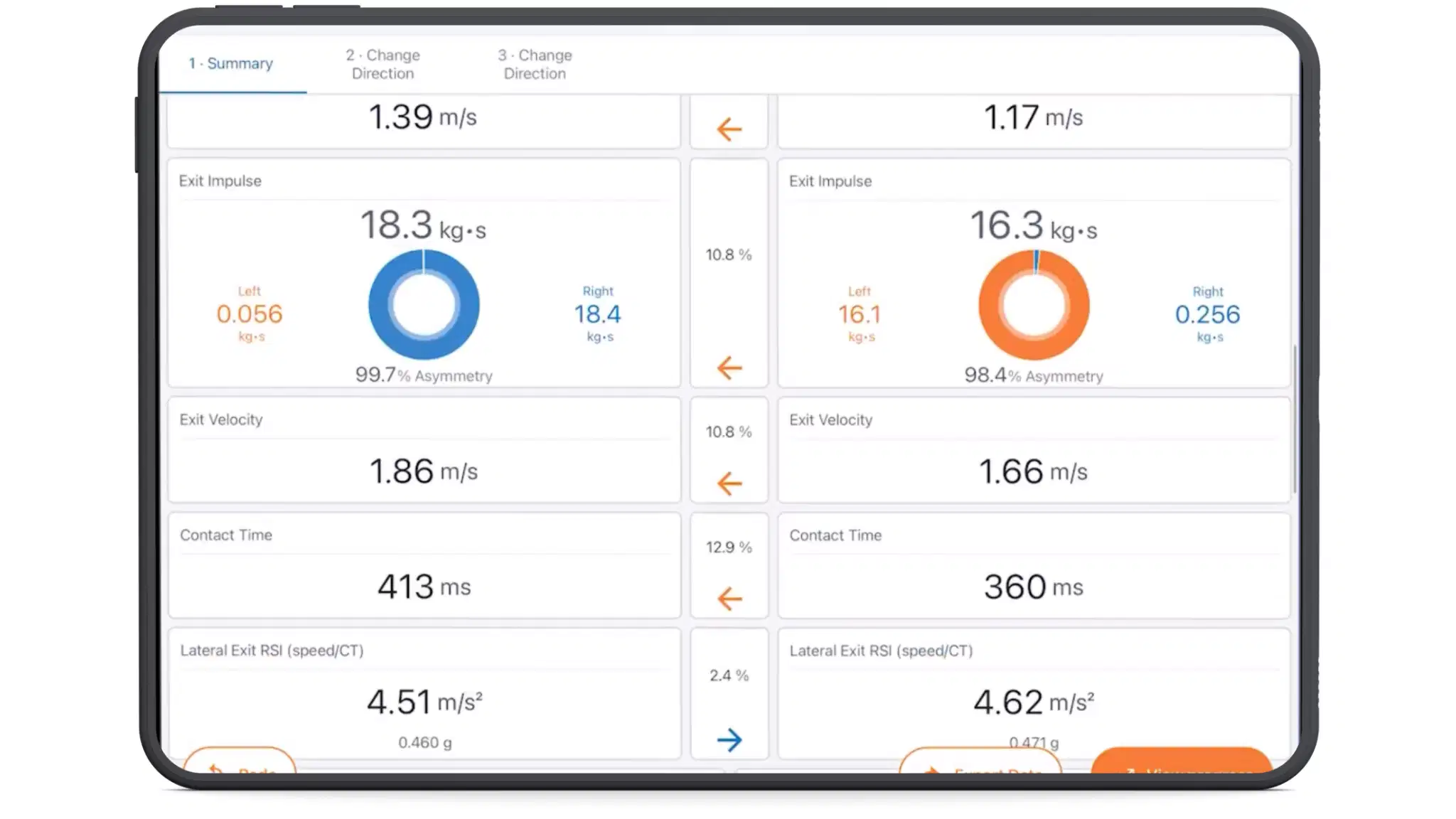
Using 3D force plate analysis, practitioners can introduce objective performance criteria into the rehabilitation process. The Kinvent 3D Deltas Force Plates allow clinicians and performance staff to quantify key indicators of functional recovery, including:
- Limb symmetry indices (LSI) across multiple movement patterns
- Eccentric braking control during landing and deceleration tasks
- Multi-directional force compensation following injury
These metrics provide deeper insight into how an athlete produces and absorbs force during dynamic movements.
When combined with Kinvent’s K-Push handheld dynamometers, practitioners can also correlate isometric strength measurements with dynamic force production. This integrated approach supports a more complete understanding of whether restored strength effectively translates into functional movement performance.
Another advantage of force plate testing is real-time data visualization. Immediate feedback helps create coachable moments for athletes, allowing practitioners to explain deficits and track progress objectively throughout the rehabilitation process.
This data-driven approach also allows practitioners to individualize return-to-play protocols based on both the athlete’s injury and positional demands. For example:
- An offensive lineman may require high levels of power production across multiple planes of movement.
- A defensive back may rely more heavily on rapid acceleration, deceleration, and change-of-direction capabilities.
Because athletes in these positions operate in multi-planar environments, the 3D Deltas Force Plates allow practitioners to assess force production in movement patterns that closely reflect real sport demands.
Ultimately, force plate testing transforms return-to-play from a time-based process into a data-driven progression, where readiness is defined by objective performance restoration rather than the calendar.
3- Analyzing Change of Direction with 3D Force Plate Data and Video Integration
Change of direction (COD) ability is a critical component of performance in many sports. It also plays an important role in injury resilience, particularly in sports that require rapid deceleration, cutting, and re-acceleration.
Traditional COD testing typically focuses on completion time, which provides limited insight into the movement strategies athletes use during these tasks.
By combining 3D force plate analysis with video integration, practitioners can gain a more complete understanding of how athletes produce and control force during change-of-direction movements.
Using the Kinvent 3D Deltas Force Plates, key kinetic variables can be measured, including:
- Braking impulse during deceleration
- Force vector orientation during direction change
- Time to stabilization after ground contact
At the same time, synchronized video analysis allows practitioners to evaluate visible movement mechanics such as:
- Foot placement
- Trunk position
- Hip alignment
Analyzing kinetic data from the force plates together with kinematic observations from video provides a multidimensional view of movement execution.
This combined approach helps identify:
- Inefficient force application strategies
- Asymmetrical loading patterns
- Mechanical stresses that may increase injury risk
By integrating 3D ground reaction force data with visual movement analysis, COD testing evolves from a simple stopwatch measurement into a more comprehensive biomechanical assessment of agility and movement control.
4- Broad Jump Force Plate Analysis vs Traditional CMJ Testing
The Countermovement Jump (CMJ) is widely used to evaluate lower-body power. However, CMJ testing primarily measures vertical force production, while many sport movements rely heavily on horizontal force generation.
Actions such as sprinting, accelerating, cutting, and tackling require athletes to effectively produce and transfer force in the horizontal plane.
Using the Kinvent 3D Deltas Force Plates, practitioners can perform a deeper analysis of the standing broad jump, capturing three-dimensional ground reaction forces during the movement. This allows practitioners to quantify key performance variables such as:
- Horizontal impulse
- Propulsive symmetry between limbs
- Landing force distribution
This expanded analysis provides insight into how efficiently an athlete converts strength into forward propulsion.
While CMJ height reflects vertical explosiveness, broad jump kinetics reveal how effectively athletes generate and transfer horizontal force, a key determinant of performance in many field and court sports.
Analyzing horizontal force production can also highlight important performance limitations. For example, an athlete may demonstrate high overall strength but still present low horizontal force production or insufficient braking capacity.
In these cases, force plate data can guide training adjustments. Reduced braking force during horizontal movements may indicate the need to emphasize eccentric, horizontally oriented strength exercises, which are more specific to sprinting and acceleration demands.
5- Conclusion
By incorporating 3D force plate analysis of the broad jump, practitioners gain a more complete understanding of how athletes apply force in sport-specific movement patterns.
The Kinvent 3D Deltas Force Plates represent an important step toward making advanced biomechanics accessible in real-world environments. By capturing three-dimensional ground reaction forces, practitioners can better understand how athletes generate, absorb, and control force during movement.
Whether used for pre-season assessments, return-to-play protocols, change-of-direction analysis, or horizontal power testing, 3D force plate analysis provides objective data that supports more informed decision-making.
With portable and connected systems such as the 3D Deltas, practitioners can move beyond observational assessments toward data-driven athlete monitoring, helping optimize performance while reducing injury risk.
6- FAQ: 3D Force Plate Analysis in Sports Performance and Rehabilitation
What do 3D force plates measure?
3D force plates measure ground reaction forces (GRFs) generated when an athlete interacts with the ground during movements such as jumping, landing, or changing direction. Unlike traditional systems that mainly capture vertical force, 3D force plates measure vertical, horizontal, and lateral forces, providing deeper insight into how athletes produce, absorb, and control force during movement.
How are 3D force plates used in pre-season athlete assessments?
During pre-season testing, 3D force plates help practitioners establish neuromuscular baselines for each athlete. By analyzing variables such as force production, rate of force development (RFD), and landing asymmetries, practitioners can detect potential imbalances early. This information can then be combined with other monitoring tools, such as GPS data, functional movement assessments, and strength testing, to guide performance optimization and injury prevention strategies.
Why are force plates useful for return-to-play decisions?
Return-to-play decisions can sometimes rely on subjective evaluations or athlete-reported readiness. Force plate testing introduces objective data into this process. Practitioners can measure limb symmetry indices, eccentric braking control, and multi-directional force production, helping determine whether an athlete has regained the physical capacity required for sport-specific demands.
How can force plates improve change-of-direction (COD) analysis?
Traditional change-of-direction tests often focus only on completion time. When combined with video analysis, 3D force plates provide deeper biomechanical insight by measuring variables such as braking impulse, force vector orientation, and time to stabilization. This combined analysis helps practitioners understand how athletes generate and control force during cutting and deceleration movements.
Why analyze the broad jump in addition to the CMJ?
The countermovement jump (CMJ) is commonly used to measure vertical power, but many sports require athletes to generate force horizontally. By analyzing the broad jump with 3D force plates, practitioners can measure horizontal impulse, propulsive symmetry, and landing forces. This helps reveal how effectively an athlete converts strength into forward propulsion, which is essential for sprinting, acceleration, and many sport-specific movements.
What are the advantages of portable force plate systems?
Portable systems such as the Kinvent 3D Deltas Force Plates allow practitioners to perform force plate testing outside laboratory environments. Because the plates are wireless and integrated with the Kinvent digital ecosystem, practitioners can conduct assessments in clinics, gyms, or training fields while automatically storing and tracking athlete data over time.
7- References
Turner, J. A., Chaaban, C. R., & Padua, D. A. (2025). Comparison of lower limb kinematic and kinetic estimation during athlete jumping between markerless and marker-based motion capture systems. Scientific Reports.