


Today, the physical therapy clinic is more than a treatment room; it is a learning space where patients master the movements necessary for their recovery.
In this context, the rehab gym has evolved. It’s no longer just an open floor with weights; it’s a sophisticated environment designed to turn movement into measurable clinical data. For practice owners, the challenge is building a space that meets Evidence-Based Practice (EBP) standards while remaining profitable.
Whether you’re launching a new practice or modernizing your facility, this guide covers everything you need to design a high-performance rehab gym that blends ergonomics with cutting-edge technology.
CONTENTS
1- What is a Rehab Gym in a Physical Therapy Practice?
2- The Benefits of a Well-Equipped Rehab Gym
3- Key Steps to Designing Your Rehab Gym
4- Essential Equipment for a Rehab Gym: Moving Toward 2.0
5- How to Choose the Right Equipment for Your Rehab Gym
6- Training, Implementation, and Maintenance: Future-Proofing Your Investment
7- Conclusion
1- What is a Rehab Gym in a Physical Therapy Practice?
The rehab gym (often referred to as the “clinic gym” or “open floor”) is a multidisciplinary space dedicated to active and functional rehabilitation.
A space dedicated to functional movement
Unlike private treatment rooms used for manual therapy, dry needling, or passive modalities, the rehab gym is built for action. This is where the PT applies the principles of progressive tissue loading and neuromuscular control. A well-designed rehab gym includes equipment and space for:
- Strength and Metabolic Conditioning
- Proprioception and Balance
- Mobility and Range of Motion (ROM)
- Return to Play (RTP) Training
The pillar of Evidence-Based Practice (EBP)
In an EBP framework, the rehab gym acts as the practitioner’s laboratory. It allows you to move beyond clinical intuition and test your hypotheses against physical reality. It is no longer just a place to “do sets and reps”; it is where you assess, measure, and adjust the plan of care based on real-time objective findings.
A professional showcase for your brand
Beyond the clinical benefits, the quality of your rehab gym defines your clinic’s brand. In a competitive market, a modern, high-tech gym sends a powerful message to both patients and referring physicians: your practice is at the forefront of medical technology, utilizing the latest data-driven science to ensure patient outcomes.
2- The Benefits of a Well-Equipped Rehab Gym
Investing in a high-performance rehab gym is more than just an equipment purchase; it is a strategic business decision that directly impacts your clinic’s growth, patient retention, and clinical outcomes.
Elevate Your Expertise for Patients and Referring Physicians
The era of “feeling a little better” is over. Today, patients, surgeons, and insurance carriers demand transparency and proof of progress.
- Objectifying Progress with Data: A gym equipped with objective measurement tools (such as digital dynamometers and force plates) transforms every exercise into a factual assessment. You can show a patient, using real-time graphs, their specific LSI (Limb Symmetry Index) or their explosive power gains.
- Biofeedback as an Engagement Driver: Visualizing effort on a screen changes the patient’s perception of rehab. When patients see their deficits and their improvements in real-time (gamification), their compliance and motivation skyrocket.
- Credibility with Referral Sources: Sending a professional, data-rich report to an orthopedic surgeon after an ACL reconstruction reinforces your status as a top-tier expert. It proves you are following a rigorous, data-driven return-to-play protocol.

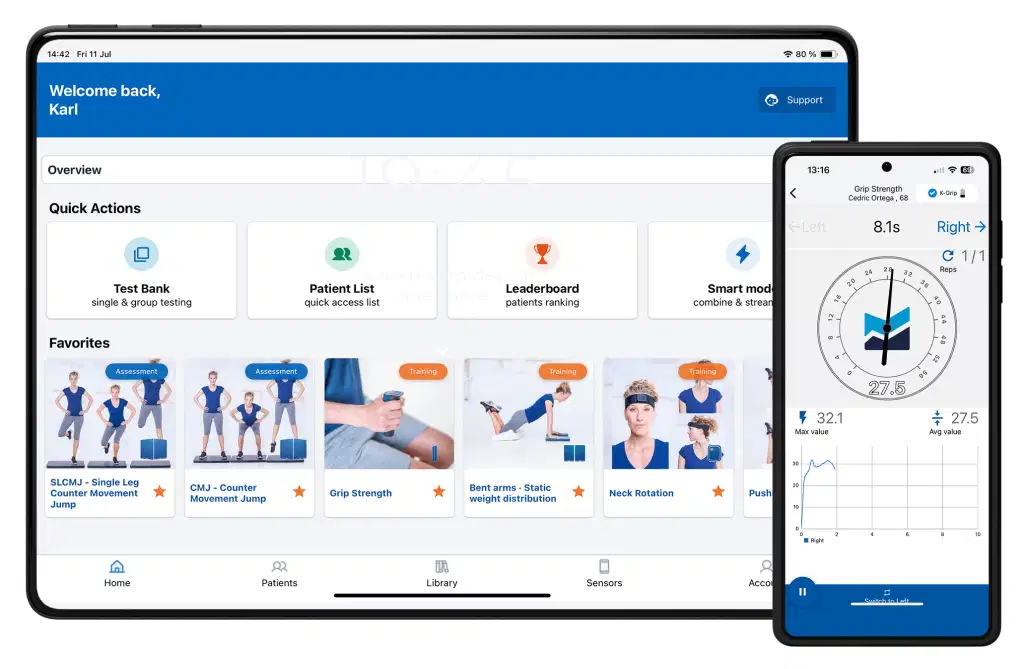
👉 This is exactly why Kinvent designed a suite of connected sensors specifically for physical therapists. By integrating tools like the K-Push or K-Deltas into your rehab gym, you move from subjective manual testing to scientific movement analysis. Through the Kinvent App, you can generate professional PDF reports in seconds, ready to be sent to physicians or insurance adjusters to justify the necessity of continued care.
ROI and Clinical Productivity
A well-designed rehab gym is a powerful financial lever for a private practice.
- Optimizing PT Productivity: An organized gym floor allows for effective “supervised autonomy” protocols. While one patient performs a strength circuit monitored by connected sensors, you can perform a manual intervention or an evaluation on another patient, increasing your units billed without compromising quality of care.
- Recruitment and Retention: Top-tier PTs want to work in clinics that invest in technology. A modern rehab gym is a magnet for high-quality clinicians looking for a dynamic work environment.
- Reducing “Drop-outs”: The variety of exercises possible in a high-performance gym prevents patient boredom. Patients stop coming just for “treatment” and start coming to “train for their health,” significantly reducing the cancellation and no-show rates.
3- Key Steps to Designing Your Rehab Gym
Designing a rehab gym is a logistical puzzle that must balance your building’s footprint, your clinical needs, and your business strategy. In a high-rent environment, every square foot must be functional.
Assess Your Space: The Precision of the Floor Plan
For a successful setup, you must master the physical limits of your space.
- Blueprint Analysis: Start with your floor plan, but always verify measurements on-site. A 4-inch discrepancy can prevent a squat rack or a cable machine from fitting properly.
- Identify Fixed Obstacles: Mark the location of load-bearing pillars, radiators, and the swing of doors and windows. A walkway obstructed by a door is both a safety hazard and a productivity bottleneck.
Electrical and Connectivity Anticipation
- Power Outlets: Map out your power needs for treadmills, hi-lo tables, and charging stations for your sensors and tablets.
- Wi-Fi Coverage: Ensure your clinic has robust Wi-Fi. Objective sensors require a stable connection to sync data in real-time to your EMR or the cloud.
Determine Priorities Based on Your Specialty
There is no “one-size-fits-all” gym. Your setup should reflect your niche:
- Sports Med & Performance: Prioritize squat racks, turf strips for sled pushes, and power analysis tools like K-Deltas.
- Geriatrics & Neuro: Focus on parallel bars, stable surfaces, and visual biofeedback tools for gait and balance training.
- Differentiation Strategy: In a saturated market, innovation is your best marketing tool. A gym floor featuring digital measurement solutions sets you apart from the other clinics and attracts patients seeking modern, data-driven care.
Organize for Efficiency and Aesthetics
A cluttered gym is stressful for patients and dangerous for clinicians.
- Smart Storage: Use wall-mounted racks for medicine balls and foam rollers. Use mobile carts for your measurement tools so they are always at arm’s reach during an evaluation.
- Categorical Layout: Group small accessories (bands, dumbbells, pads) so patients can easily navigate their HEP (Home Exercise Program) while in the clinic with minimal supervision.
4- Essential Equipment for a Rehab Gym: Moving Toward 2.0
An effective rehab gym is a subtle balance between conventional gear and cutting-edge measurement tools that provide clinical precision.
The Conventional Foundation: The Movement Essentials
Before you go high-tech, you need the staples. These tools are the workhorses of every physical therapist:
- Strength & Resistance: A range of kettlebells, hexagonal dumbbells, and high-quality resistance bands (loops and tubes).
- Multi-Functional Power: A half-rack or squat cage and a functional trainer (cable column). These allow for hundreds of different exercises in a small footprint, from heavy squats to nuanced rotator cuff work.
- Proprioception & Stability: Balance pads, BOSU balls, and medicine balls for plyometric and coordination drills.
The 2.0 Upgrade: Integrating the Data
This is where your clinic differentiates itself from a standard commercial gym. Modern rehab gym equipment transforms a simple exercise into a clinical assessment.
- Digital Dynamometers: Replace subjective manual muscle testing with precise isometric force measurement. Tools like the K-Push are the gold standard for assessing shoulder or hip rotator strength and identifying hidden deficits.
- Force Plates: Once reserved for elite sports labs, force plates like the K-Deltas are now essential for everyday clinical use. They provide instant data on jump tests, weight distribution, and stability. Calculating the LSI (Limb Symmetry Index) is a critical metric for clearing a patient for return to sport after an ACL injury.
- Real-Time Biofeedback: Every piece of equipment should ideally connect to an app that displays a force or balance curve. The patient isn’t just “pushing” anymore; they are hitting a visual target. This gamification optimizes neuromuscular recruitment and keeps the patient highly engaged.
Modular Setup
Instead of cluttering your floor with single-use machines (like a dedicated leg extension machine), prioritize adjustable benches and testing frames where sensors can be easily attached. The goal is modularity: the same 10×10 space should be able to host a maximal strength test in the morning and a fine proprioception drill in the afternoon.
5- How to Choose the Right Equipment for Your Rehab Gym
With thousands of vendors in the market, from specialized medical distributors to commercial fitness giants, choosing equipment can be overwhelming. To make the right investment, focus on three pillars: Versatility, Clinical Precision, and Durability.
Prioritize Versatility
In a private practice, every square foot carries a monthly rent cost. Avoid single-use machines that only target one muscle group. Instead, invest in multi-functional tools. An adjustable cable column or portable force sensors that can be used on a treatment table, a squat rack, or a wall are far more valuable than a bulky leg press.
Demand Clinical-Grade Precision
If you are investing in technology to objectify your care, ensure the sensors are designed for medical use. Sampling frequency and algorithm reliability are the difference between a “gadget” and a professional tool. Inaccurate data can lead to poor clinical decisions, which risks your credibility with both patients and referring surgeons. Always ask for the science behind the hardware.
The Financial Strategy: New vs. Pre-Owned
Setting up a full rehab gym is a significant capital expenditure. A smart way to optimize your budget is to mix new and pre-owned equipment:
- Buy New: For cutting-edge technology (connected sensors, software, and electronic treadmills) to ensure you have the latest updates, cloud support, and manufacturer warranties.
- Buy Pre-Owned: For heavy-duty gear like power racks, weight plates, benches, and dumbbells. These items are built to last decades and can often be found at 50% of the cost through refurbished gym equipment liquidators.
💡 Pro Tip: When buying technology, consider the ecosystem. Choosing a brand like Kinvent allows all your devices (dynamometers, force plates, and motion sensors) to connect to the same app, creating a unified patient report that simplifies your documentation.
6- Training, Implementation, and Maintenance: Future-Proofing Your Investment
Owning the best equipment is only half the battle; the success of your rehab gym depends on how well your staff masters the tools and integrates them into the patient’s journey.
Continuous Staff Education: The Key to Expertise
Switching to a high-performance rehab gym model requires an adjustment period. It is crucial that every clinician in your practice, from the Lead PT to the PTA, is proficient in:
- Standardized Testing Protocols: Knowing exactly when and how to perform an isometric strength test or a squat analysis to ensure reproducible, high-quality data.
- Data Interpretation: Moving beyond the numbers to analyze force ratios and proprioceptive curves, allowing for real-time adjustments to the plan of care.
- Patient Communication: Learning to explain complex graphs to the patient. This strengthens the therapeutic alliance.
Seamless Daily Workflow
For the gym to be an asset rather than a bottleneck, the workflow must be frictionless:
- Rapid Setup: Connected sensors must be immediately accessible. If a setup takes more than two minutes, a busy PT won’t use it. Creating “testing stations” or keeping sensors on mobile carts ensures they are used in every session.
- Hygiene and Safety: In a high-traffic movement space, sweat and frequent contact require a strict cleaning protocol.
- Safety Checks: Regularly inspect cables, bolts on racks, and the integrity of resistance bands to prevent injuries on the floor.
Maintaining Your Digital Tools
Technology requires specific care to remain accurate:
- Software Updates: Ensure your biofeedback apps and firmware are up to date to benefit from the latest features, security patches, and bug fixes.
- Calibration: For high-precision tools like K-Deltas, check the manufacturer’s recommendations for periodic calibration to ensure your baseline reports remain scientifically valid.
- Battery Management: Establish a charging routine for your wireless sensors to avoid being blocked during a busy morning evaluation.
7- Conclusion
Designing a rehab gym is a foundational act for any physical therapy practice. It is the physical manifestation of your clinical philosophy: a space where science, movement, and patient empowerment meet.
By combining ergonomic design, heavy-duty equipment, and connected measurement tools, you aren’t just building a gym; you are creating a high-precision clinical environment capable of transforming patient outcomes.
Ready to elevate your practice? Whether you are starting with a blank canvas or looking to modernize your current facility, Kinvent’s solutions integrate seamlessly into your space, turning your gym into a world-class center of performance and recovery.


