


Accurate sprint timing systems are essential for talent identification, performance monitoring, and return-to-play decision-making. While infrared timing gates have long been considered the gold standard for sprint assessment, they remain costly, time-consuming to set up, and sensitive to measurement errors caused by limb movements rather than true body displacement.
Although GPS systems are useful over longer distances, they often lack the sampling frequency needed to accurately capture the rapid acceleration phase of short sprints.
This study evaluates whether a hybrid wearable sensor combining IMU motion tracking and UWB positioning can provide a practical and accurate alternative to timing gates. We present the study design, key findings on measurement accuracy, and the practical implications for coaches, sport scientists, and clinicians.
CONTENTS
1- Sprint Timing Systems: From Timing Gates to Hybrid Wearable Sensors
2- Study Design: Comparing a Wearable Sprint Timing System to Timing Gates
3- Key Results: Accuracy and Sensitivity of the Hybrid Sprint Timing System
4- Practical Applications for Coaches, Sport Scientists and Clinicians
5- FAQ: Sprint Timing Systems and Performance Testing
6- Key takeaways
7- Reference
1- Sprint Timing Systems: From Timing Gates to Hybrid Wearable Sensors
Limitations of Traditional Timing Gates
Accurate speed measurement is a cornerstone of athletic development. Sprint timing systems are widely used to support performance profiling, monitor training adaptations, and inform return-to-play decisions following injury.
For decades, infrared timing gates have been considered the reference method for field sprint testing due to their reliability and widespread adoption in sports performance environments. Despite this status, several practical limitations remain.
Traditional timing gates present several challenges:
- Complex setup procedures, requiring careful alignment to ensure measurement accuracy
- Time-consuming installation, particularly when testing large groups of athletes
- High equipment costs, which may limit accessibility for some organizations
- Measurement inconsistencies, as timing can be triggered by a hand, knee, or foot rather than the athlete’s center of mass
Limitations of GPS for Short Sprint Measurement
While GPS systems offer advantages for monitoring running performance over longer distances, they also present important limitations when used for short sprint assessment.
Key limitations include:
- Lower sampling frequencies compared to local sensor systems
- Reduced accuracy during rapid acceleration phases
- Limited ability to detect small velocity changes during the first meters of a sprint
As a result, practitioners often face a compromise between practicality and precision when selecting a sprint timing system.
Hybrid Wearable Sensors: A New Approach to Sprint Timing Systems
To address these limitations, new wearable sprint timing systems have emerged, combining multiple sensing technologies to improve both accuracy and usability in field conditions.
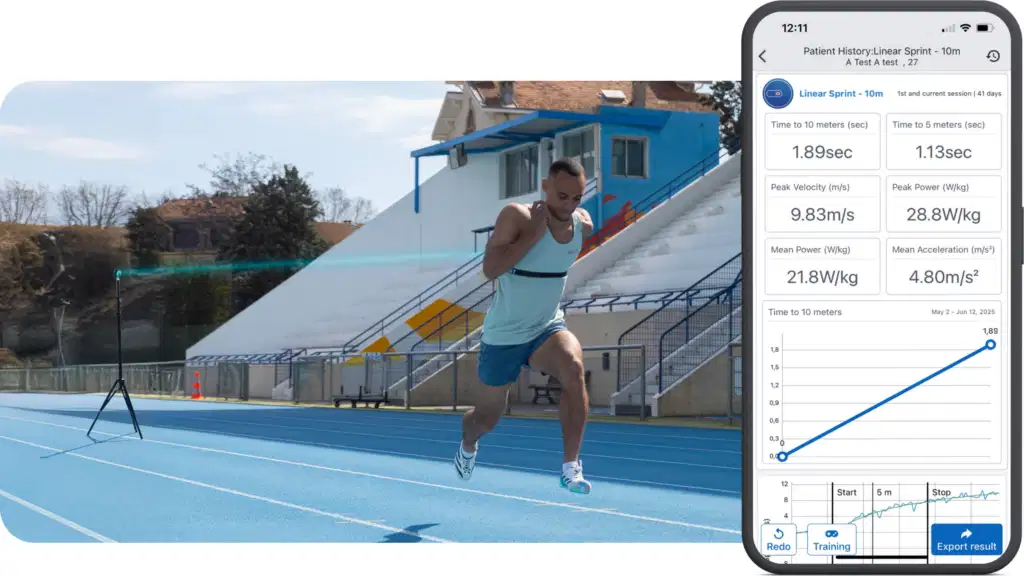
The system evaluated in this study, the K-Power sensor, represents this new generation of hybrid performance monitoring technology. Rather than relying on a single measurement principle, it combines two complementary technologies:
- Inertial Measurement Unit (IMU):
- Tracks body movement at a frequency of 200 Hz
- Captures rapid acceleration changes during sprint initiation
- Provides detailed motion data during high-intensity efforts
- Ultra-Wideband (UWB) positioning:
- Uses a fixed external anchor to determine absolute distance
- Reduces positional drift typically observed in wearable sensors
- Improves distance measurement reliability in field settings
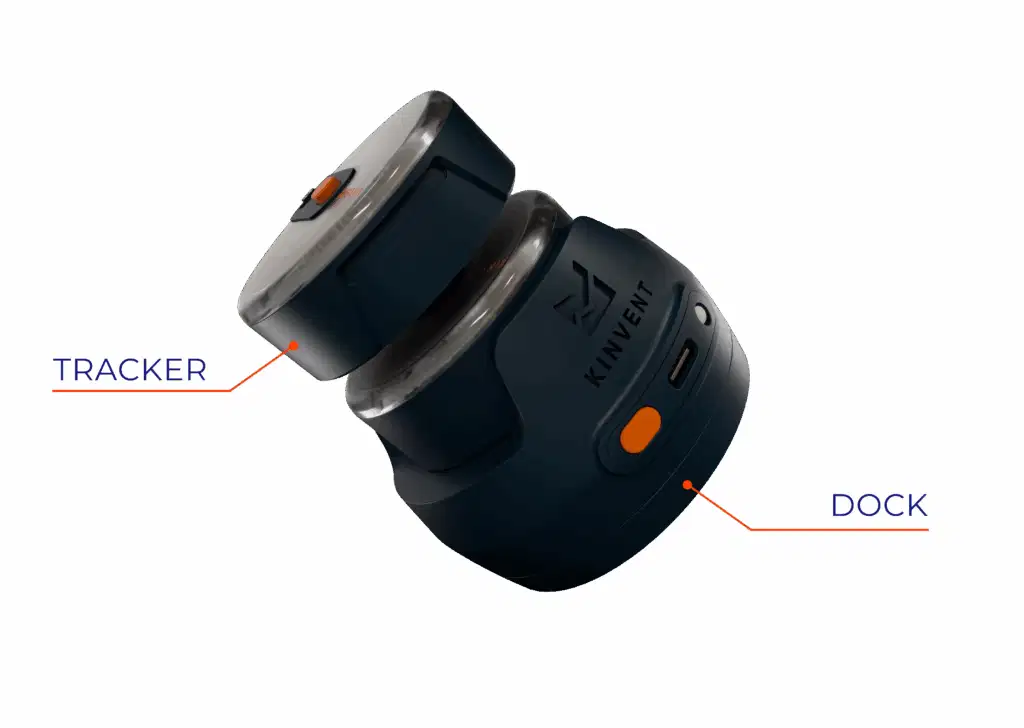
By combining these technologies, the hybrid system aims to overcome common wearable limitations such as signal drift and sampling errors during high-intensity acceleration.
Additionally, by positioning the sensor on the athlete’s lower back, the system tracks the athlete’s center of mass, potentially providing a more consistent representation of sprint performance compared to limb-triggered timing gates.
This technological approach forms the basis of the study, which aimed to determine whether this hybrid wearable sprint timing system could provide measurements comparable to traditional timing gates for group performance monitoring.
2- Study Design: Comparing a Wearable Sprint Timing System to Timing Gates
To evaluate the validity of this hybrid sprint timing system, researchers recruited 15 trained adolescent sprinters (average age 15.2 years) to perform maximal 20-meter sprints. Each performance was recorded simultaneously using two different systems.
Participants and Testing Protocol
The testing protocol included:
- 15 trained youth sprinters
- Average age: 15.2 years
- Maximal 20-meter sprint tests
- Simultaneous recording from both systems
This approach allowed direct comparison between the wearable sensor and the reference timing system.
Reference System: Timing Gates
The criterion system consisted of professional infrared timing gates:
- Start gate positioned at sprint initiation
- The second gate is positioned at 20 meters
- Standard reference method for sprint timing
Tested Technology: Hybrid Wearable Sprint Timing System
The challenger system was the K-Power sensor, a small wearable device fixed on the athlete’s lower back (lumbar area). By combining IMU and UWB data, the system aims to reduce drift and sampling errors that typically affect wearable sensors during high-intensity sprint acceleration.
3- Key Results: Accuracy and Sensitivity of the Hybrid Sprint Timing System
The statistical analysis showed strong agreement between the hybrid wearable sprint timing system and the reference timing gates, supporting its use for sprint performance monitoring. The main findings of the study included:
Agreement with Timing Gates
The hybrid sensor demonstrated excellent agreement with the reference system:
- Intraclass Correlation Coefficient (ICC): 0.96
- Indicates near-perfect consistency between the wearable and timing gates
- Confirms the device can reliably rank athlete performance within a group
Measurement Precision
The device showed a very small measurement error:
- Coefficient of Variation (CV): 1.07%
- Well below the commonly accepted 5% industry benchmark
- Indicates high precision for field-based sprint testing
Sensitivity to Performance Changes
The system also demonstrated the ability to detect meaningful performance improvements:
- Typical Error: 0.034 s
- Smallest Worthwhile Change: 0.040 s
Because the typical error is smaller than the smallest worthwhile change, the device is considered sensitive enough to detect real performance improvements rather than measurement noise.
Understanding Variability in Youth Athletes
The study reported a Minimal Detectable Change (MDC) of 0.09 s in this population. Importantly, this value is not explained by measurement limitations but rather by normal biological variability in adolescent athletes. Young sprinters often show greater stride-to-stride variability as their neuromuscular systems continue to mature.
As a practical takeaway:
- Improvements smaller than 0.09 s may reflect normal biological variation
- Improvements greater than 0.09 s are more likely to reflect meaningful performance gains
4- Practical Applications for Coaches, Clinicians, and Sport Scientists
Beyond the validation results, the study also highlights several practical implications for athletes and practitioners using sprint timing systems in daily performance environments.
What This Means for Athletes
For athletes, the use of a wearable sprint timing system may improve both measurement consistency and access to performance feedback. Key benefits include:
- Improved measurement consistency, as the sensor tracks the center of mass rather than a limb crossing a timing beam
- Reduced risk of false starts, caused by early movement of the hands or knees
- More representative acceleration data, reflecting true body displacement
- Immediate performance feedback, with data directly available in a mobile application
- Faster access to velocity profiles, without requiring manual transcription of timing gate results
What This Means for Coaches and Practitioners
For coaches, sport scientists, and clinicians, the main advantages relate to workflow efficiency and better interpretation of performance changes. Practical benefits include:
- Faster testing workflows, particularly when assessing large groups of athletes
- Reduced setup constraints compared to the alignment requirements of timing gates
- Simplified field testing logistics
- Improved monitoring of meaningful performance changes
The study also provides an important interpretation guideline when testing youth athletes: Performance improvements of less than 0.02 s should be interpreted cautiously. Small changes may reflect normal biological variability. Improvements greater than 0.09 s provide greater confidence that training interventions are producing real performance gains.
5- FAQ: Sprint Timing Systems and Performance Testing
Are timing gates still the gold standard for sprint timing?
Timing gates remain a widely accepted reference for sprint performance testing due to their reliability and extensive use in sports science. However, newer wearable sprint timing systems are emerging as valid alternatives, particularly when they demonstrate strong agreement with timing gate measurements, as shown in this study.
How accurate are wearable sprint timing systems?
Accuracy depends on the technology used. Hybrid systems combining IMU and UWB technologies may achieve high levels of precision by combining high-frequency motion tracking with accurate distance measurement. In this study, the wearable system showed a measurement error of only 1.07%, which is well within accepted standards for performance testing.
How do you measure sprint performance accurately?
Accurate sprint performance measurement typically requires reliable timing technology, consistent testing conditions, standardized sprint distances, and repeated testing protocols. Common tools include timing gates, radar systems, GPS (for longer distances), and hybrid wearable sensors (such as the K-Power).
Can wearable sensors be used for return-to-play testing?
Wearable sprint timing systems may be useful in return-to-play processes when they provide reliable and objective performance data. Their ability to quickly collect data and monitor progress over time may support decision-making when combined with other clinical and performance indicators.
6- Key Takeaways for Sprint Performance Monitoring
This study suggests that hybrid wearable sprint timing systems may provide a practical and reliable alternative to traditional timing gates for field-based performance monitoring. Key takeaways include:
- Strong agreement with timing gates supports the validity of the hybrid wearable system
- High measurement precision, with error well below accepted industry standards
- Ability to detect meaningful performance changes in sprint performance
- Improved testing efficiency compared to traditional timing gate setups
- Better scalability when testing large groups of athletes
- Useful decision-support tool for performance monitoring and return-to-play assessment
7- Reference
Panoutsakopoulos, V., Athanasopoulos, E., Li, T., Kitsikoudis, P., & Chalitsios, C. (2026). Field-Based Monitoring of Linear Sprint Performance: Agreement Between the K-Power Sensor and Timing Gates in Trained Youth Sprinters. Applied Sciences, 16(3), 1268. https://doi.org/10.3390/app16031268


